



Have you noticed how native speakers sound natural and relaxed, even when they use the simplest words? Their secret is not a huge vocabulary—it is the grammar beneath the surface. Certain structures rarely appear in beginner textbooks, yet they determine whether you sound like a hesitant learner or a confident English user. In this guide we break down five powerful constructions, explain how they work in real conversations, and give you practice activities to lock them into your active memory.
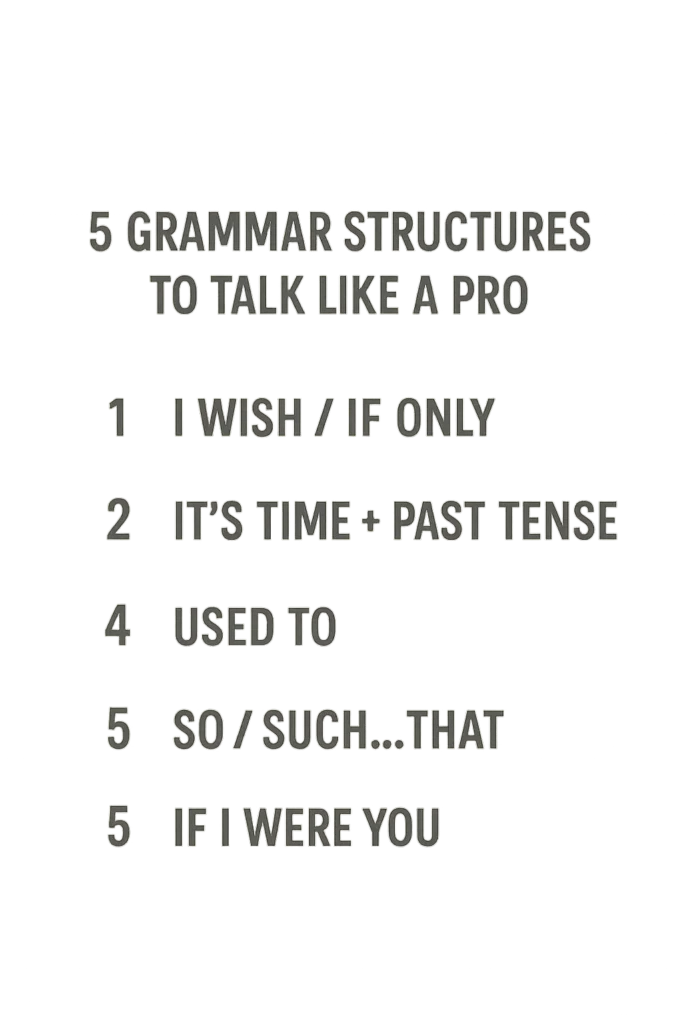
1. I wish … / If only … — turning regret and imagination into fluent English
When you want to express regret about the past or dissatisfaction with the present, “I wish” and “If only” create an instant emotional punch. Native speakers use them in movies, songs and everyday chat.
I wish I spoke English better.
I wish I hadn’t said that.
If only it were warmer today!
Why bother? Because facts alone rarely move a conversation forward; feelings do. Mastering this structure lets you add depth—sadness, hope, or longing—without long explanations.
2. It’s time + past tense — a gentle nudge (or polite complaint)
For Ukrainian‑speaking learners this looks odd: we talk about the present but use a past form. In English, “It’s time” plus a past tense means “We really should do this now,” often with a hint of impatience.
It’s time we left.
It’s time you started your homework.
It’s time I got serious about learning English.
Using this construction signals advanced awareness of English nuance. It also softens direct criticism—you’re pushing action forward without sounding aggressive.
3. Used to / be used to / get used to — habits, states and adaptation
These three look similar but deliver totally different messages.
- used to + verb: a past habit that no longer existsI used to play football every day.
- be used to + –ing/noun: you are already comfortable with somethingI’m used to getting up early.
- get used to + –ing/noun: the process of becoming comfortableI’m getting used to working remotely.
Native speakers switch among them without thinking—and once you can, your stories about habits, change and experience become crystal clear.
4. So/Such … that — intensity and consequence in one elegant package
Whether you’re describing an unbelievably good film or a disaster of a day, this structure lets you link cause and effect smoothly.
The movie was so good that I watched it twice.
It was such a beautiful day that we stayed outside all afternoon.
She’s so talented that everyone admires her.
The pattern feels natural in English and instantly replaces wordy phrases like “very, very, very.”
5. If I were you, I’d … — advice without pressure
Giving advice can feel rude if you use commands. “If I were you” plus “I’d” turns advice into a friendly suggestion.
If I were you, I’d take the job.
If I were you, I wouldn’t trust him.
I’d talk to her if I were you.
Grammatically, “If I were” (not “was”) shows a hypothetical, polite mood. Using it tells listeners you know how to soften your opinion the way native speakers do.
How to Train These Constructions
Turn them into daily micro‑practice:
- Create three personal sentences for each structure and say them aloud.
- Write a short paragraph or dialogue that combines at least two constructions.
- Re‑watch a favourite scene in a series and try to spot these forms.
- Record yourself for one minute a day; notice which patterns feel natural and which need drilling.
Choose one construction per week, practise intentionally, and after a month you will hear your English level shift.
Practice Exercises
Exercise 1 – Inversion for Emphasis
Rewrite the sentences using inversion to create a more formal or dramatic tone.
- I had never heard such a strange story before.
- He not only passed the exam, but he also got the best mark.
- As soon as she sat down, the phone rang.
- If I had known about the meeting, I would have come earlier.
- The sun had hardly risen when they started the hike.
Keys
- Never had I heard such a strange story before.
- Not only did he pass the exam, but he also got the best mark.
- No sooner had she sat down than the phone rang.
- Had I known about the meeting, I would have come earlier.
- Hardly had the sun risen when they started the hike.
Exercise 2 – Third & Mixed Conditionals
Finish each sentence. Use a third or mixed conditional.
- If I had studied more, …
- If she were more confident, …
- If they had left earlier, …
- If I hadn’t eaten that much, …
- If he had worked harder, he …
Sample Answers
- If I had studied more, I would have passed the exam.
- If she were more confident, she would speak in public more often.
- If they had left earlier, they wouldn’t be stuck in traffic now.
- If I hadn’t eaten that much, I wouldn’t feel so sick now.
- If he had worked harder, he would have finished the project on time.
Exercise 3 – Cleft Sentences
Complete each cleft sentence.
- ______ I like most about this city is the atmosphere.
- ______ helped me was her advice.
- ______ makes the difference is attention to detail.
- ______ surprised me was his reaction.
- ______ we need is a proper plan.
Keys
- What I like most about this city is the atmosphere.
- What helped me was her advice.
- What makes the difference is attention to detail.
- What surprised me was his reaction.
- What we need is a proper plan.
Exercise 4 – Relative Clauses
Combine each pair into one sentence using an advanced relative clause.
- This is the book. I told you about it.
- The woman is a professor. Her lecture was amazing.
- He spoke to the man. The man works at the embassy.
- They hired a candidate. His experience was impressive.
- The house was lovely. We stayed there last summer.
Keys
- This is the book that I told you about.
- The woman whose lecture was amazing is a professor.
- He spoke to the man who works at the embassy.
- They hired a candidate whose experience was impressive.
- The house where we stayed last summer was lovely.
Exercise 5 – Subjunctive Mood
Complete each sentence using the correct subjunctive form.
- I wish I ___ more confident when speaking.
- If only he ___ more careful with his words.
- It’s essential that she ___ on time.
- I wish I ___ taken that opportunity.
- If only we ___ known the truth earlier.
Keys
- I wish I were more confident when speaking.
- If only he were more careful with his words.
- It’s essential that she be on time.
- I wish I had taken that opportunity.
- If only we had known the truth earlier.
Final Thought
These five structures aren’t abstract grammar—they are the difference between English that sounds “learnt” and English that feels alive. Give yourself a month: focus on one pattern each week, weave it into your daily routine, and watch your fluency—and confidence—take a serious leap forward.

