



Your phone rings. You look at the screen and say, “I’ll answer it.” Later that evening, you tell a friend, “I’m going to call my sister tonight.” Both sentences talk about the future, so why do they feel different?
That small difference is exactly what confuses English learners at every level. The question of Future Simple vs going to isn’t really about grammar rules you memorize; it’s about why you’re talking about the future in that particular moment. whether you’re deciding something right now, describing a plan you already made, or predicting something based on what you feel or what you can see. Once you understand that idea, choosing between “will” and “going to” stops being guesswork.
Table of Contents
- What Is Future Simple?
- What Is Going to?
- Future Simple vs Going to: The Main Difference
- Will vs Going to for Predictions
- Will vs Going to for Decisions and Plans
- Signal Words and Time Expressions
- Future Simple vs Going to: Common Mistakes
- Can You Use Both Will and Going to?
- Going to vs Present Continuous for Future Plans
- How to Choose Between Will and Going to
- Practice: Will or Going to?
- Quick Summary
- FAQ
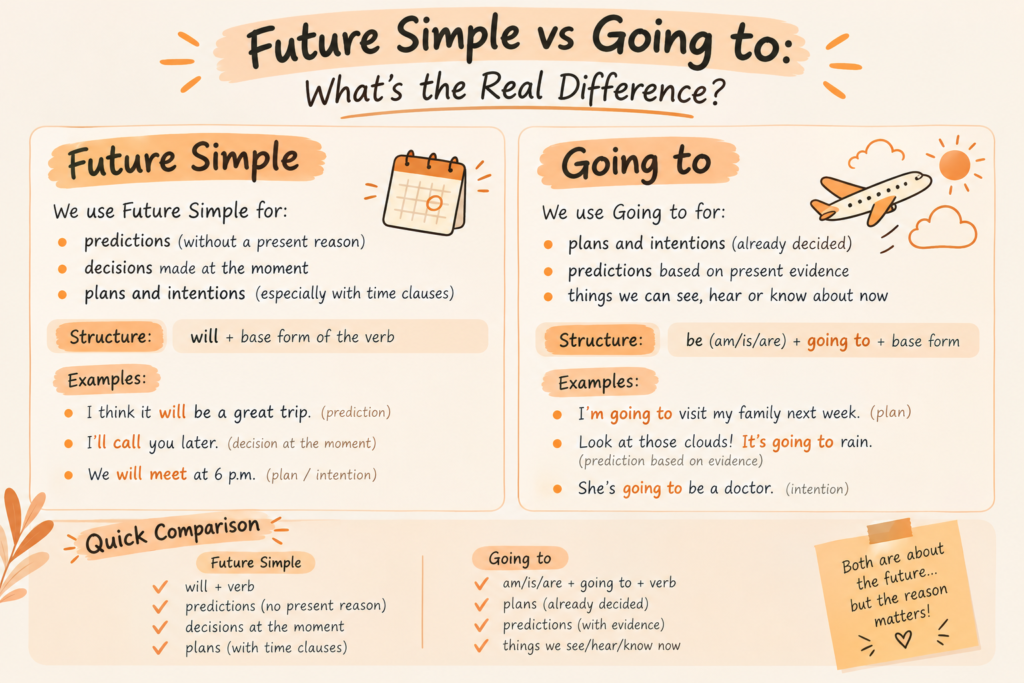
What Is Future Simple?
Future Simple is formed with:
will + base verb
- I will call you tomorrow.
- She will help us with the move.
- They won’t come tonight, they’re too tired.
- Will you help me carry these boxes?
Future Simple isn’t just “the future tense” it covers several very different speaking situations, and understanding each one is the real key to using it correctly.
1. Spontaneous decisions
The phone is ringing. “I’ll answer it.” The decision happens at the exact moment of speaking, you didn’t plan it five minutes earlier.
2. Offers
“You look exhausted, I’ll carry your bag.”
3. Promises
“I’ll call you the moment I land.”
4. Requests
“Will you help me with this report?”
5. Predictions and opinions about the future
“I think it will rain tomorrow.” “Our team will probably win.”
This last use is important, and learners often oversimplify it. A prediction with will is usually based on your opinion, belief, expectation, or general knowledge of the world not on something you can see right now. That distinction becomes crucial when we compare it with going to below.
What Is Going to?
Going to is formed with:
am / is / are + going to + base verb
- I am going to study tonight.
- She is going to buy a new laptop next week.
- They are going to move to Krakow next year.
There are two main uses.
1. Plans and intentions decided before now
“I’m going to learn Spanish this year.” The intention already existed in your mind before you said the sentence, it isn’t a decision you’re making on the spot.
2. Predictions based on present evidence
“Look at those clouds, it’s going to rain.” Here, something you can observe right now (dark clouds) leads you to a conclusion about what will happen next.
Future Simple vs Going to: The Main Difference
Here’s a quick comparison to keep in mind:
| Situation | Future Simple (will) | Going to |
| Decision made right now | ✓ | Usually no |
| Previous plan or intention | Usually no | ✓ |
| Offer | ✓ | Usually no |
| Promise | ✓ | Usually no |
| Prediction based on opinion | ✓ | Sometimes |
| Prediction based on present evidence | Sometimes | ✓ |
The clearest way to see the difference is through a pair of sentences:
The phone is ringing. I’ll answer it. a decision made at that exact second.
I’m going to call John tonight. a decision you already made earlier in the day.
Both sentences are grammatically correct future statements, but they tell the listener something different about when the decision happened. That’s the heart of the will vs going to distinction, and it’s more useful than memorizing “will = future” and “going to = future,” which tells you nothing about meaning.
Will vs Going to for Predictions
This is one of the trickiest and most searched parts of the topic, so it’s worth slowing down here.
Will for predictions is typically used when you’re speaking from opinion, belief, expectation, or general judgment, without something concrete in front of you right now.
- “I think our team will win the match.”
- “House prices will probably rise next year.”
- “I’m sure she’ll enjoy the trip.”
Going to for predictions is used when there’s visible, present evidence pointing to a near-certain outcome.
- “Look at that car, it’s going to crash!”
- “She’s eight months pregnant; she’s going to have the baby any day now.”
- “He’s running so fast he’s going to win this race.”
In each going to example, something observable right now (the car’s speed, the stage of pregnancy, the runner’s pace) supports the prediction. With will, the prediction comes more from inside the speaker’s head than from the scene in front of them.
That said, real spoken English isn’t a strict binary system. Native speakers sometimes choose either form depending on what they want to emphasize, and both can occasionally describe the same future event. Avoid teaching yourself that one form is always right and the other is always wrong context matters more than a fixed rule.
Will vs Going to for Decisions and Plans
Decision made at the moment of speaking → will
- “I’ve forgotten my keys.” “Don’t worry, I’ll go back and get them.”
- “We’re out of milk.” “Okay, I’ll pick some up on my way home.”
- “This box is too heavy for me.” “I’ll help you lift it.”
Existing plan or intention → going to
- “I’ve already decided I’m going to take an evening course this autumn.”
- “We’re going to spend Christmas with my parents this year.”
- “I’m going to hand in my resignation next month; I’ve been thinking about it for weeks.”
- “She’s going to start a new diet. She signed up for a nutritionist last week.”
Notice that the going to examples all reference a decision that already existed before the sentence was spoken, while the will examples describe the decision happening in real time, right there in the conversation.
If you’d like a refresher on how routines and habits are expressed in the present before moving into future forms, see Present Simple article for a closer look.
Signal Words and Time Expressions
Signal words are helpful clues, not strict rules.
Often appear with will:
- I think / I believe
- probably
- maybe
- I’m sure
- I expect
Often appear with going to:
- Look! / Watch out!
- soon
- tonight
- next week
- this weekend
Be careful, though: time expressions like tomorrow or next week can appear naturally with either form. “I’ll see you tomorrow” and “I’m going to see the dentist tomorrow” are both completely normal. Never teach yourself that “tomorrow always means will” or “next week always means going to” the time expression tells you when, not how the decision was made.
Future Simple vs Going to: Common Mistakes
1. “I’m going to call you when I arrive.” (as a spontaneous promise made right now) “I’ll call you when I arrive.”Explanation: A promise made on the spot uses will, not going to.
2. “I will take that course I signed up for last month.” (describing an existing plan) “I’m going to take that course I signed up for last month.” Explanation: Since the decision was made earlier, going to is more accurate.
3. “I going to study tonight.” “I’m going to study tonight.” Explanation: The verb “be” (am/is/are) can never be dropped before going to.
4. “She’s go to visit her parents this weekend.” “She’s going to visit her parents this weekend.” Explanation: Don’t forget the “-ing” ending on “go”, it’s “going to,” never “go to,” in this structure.
5. “I not will come tomorrow.” “I won’t come tomorrow.” Explanation: The negative of will is “will not / won’t,” placed directly after the subject.
6. “Will you going to the party?” (mixing two future forms) “Are you going to the party?” or “Will you come to the party?” Explanation: Don’t combine will and going to in the same question, choose one structure.
7. “Look at those clouds! I think it will rain.” (present evidence, but will is used) “Look at those clouds! It’s going to rain.”Explanation: When there’s visible evidence right now, going to is the natural choice, not a belief-based will.
Can You Use Both Will and Going to?
Sometimes, yes, both forms are grammatically possible, but the speaker’s perspective changes the meaning slightly.
Compare:
“I think it will rain.” a general opinion, perhaps based on the season or a weather app you checked earlier.
“Look at those clouds, it’s going to rain.” a prediction based on what you can see right now.
Both sentences might end up being true about the very same rain shower, but they express two different reasons for making the prediction. In other cases, a plan can also be expressed with will if the speaker wants to sound more like a firm decision or promise than a pre-existing intention: “Don’t worry about the flights I will book them this evening” can work almost like “I’m going to book them,” especially when the speaker wants to reassure someone. English grammar isn’t a rigid set of switches; it’s a set of tendencies that native speakers apply flexibly depending on what they want to communicate.
Going to vs Present Continuous for Future Plans
Going to expresses an intention or plan in general.
Present Continuous expresses a specific, already-arranged plan, usually connected to a time, a place, or another person.
- “I’m going to visit London this summer.” (a general intention flights and dates aren’t fixed yet)
- “I’m meeting my friend in London on Saturday at 3pm.” (a concrete arrangement the meeting is already set)
If you’d like to explore how Present Continuous also describes actions happening right now, take a look at Present Continuous vs Present Simple article for a full comparison.
How to Choose Between Will and Going to
When you’re not sure which form to use, ask yourself these three questions in order:
Question 1: Did I decide this at the moment of speaking? → Use will.
Question 2: Was this already my intention or plan before now? → Use going to.
Question 3: Am I making a prediction? → If it’s mainly an opinion or belief → will → If there’s visible evidence right now → going to
Quick visual reminder:
WILL = decision now · offer · promise · opinion-based prediction GOING TO = existing plan · intention · evidence-based prediction
Practice: Will or Going to?
Try to choose the correct form based on context, not just memory.
- “I’ve decided — I ______ (start) going to the gym every morning.” (already decided)
- The doorbell just rang. “I ______ (get) it!”
- Look at the sky! It ______ (rain) any minute now.
- “I’m exhausted.” “Sit down, I ______ (make) you some tea.”
- We ______ (visit) my grandparents next month — the tickets are already booked.
- I think prices ______ (increase) again next year.
- Correct the mistake: “She go to call you tomorrow.” → ______
- Correct the mistake: “I not will forget your birthday.” → ______
- “Why are you carrying a suitcase?” “I ______ (fly) to Berlin this evening — I planned it last week.”
- “I can’t decide what to order.” “Okay, I ______ (wait) a bit longer, then.”
- He’s driving so recklessly — he ______ (have) an accident.
- “Will you help me move this weekend?” “Sure, I ______ (help) you.”
- Choose the correct option: I ______ (will / am going to) become a doctor — I’ve wanted this since childhood.
- Choose the correct option: “The line is busy.” “Okay, I ______ (will / am going to) try again later.”
- Fill in with your own idea: What are you ______ (do) this weekend? (Answer using going to for an existing plan.)
Answer Key
- am going to start — an already-made decision, not spontaneous.
- will get — a spontaneous reaction to the doorbell.
- is going to rain — present evidence (dark sky).
- will make — a spontaneous offer.
- are going to visit — an existing, already-arranged plan.
- will increase — an opinion/prediction about the future.
- “She’s going to call you tomorrow.” — going to needs the verb “be.”
- “I won’t forget your birthday.” — correct negative form of will.
- am going to fly — a plan made earlier, supported by present evidence (the suitcase).
- will wait — a decision made on the spot.
- is going to have — present evidence (reckless driving) supports the prediction.
- will help — a promise/offer in response to a request.
- am going to — a long-held intention, not a spontaneous choice.
- will — a spontaneous decision made right now.
- Any going to answer describing something already planned, e.g., “I’m going to visit my parents.”
Quick Summary
| Future form | Main uses | Example |
| will | spontaneous decisions, offers, promises, opinion-based predictions | I’ll help you. |
| going to | prior plans, intentions, evidence-based predictions | I’m going to study tonight. |
Memorable rule: If the idea was already in your head before you opened your mouth, use going to. If it just popped into your head as you were speaking, use will.
FAQ
What is the difference between will and going to? Will usually expresses decisions made at the moment of speaking, offers, promises, and predictions based on opinion. Going to usually expresses plans made earlier and predictions based on visible evidence.
When should I use will? Use will for spontaneous decisions, offers, promises, requests, and predictions based on belief or general expectation rather than something you can see right now.
When should I use going to? Use going to for plans or intentions you already had before speaking, and for predictions supported by present evidence.
Is going to a future tense? Going to is a future form built with the present tense of “be” plus “going to” plus the base verb. It functions as one of the main ways to talk about the future in English, alongside Future Simple and Present Continuous.
Can I use will for plans? You can, especially when the plan sounds more like a firm decision or promise (“I will book the tickets tonight”), but going to is generally more natural for describing pre-existing plans.
Is going to always used for plans? No, going to is also used for predictions based on present evidence, such as “Look at those clouds, it’s going to rain.”
What is the difference between will and going to for predictions? Will-based predictions usually come from opinion or belief; going to-based predictions usually come from something observable right now.
Can will and going to mean the same thing? Sometimes, yes. In flexible contexts, both forms can refer to the same future event, though they emphasize a slightly different reason behind the statement, a spontaneous choice versus an existing plan, or an opinion versus visible evidence.
Which is more common: will or going to? Both are extremely common in everyday English, and native speakers switch between them naturally depending on context rather than favoring one over the other overall. According to the Cambridge Dictionary’s grammar guide on the future, both forms are core ways of expressing future time in English, each suited to different speaking situations.
If you’d like to keep building your understanding of English tenses step by step, you might also enjoy Past Simple article, Conditionals article, and Microlearning / learning English effectively article for tips on making steady progress with grammar over time.

