



“If I would have known…” If that sentence sounds fine to you, you have a conditionals problem, and you’re far from alone. Conditional sentences trip up even advanced learners because they encode a precise degree of reality: from scientific fact to an impossible regret about the past. This guide breaks down all five conditional types with formulas, a comparison table, and a rundown of the mistakes learners make most often.
Table of Contents
- What Conditionals Are and Why They’re Tricky
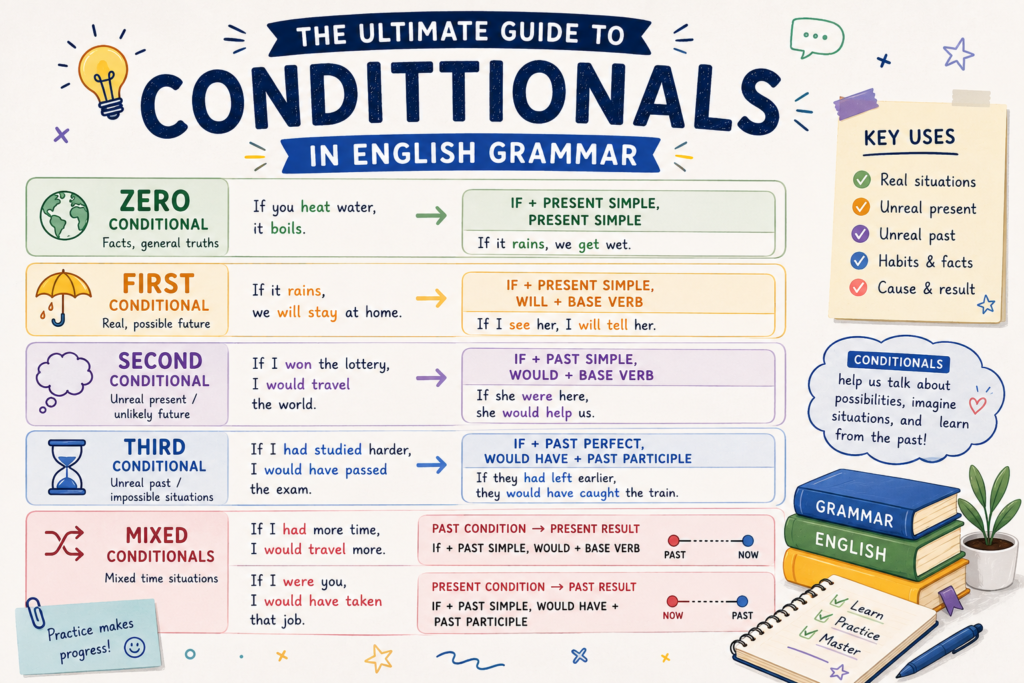
- Comparison Table of All Conditional Types
- Zero Conditional: Facts and General Truths
- First Conditional: Real Future Possibility
- Second Conditional: Unreal Present
- Third Conditional: Regret About the Past
- Mixed Conditionals: When Timelines Overlap
- Self-Check List and Common Mistakes
- FAQ
What Conditionals Are and Why They’re Tricky
A conditional sentence has two parts: the if-clause (the condition) and the main clause (the result). The real challenge isn’t translation, it’s that each type signals a different degree of likelihood, from a hard fact to a purely hypothetical, unchangeable past.
Native speakers absorb this distinction naturally; learners need to memorize the logic behind it. The good news: there are only five patterns, and each follows a predictable structure.
Comparison Table of All Conditional Types
Bookmark this table and it answers 90% of conditional-related questions.
| Type | Situation | If-clause | Main clause | Example |
| Zero | Fact, general truth | Present Simple | Present Simple | If you heat ice, it melts. |
| First | Real future possibility | Present Simple | will + V1 | If it rains, I will stay home. |
| Second | Unreal present/future | Past Simple | would + V1 | If I had more time, I would travel more. |
| Third | Unreal past (regret) | Past Perfect | would have + V3 | If I had studied, I would have passed. |
| Mixed | Past affects present | Past Perfect | would + V1 | If I had saved money, I would be rich now. |
Zero Conditional: Facts and General Truths
Use this type for objective facts: scientific laws, habits, and instructions. There’s no hypothetical element: the condition always leads to the result.
Formula: If + Present Simple, Present Simple.
- If you mix blue and yellow, you get green.
- If the temperature drops below zero, water freezes.
- If I miss the bus, I usually walk to work.
Quick tip: In the Zero Conditional, “if” can be swapped for “when” without changing the meaning, since you’re describing a pattern, not a hypothesis.
First Conditional: Real Future Possibility
Use this when the condition is genuinely realistic and refers to the future. It works for plans, warnings, and promises.
Formula: If + Present Simple, will + V1.
| Correct | Incorrect |
| If I finish the project early, I will call you. | If I will finish the project early, I will call you. |
| If she doesn’t reply by Friday, we’ll cancel the meeting. | If she won’t reply by Friday, we’ll cancel the meeting. |
Common mistake: learners often add “will” to both clauses, since their native language allows a future tense in the condition. In English, “will” straight after “if” is grammatically off-limits (outside of polite requests like “If you will wait a moment…”).
Second Conditional: Unreal Present
This type describes unreal or unlikely situations in the present or future, fantasies, advice, or “what if” hypotheses.
Formula: If + Past Simple, would + V1.
- If I won the lottery, I would buy a house by the sea.
- If I were you, I would talk to your manager. (Note: “were” is used for all subjects here, this is standard subjunctive grammar, not an error.)
- If we had a bigger team, we could finish faster.
Ready-to-use phrase for giving advice: “If I were you, I would…” a versatile structure for softening recommendations to colleagues or friends.
Third Conditional: Regret About the Past
This is the trickiest type to grasp, since it describes a situation that can no longer happen, the past cannot be changed. It’s used for regret, criticism, or analyzing past mistakes.
Formula: If + Past Perfect, would have + V3.
- If I had left earlier, I wouldn’t have missed the train.
- If they had hired a native speaker, the negotiations would have gone smoother.
- If she had prepared better, she would have passed the interview.
Memory trick: the Third Conditional almost always carries a sense of “should have” or “could have” it’s the grammar of hindsight.
Mixed Conditionals: When Timelines Overlap
Don’t be intimidated by the name, a Mixed Conditional simply combines the past and the present: the condition refers to the past, but the result is felt right now.
Formula: If + Past Perfect, would + V1 (no “have”).
- If I had studied medicine, I would be a doctor now. (a past decision → a present result)
- If he hadn’t missed the flight, he would be here with us today.
This is the type that sounds the most natural in everyday and business English, it’s how you explain why the present situation turned out the way it did.
Self-Check List and Common Mistakes
Run through this checklist before writing or saying a conditional sentence:
- Did I put “will” right after “if”? If so, that’s usually a mistake (except in polite requests: “If you will wait a moment…”).
- Does the verb tense in the if-clause match the conditional type (Present / Past / Past Perfect)?
- Am I confusing Second and Third Conditional (unreal present vs. unreal past)?
- In a Mixed Conditional, did I drop “have” from the second clause when the result refers to the present?
- Does the sentence sound natural when read aloud?
For a deeper breakdown of verb tenses, check the Cambridge Dictionary grammar section, and for interactive practice exercises, visit British Council.
Quick Practice: 5 Questions
Try completing these sentences, then check the answers below.
- If I ___ (be) you, I would apply for that job.
- If it ___ (rain) tomorrow, we will cancel the picnic.
- If she had known about the meeting, she ___ (attend) it.
- If water ___ (reach) 100°C, it boils.
- If I hadn’t missed my flight, I ___ (be) home by now.
Answers: 1. were — 2. rains — 3. would have attended — 4. reaches — 5. would be
FAQ
Can I use “was” instead of “were” in the Second Conditional? “If I was you…” is common in casual speech, but the grammatically correct form is “If I were you…”. Use “were” for exams and formal writing.
Why doesn’t the Zero Conditional use “will”? Because it describes a fact or a recurring pattern, not a one-time future event, only the Present Simple fits that logic.
How can I quickly tell Second and Third Conditionals apart by ear? Listen to the verb in the if-clause: Past Simple (had, went, knew) signals Second Conditional; Past Perfect (had had, had gone, had known) signals Third Conditional.
Are there conditional forms beyond these five? Yes, variations like “Zero Conditional with an imperative” (If you see him, tell him to call me) and conditionals with “unless” or “provided that” build on the First Conditional pattern. For more on alternatives to “if,” see this Grammarly Blog article.

