



You’ve finished three seasons of your favorite show in English, yet you still stumble over the Present Perfect in a job interview. Sound familiar? The problem isn’t the show, it’s how you’re watching it.
Passive watching is great for relaxing, but it won’t move the needle on your English. For your brain to actually absorb vocabulary and grammar patterns, watching needs to become an active exercise. Below is a concrete step-by-step method plus a show list matched to different levels.
Table of Contents
- Why Passive Watching Doesn’t Work
- Subtitles: When to Use English, Ukrainian, or None
- Step-by-Step Framework for a 5-Minute Clip
- Recommended Series by Level (A2–C1)
- FAQ
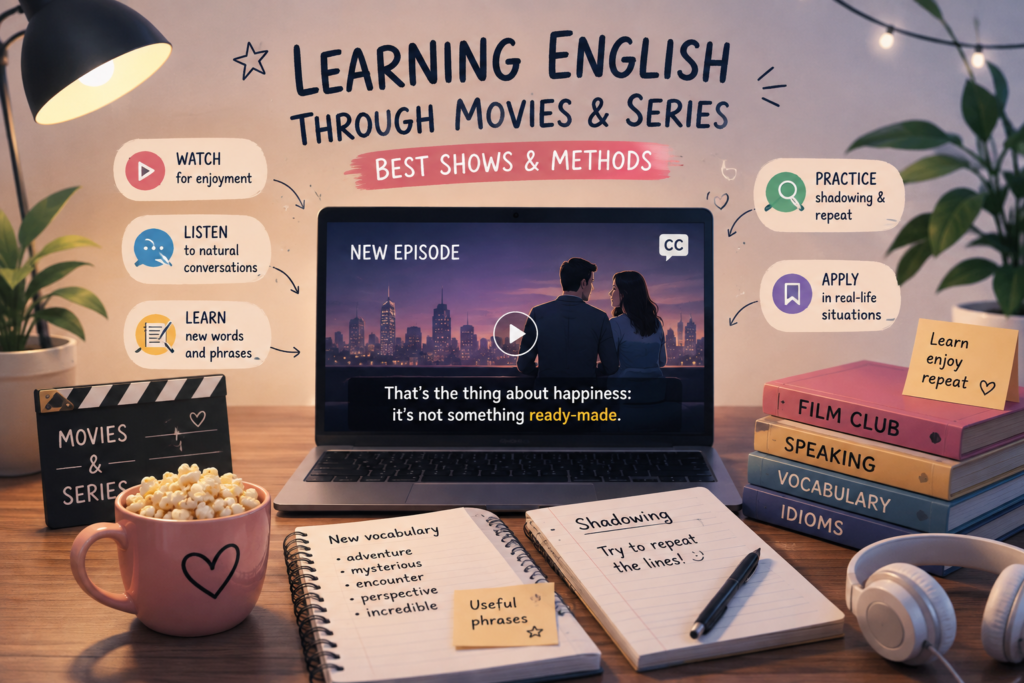
Why Passive Watching Doesn’t Work
When you watch a show purely for entertainment, your brain processes the plot, not the language. You recognize words you already know and “swallow” unfamiliar ones using context and subtitles in your native language.
The result: your passive vocabulary (words you understand) grows slowly, while your active vocabulary (words you can actually use) barely grows at all.
What active learning looks like instead:
- You pause on unfamiliar phrases.
- You write down expressions, not isolated words.
- You repeat lines out loud, copying the intonation.
- You return to the same clip multiple times.
Think of it like an athlete reviewing match footage not for entertainment, but to break down every single move.
Subtitles: When to Use English, When Ukrainian, and When to Turn Them Off
Subtitles are a tool, not a lifelong crutch. Here’s how to use them depending on your level.
| Level | Subtitles | Goal |
| A2–B1 | English + native (alternating) | Get used to the sound, connect word to meaning |
| B1–B2 | English only | Train recognition of spoken language through text |
| B2–C1 | None (first viewing) | Real-time listening comprehension |
Practical tip: watch the same clip three times, first with no subtitles (check how much you understood), then with English subtitles (fill the gaps), and finally without subtitles again (lock it in).
Avoid keeping native-language subtitles on permanently at B1 and above, your brain gets used to reading instead of listening, and your listening skills plateau.
Step-by-Step Framework: Working With a 5-Minute Clip
Pick a scene with active dialogue (not a monologue, not a dialogue-free action sequence). Five minutes is the sweet spot, long enough to matter, short enough not to overwhelm you.
- First watch no subtitles. Just watch and grasp the general meaning. Don’t pause.
- Second watch English subtitles on. Pause on every unfamiliar phrase. Write it down along with the full sentence for context.
- Look up the vocabulary. Check meanings in the Cambridge Dictionary, which shows usage examples, not just a translation.
- Shadowing. Play the scene again and speak the lines simultaneously with the actors, copying their pace, stress, and intonation.
- Active use. Take 3–5 of the phrases you wrote down and build your own sentences about your own life.
- Repeat after 48 hours. Watch the same clip again with no prompts, this locks it into long-term memory.
Post-session checklist:
- Wrote down at least 5 new phrases (not single words)
- Checked meaning in a dictionary
- Spoke the lines out loud
- Built original sentences
- Scheduled a repeat session in 2 days
Recommended Series by Level: A2 to C1
| Series | Level | Accent | Why It Works |
| Friends | A2–B1 | American (neutral) | Simple dialogue, everyday vocabulary, slower pace |
| Modern Family | B1–B2 | American | Varied voices and characters, humor, everyday situations |
| The Crown | B2–C1 | British (RP) | Formal vocabulary, classic pronunciation, historical context |
| Peaky Blinders | C1 | British (regional, Birmingham) | Dense accent and idioms, great for real-world listening practice |
| The Office (US) | B1–B2 | American | Workplace conversational vocabulary, office humor, short lines |
Tip: don’t pick a show purely by difficulty level, pick one whose humor and themes genuinely interest you. Motivation keeps you watching (and learning) far longer than any method alone.
For extra listening practice, try short clips from BBC Learning English, where materials are already organized by CEFR level.
If you plan to use your new vocabulary in a resume or professional communication, double-check your sentence structure with Grammarly to save time on self-editing.
FAQ
How much time per day should I spend watching to see real progress? Aim for 20–30 minutes of active watching (using the method above) rather than two hours of passive background viewing. Quality beats quantity here.
Can I learn English from TV shows alone, without textbooks? Series are excellent for listening skills, conversational vocabulary, and accent training, but you’ll still want a structured resource, a course, textbook, or tutor, to build a solid grammar foundation.
What if the show is too hard and I understand almost nothing? Drop down a level or pick a show with a slower pace of speech (Friends instead of Peaky Blinders, for example). Frustration from not understanding kills motivation faster than anything else.
Does watching without subtitles hurt my understanding of the plot? At first, yes, you might miss some details. But that’s exactly what trains your brain to guess meaning from context, which is a core skill for real-world English communication.

