



If your child is planning to apply to a university in Ukraine, you’ve probably come across the term NMT and if you’re reading this from abroad, it likely needs some explaining. The NMT exam Ukraine uses for university admission includes an English section that many families, especially those living outside the country, find confusing at first. This guide breaks down what the NMT English test actually checks, where students typically lose points, and how to prepare whether you’re based in Kyiv or in another country entirely.
Table of Contents
- What Is the NMT and Why It Matters for University Admission in Ukraine
- What the English Section of the NMT Actually Tests
- Common Mistakes That Cost Students Points
- Preparation Formats: What to Choose
- How Much Time You Realistically Need Before the Test
- How to Know a Student Is Ready (checklist)
- How Profound English Students Prepare for the NMT
- FAQ
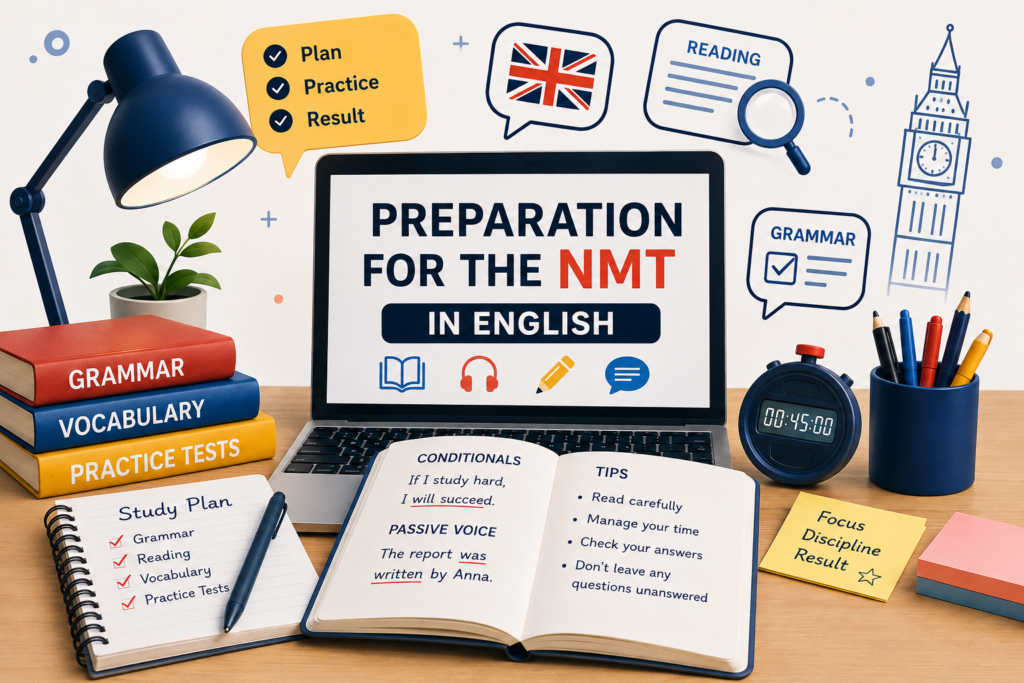
What Is the NMT and Why It Matters for University Admission in Ukraine
The National Multi-subject Test, commonly referred to as the NMT, is Ukraine’s standardized exam used for admission to state universities. There’s no exact equivalent in English-speaking education systems, which is exactly why it can be confusing for parents and students who grew up with SATs, A-Levels, or IB exams. The NMT English test covers a defined set of language skills, and the score a student earns directly affects which universities and programs they can apply to.
A quick explainer for readers unfamiliar with the Ukrainian system: unlike a school final exam, the NMT is a national, standardized test taken by applicants across the country in the same testing window, with results used by universities for admission decisions. It typically includes several subjects – Ukrainian language, mathematics, history, and, depending on the program, English or another foreign language. For families abroad planning remote or return admission to a Ukrainian university, the English section is often the subject with the most room for structured, plannable improvement, since it doesn’t depend on which Ukrainian school curriculum a student followed.
What the English Section of the NMT Actually Tests
The NMT English test explained simply: it checks reading comprehension, grammar structures, vocabulary, and the ability to work quickly through closed-format tasks like multiple choice, matching, and gap-fill exercises. It’s less about “can you have a conversation in English” and more about how automatically and accurately a student applies grammar and reading skills under time pressure.
The exact scoring scale and conversion to university admission points is published annually by Ukraine’s testing authority, and it’s worth checking the current year’s version directly rather than relying on outdated figures, since the scale can shift slightly from year to year.
Common Mistakes That Cost Students Points
Most lost points aren’t about not knowing a word; they come from a handful of recurring gaps that show up year after year.
Grammar structure errors
Conditional sentences, tense agreement, passive voice, and modal verbs are the areas that trip students up most often, even those who speak English fairly comfortably in conversation. Conversational fluency and grammatical accuracy under test conditions are different skills, and the NMT specifically tests the second one. Without a clear, structured understanding of these rules, mistakes appear even on familiar topics once time pressure kicks in.
Reading comprehension under time pressure
The reading section is often the biggest challenge not because the texts are especially difficult, but because of the time limit. Students are used to reading carefully and slowly in class, while the test requires a different skill: scanning and skimming to locate specific information quickly, without trying to understand every single word. Without targeted practice in this skill, points get lost even on texts a student would easily understand given unlimited time.
Not enough practice with the test format
Knowing the grammar isn’t enough if a student has never actually worked through the test format itself. The logic behind matching-type tasks, the specific phrasing patterns, and how to divide time across sections are all skills built only through regular practice tests, not by re-reading a textbook.
Preparation Formats: What to Choose
Once the common gaps are clear, the next question is how to prepare for NMT English online or in person, alone, with a private tutor, in a group, or in a duo. Each format has its own logic, and the right choice depends on level, discipline, and budget.
Private (one-on-one) lessons: pros and cons
One-on-one lessons offer maximum flexibility: pace, topics, and scheduling adapt entirely to the student. This is usually the best option when there are significant gaps in the fundamentals or very little time left before the test. The trade-off is a higher cost and the absence of any peer dynamic that can help with motivation.
Group classes: when they work, when they don’t
Group classes are more budget-friendly and add a sense of community, but they only work well when everyone in the group is at roughly the same level. When levels are mismatched, stronger students get bored and weaker ones fall behind and both sides lose out. For exam prep with a fixed deadline, this is a risky format unless the group was actually matched by level.
Duo format: why a level-matched study partner improves results and lowers cost
The Duo format sits between private lessons and group classes. When two students at a similar level study together, the main downside of group classes (mismatched levels) disappears, while most of the benefits of one-on-one attention remain, the teacher can track each student’s progress individually, and topics are tailored to the pair’s actual gaps. At the same time, the cost per lesson is lower than fully private tutoring. There’s also a motivational benefit: having a study partner at the same level makes it easier to stay consistent and not skip sessions.
This makes the duo format less of a “budget option” and more of a distinct approach with its own advantages, as long as the pair is genuinely matched by level and pace.
How Much Time You Realistically Need Before the Test
There’s no universal number of months that works for everyone, it depends on the starting level, hours per week, and how significant the underlying gaps are. But one principle holds regardless: earlier is better, because grammar structures and reading skills develop gradually, not through a two-week cram session.
Starting structured preparation in September gives one key advantage: time for spaced repetition. Material learned with regular review over several months tends to stick far better than material crammed in the final month, where new topics keep piling on top of unconsolidated ones. An early start also leaves room for several practice tests along the way which is what actually shows real progress, rather than a vague sense of “I think I know this.”
How to Know a Student Is Ready (checklist)
- They comfortably finish a practice reading section within the time limit, rather than rushing to just barely get through it.
- Conditionals, passive voice, and tense agreement no longer cause hesitation.
- Recent practice test scores are consistent, not swinging widely from one attempt to the next.
- They understand the logic of each task type well enough not to lose time figuring out the format during the actual test.
- Mistakes that showed up early in preparation are now rare or gone entirely.
If two or three of these points still feel shaky, that’s simply a normal sign it’s time for structured preparation not a sign that something has gone wrong.
How Profound English Students Prepare for the NMT
At Profound English, NMT preparation is built around tracking real progress rather than guesswork: regular practice tests, mistake analysis, and a study plan adjusted to each student’s specific gaps. The format, private or duo, is chosen based on level and pace rather than applied by default, so results depend on consistency in the process, not luck on test day.
FAQ
When should NMT English preparation start?
Ideally 7–9 months before the test date, meaning around September or October. This gives enough time not just to cover the material, but to reinforce it through repetition and several practice tests, which directly affects how stable the final score is.
Can a student prepare on their own?
Technically yes, if the student has strong self-discipline and a clear sense of their own gaps. In practice, self-study is often limited by the lack of feedback — it’s hard to spot recurring grammar mistakes or an ineffective reading strategy without outside input.
What if a student is preparing while living abroad?
Online preparation works well for students abroad, since duo and private formats both run remotely and can be scheduled around a different time zone. The main thing to plan for is coordinating lesson times and, if relevant, syncing with any Ukrainian school curriculum a student is following in parallel.

