



If you’ve ever said “I’ve been waiting for twenty minutes” or “She’s been studying all afternoon,” you’ve already used the Present Perfect Continuous even if you didn’t know its name. This tense connects the past to the present in a very specific way: it shows that something started before now and is either still happening, or has just stopped and left a visible result.
In this guide, you’ll learn what the Present Perfect Continuous means, how to form it correctly, when native speakers actually use it, and how it’s different from the Present Perfect, Present Simple, and Present Continuous. You’ll also find common mistakes, real-life examples, and 15 practice exercises with an answer key at the end.
Table of Contents
- What Is the Present Perfect Continuous?
- How to Form the Present Perfect Continuous
- When Do We Use the Present Perfect Continuous?
- Since and For with Present Perfect Continuous
- Present Perfect Continuous vs Present Perfect
- Present Perfect Continuous vs Present Simple
- Present Perfect Continuous vs Present Continuous
- Common Mistakes with Present Perfect Continuous
- Stative Verbs and Present Perfect Continuous
- Present Perfect Continuous in Real-Life English
- How to Choose the Right Tense
- Practice: Present Perfect Continuous Exercises
- Quick Summary
- FAQ
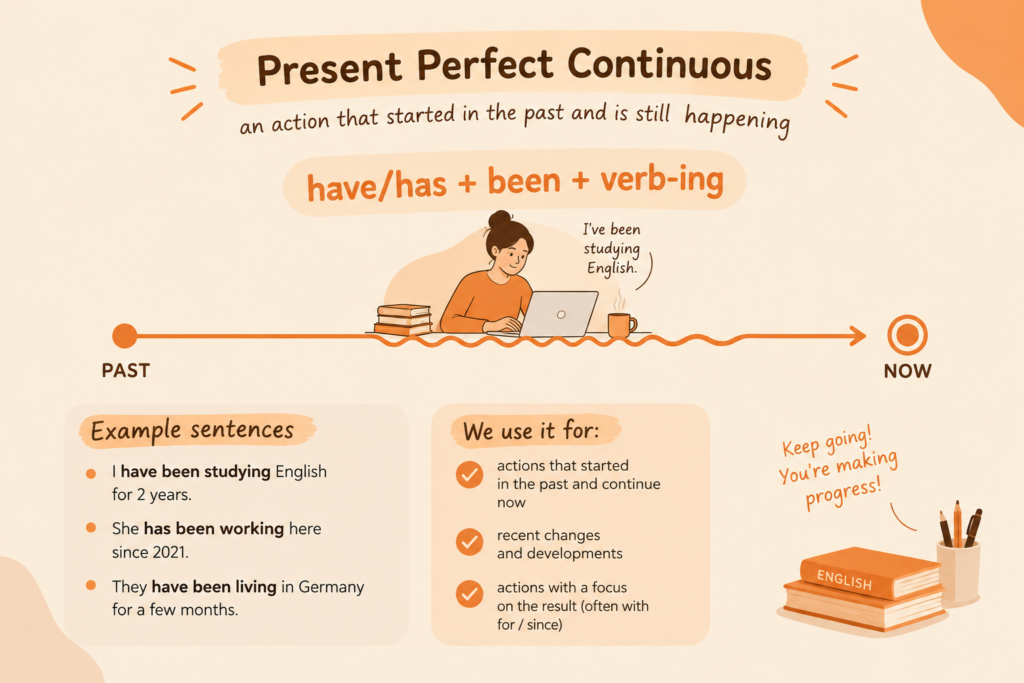
What Is the Present Perfect Continuous?
The Present Perfect Continuous (also called the Present Perfect Progressive) describes an activity or situation that began in the past and is still going on now, or has only just finished and is closely connected to the present moment.
Think of it as a spotlight on the duration or the process of an action, rather than on the final result. Compare these two ideas:
- I have been learning English for three years. (The process is still going on, I’m still learning.)
- I have learned three hundred words. (This focuses on a completed result, not the process.)
A few natural examples of the Present Perfect Continuous in action:
- He has been working from home since March.
- We’ve been talking for almost an hour.
- It has been raining all day.
- I’m exhausted, I’ve been cleaning the house since 9 a.m.
Notice that in each case, the action links a period of past time directly to now. That’s the core idea behind the Present Perfect Continuous tense, and it’s what makes it so useful for talking about ongoing work, study, habits, and daily life.
How to Form the Present Perfect Continuous
The formula is simple once you see the pattern:
Subject + have/has + been + verb-ing
For example: I have been working. / She has been studying.
When to use HAVE and HAS: use have with I, you, we, and they; use has with he, she, and it.
- I have been working. / You have been working. / They have been working.
- She has been studying. / He has been studying. / It has been raining.
In everyday spoken and written English, these are almost always contracted: I’ve been working, she’s been studying, we’ve been waiting.
Here’s a compact overview of all the sentence forms:
| Form | Structure | Example |
| Affirmative | Subject + have/has + been + verb-ing | I have been working here for two years. |
| Negative | Subject + haven’t/hasn’t + been + verb-ing | She hasn’t been feeling well lately. |
| Question | Have/Has + subject + been + verb-ing? | Have you been waiting long? |
| Short answers | Yes/No + have/has (+n’t) | Yes, I have. / No, she hasn’t. |
A few more realistic examples for each form:
- Affirmative: They’ve been renovating the kitchen for a month.
- Negative: We haven’t been sleeping well because of the heat.
- Question: Has he been working on this project alone?
- Short answer: Has it been snowing? Yes, it has.
One small formation note: spelling changes that apply to any -ing verb also apply here (run → running, write → writing, lie → lying), so if you’re unsure about a specific verb, it’s worth double-checking the spelling rule rather than the tense itself.
When Do We Use the Present Perfect Continuous?
The Present Perfect Continuous covers a few closely related situations. Here’s a breakdown of the most common ones.
Actions That Started in the Past and Are Still Continuing
This is the classic use: something began at a point in the past and is still true right now.
- I have been learning English for three years.
- She has been living in Berlin since 2020.
- We have been waiting for the bus for fifteen minutes.
If you’re comparing this to how a simpler, single-point-in-time tense works, it can help to look at the Present Simple article, which describes actions without this sense of ongoing duration.
Actions That Have Recently Stopped
Sometimes the activity has just finished, but its effect is still visible or relevant now.
- She is tired because she has been working all morning.
- My hands are covered in paint, I’ve been decorating the living room.
- He’s out of breath. He’s been running.
In each case, the action itself is over, but you can still see or feel the result in the present. That present-day connection is exactly what separates this tense from a plain past description.
Temporary or Ongoing Activities
The Present Perfect Continuous is a natural fit for talking about something you’re currently in the middle of, especially if it feels temporary.
- I’ve been working on a new project at the office this week.
- She’s been studying for her exams for the last few days.
- We’ve been training for the marathon since January.
- They’ve been travelling around Europe for a month.
Repeated Actions Over a Period of Time
You can also use this tense for something that has happened again and again over a stretch of time, when you want to emphasise the pattern rather than a single event.
- I’ve been going to the gym three times a week.
- He’s been calling me every day this week.
- She’s been applying for jobs since she graduated.
Since and For with Present Perfect Continuous
Two of the most common companions of this tense are since and for, and they answer slightly different questions.
- since = the starting point in time (a specific moment)
- for = the duration or length of time
| Word | Meaning | Example |
| since | starting point | I have been working here since 2019. |
| since | starting point | She has been studying since 8 a.m. |
| for | duration | I have been working here for five years. |
| for | duration | She has been studying for three hours. |
A useful way to remember it: if you can answer the question “How long?” with a number and a unit of time (three hours, two weeks, five years), use for. If you’re naming a specific starting point (Monday, 2019, 8 a.m., I was a child), use since.
- How long have you been living here? I’ve been living here for six months / since March.
Present Perfect Continuous vs Present Perfect
This is one of the trickiest comparisons for learners, so it’s worth slowing down here.
The Present Perfect usually focuses on a completed result, a quantity, or an achievement. The Present Perfect Continuous focuses on the activity, process, or duration itself.
Compare these pairs both are grammatically correct, but they say different things:
- I have been reading for two hours. (Focus on the activity, I’ve spent two hours reading, and I might still be reading.)
- I have read three chapters. (Focus on the result, three chapters are now finished.)
- She has been painting the fence all day. (Focus on the ongoing effort.)
- She has painted the fence. (Focus on the fact that it’s now done.)
| Present Perfect Continuous | Present Perfect | |
| Focus | the activity, process, duration | the result, completion, quantity |
| Typical question | How long have you been…? | How many / How much have you…? |
| Example | I’ve been writing this report for hours. | I’ve written five pages of the report. |
| Often used with | since, for, how long | already, yet, just, ever, times |
A helpful rule of thumb: if you can imagine yourself still in the middle of doing something, the continuous form usually fits. If you’re describing a finished outcome or how many times something happened, the simple perfect usually fits better.
Present Perfect Continuous vs Present Simple
These two tenses describe very different kinds of time. The Present Perfect Continuous connects a period of time up to now, while the Present Simple describes habits, facts, and regular routines without that sense of continuing duration. If you want a deeper look at everyday routines and general truths, the Present Continuous vs Present Simple article covers that comparison in more detail.
- I work at a marketing agency. (a general fact, my job)
- I’ve been working at a marketing agency for two years. (emphasises how long, and that it’s still going on)
- She teaches yoga on Saturdays. (a regular routine)
- She’s been teaching yoga for over a decade. (the duration of her experience, up to now)
The Present Simple tells you what is generally true; the Present Perfect Continuous tells you how long something has been happening.
Present Perfect Continuous vs Present Continuous
These two are close cousins, and the difference often comes down to whether duration is being emphasised.
- I am studying English. (describes what’s happening right now, without saying how long)
- I have been studying English for two years. (adds the duration, it started two years ago and continues now)
Picture a timeline: the Present Continuous is a snapshot of the present moment, while the Present Perfect Continuous draws a line from a point in the past all the way up to that same moment, showing the stretch of time in between.
- Look, it’s raining again! (a simple observation right now)
- It has been raining since this morning. (this adds when it started and how long it’s continued)
Common Mistakes with Present Perfect Continuous
Here are some realistic mistakes learners make, along with corrections and short explanations.
1. Forgetting “been”
- Incorrect: I have working here for two years.
- Correct: I have been working here for two years.
- The auxiliary been is easy to drop in fast speech, but it’s a required part of the structure: have/has + been + verb-ing.
2. Using the wrong auxiliary
- Incorrect: She have been waiting for an hour.
- Correct: She has been waiting for an hour.
- Third-person singular subjects (he, she, it) need has, not have.
3. Incorrect verb form
- Incorrect: They have been work all night.
- Correct: They have been working all night.
- After “been,” the main verb always takes the -ing form, never the base form.
4. Confusing since and for
- Incorrect: I’ve been living here since five years.
- Correct: I’ve been living here for five years.
- Use for with a length of time (five years) and since with a starting point (2019, last Monday).
5. Using Present Continuous instead
- Incorrect: I am waiting here for twenty minutes.
- Correct: I have been waiting here for twenty minutes.
- When you’re describing how long something has continued up to now, the Present Continuous alone isn’t enough — you need the Present Perfect Continuous.
6. Using Present Perfect when the activity or process is the main focus
- Incorrect (in context): I’ve written this essay all morning, so my hand hurts.
- Correct: I’ve been writing this essay all morning, so my hand hurts.
- Since the sentence is about the ongoing effort (and its physical result), the continuous form fits the meaning better than the simple perfect.
7. Using continuous forms with stative verbs
- Incorrect: I have been knowing him for years.
- Correct: I have known him for years.
- Verbs like know describe a state, not an action, so they normally stay in the Present Perfect simple form. More on this below.
Stative Verbs and Present Perfect Continuous
Some verbs describe states, feelings, thoughts, or relationships rather than actions and these are generally not used in continuous forms, including the Present Perfect Continuous. Common examples include:
know, believe, understand, want, need, own, belong, like, love, hate, prefer, seem
Instead of a continuous form, these verbs typically appear in the simple Present Perfect:
- Incorrect: I have been knowing the answer.
- Correct: I have known the answer for a while.
- Incorrect: She has been believing in him since the start.
- Correct: She has believed in him since the start.
That said, this isn’t an absolute rule without exceptions. Some verbs can be either stative or dynamic depending on their meaning. Think, for example, is stative when it means “have an opinion” (I’ve always thought he was right), but it can behave more like an action verb when it means “consider” or “process an idea” (I’ve been thinking about changing jobs). Similarly, have is stative when it means “possess” (I’ve had this car for years), but it can appear in continuous forms in expressions like have a shower or have lunch (I’ve been having a really busy week). Context matters more than a strict list here.
Present Perfect Continuous in Real-Life English
This tense shows up constantly in everyday conversation, because so much of daily life involves things that are still in progress. A few situations where it fits naturally:
- Work: I’ve been working on the quarterly report since Monday.
- Studying: She’s been preparing for her IELTS exam for two months.
- Fitness: We’ve been going to the gym together since January.
- Daily routines: He’s been getting up earlier this week.
- Travel: They’ve been backpacking through Southeast Asia for six weeks.
- Waiting: Sorry I’m late, have you been waiting long?
- Hobbies: I’ve been learning to play the guitar in my free time.
- Conversations: What have you been up to lately?
That last example, What have you been up to? is one of the most common uses of the Present Perfect Continuous in casual English. It’s a friendly, natural way to ask what someone has been doing recently, without needing an exact start date or a finished result.
How to Choose the Right Tense
When you’re not sure which tense fits, ask yourself these questions:
- Did the activity start in the past?
- Is it connected to the present still happening, or just finished with a visible result?
- Am I emphasising the activity, duration, or process, rather than a specific result?
- Is there a visible present result of a recently finished action?
- Am I actually talking about a completed result, an achievement, or a number of times something happened?
If your answers point to duration, process, or an ongoing/recently finished activity, the Present Perfect Continuous is usually the right choice. If you’re focused on a completed result or a quantity, the Present Perfect fits better. If you’re describing a general routine or fact with no sense of “up to now,” reach for the Present Simple. And if you’re only describing what’s happening at this exact moment, without any duration, the Present Continuous is enough.
Practice: Present Perfect Continuous Exercises
Try these 15 exercises before checking the answer key below.
- Fill in the blank: I ______ (learn) Spanish for six months.
- Choose the correct tense: She ______ (study / has been studying) all night — that’s why she looks so tired.
- Correct the mistake: They have been work in this office since 2018.
- Since or for: He has lived in Paris ______ ten years.
- Present Perfect or Present Perfect Continuous: I ______ (read) that book — I finished it yesterday.
- Fill in the blank: ______ you ______ (wait) long?
- Choose the correct tense: We ______ (know / have known) each other since college.
- Correct the mistake: She has been knowing the answer for a while.
- Since or for: It has been raining ______ this morning.
- Present Perfect or Present Perfect Continuous: He ______ (write) five emails this morning. (all finished)
- Fill in the blank: My eyes hurt because I ______ (stare) at the screen all day.
- Choose the correct tense: Look outside — it ______ (rain / has been raining) again.
- Correct the mistake: I have been living in this city since three years.
- Short contextual sentence: Write a sentence using the Present Perfect Continuous to describe something you have been doing this week.
- Present Perfect or Present Perfect Continuous: We ______ (paint) the fence — it’s completely finished now.
Answer Key
- have been learning — duration up to now, use “for” with a length of time.
- has been studying — the tiredness is a present result of an ongoing activity.
- They have been working in this office since 2018. — the main verb needs the -ing form after “been.”
- for — ten years is a duration, not a starting point.
- have read — the focus is on the completed result (finished yesterday).
- Have you been waiting long? — question form: Have/Has + subject + been + verb-ing.
- have known — “know” is a stative verb and doesn’t usually take a continuous form.
- She has known the answer for a while. — same rule as above; stative verbs stay in the simple form.
- since — “this morning” is a specific starting point.
- has written — the focus is on the number of completed emails, not the ongoing process.
- have been staring — the sore eyes are a present result of an ongoing activity.
- is raining — this describes what’s happening right now with no mention of duration, so the Present Continuous is enough; adding “has been raining” would also be correct if you wanted to emphasise duration, but the simplest natural answer here is the Present Continuous.
- I have been living in this city for three years. — use “for” with a length of time, not “since.”
- Answers will vary — for example: I’ve been reading a new novel this week.
- have painted — the fence is completely finished, so the focus is on the result.
Quick Summary
| Present Perfect Continuous | |
| Form | have/has + been + verb-ing |
| Main uses | ongoing actions started in the past; recently finished actions with a present result; temporary activities; repeated actions over time |
| Common signal words | since, for, how long, lately, recently |
| Example | I have been working on this project for three weeks. |
In short: reach for the Present Perfect Continuous whenever you want to highlight how long something has been happening, or when an activity has just stopped but its effect is still visible now. If you’re focused on a finished result instead, the Present Perfect is usually the better fit.
FAQ
What is the Present Perfect Continuous? It’s a verb tense used to describe an activity that started in the past and is still continuing now, or has recently finished with a visible connection to the present. It’s formed with have/has + been + verb-ing.
When do we use Present Perfect Continuous? We use it for actions that began in the past and are still going on, for recently finished actions with a present result, for temporary ongoing activities, and for repeated actions over a period of time.
What is the formula for Present Perfect Continuous? Subject + have/has + been + verb-ing, for example I have been working or she has been studying.
What is the difference between Present Perfect and Present Perfect Continuous? The Present Perfect usually highlights a completed result or a quantity (I’ve read three books), while the Present Perfect Continuous highlights the activity, process, or duration itself (I’ve been reading for three hours).
Can Present Perfect Continuous describe an action that has stopped? Yes. It can describe an activity that has just finished if there’s still a visible or logical connection to the present, such as She’s tired because she’s been working all day.
How do I use since and for? Use since with a specific starting point (since 2020, since Monday) and for with a length or duration of time (for two years, for a week).
Which verbs cannot be used in Present Perfect Continuous? Stative verbs such as know, believe, understand, want, need, own, and belong are generally not used in continuous forms, though some of these verbs can behave differently depending on their meaning in context.
Is Present Perfect Continuous the same as Present Perfect Progressive? Yes, “Present Perfect Continuous” and “Present Perfect Progressive” are two names for exactly the same tense.
For a deeper reference on the grammar behind this tense, Cambridge Dictionary’s grammar guide is a solid resource: Cambridge Dictionary’s guide to the Present Perfect Continuous. And if you’d like to explore how this connects to talking about future plans, the Future Simple vs Going to article is a natural next step in your grammar journey.

