



You know 3,000 words, you can explain the Present Perfect, you even watch shows without subtitles. Then someone speaks to you in English and your brain goes blank. That’s the language barrier: the gap between knowing English and being able to use it in real time. Here are 7 techniques that actually close that gap, no “just relax” advice included.
Table of Contents
- Psychological roots of speaking anxiety in adult learners
- Practical exercises: Shadowing and self-talk
- How to focus on communication over perfection
- The role of guided conversation practice
- FAQ
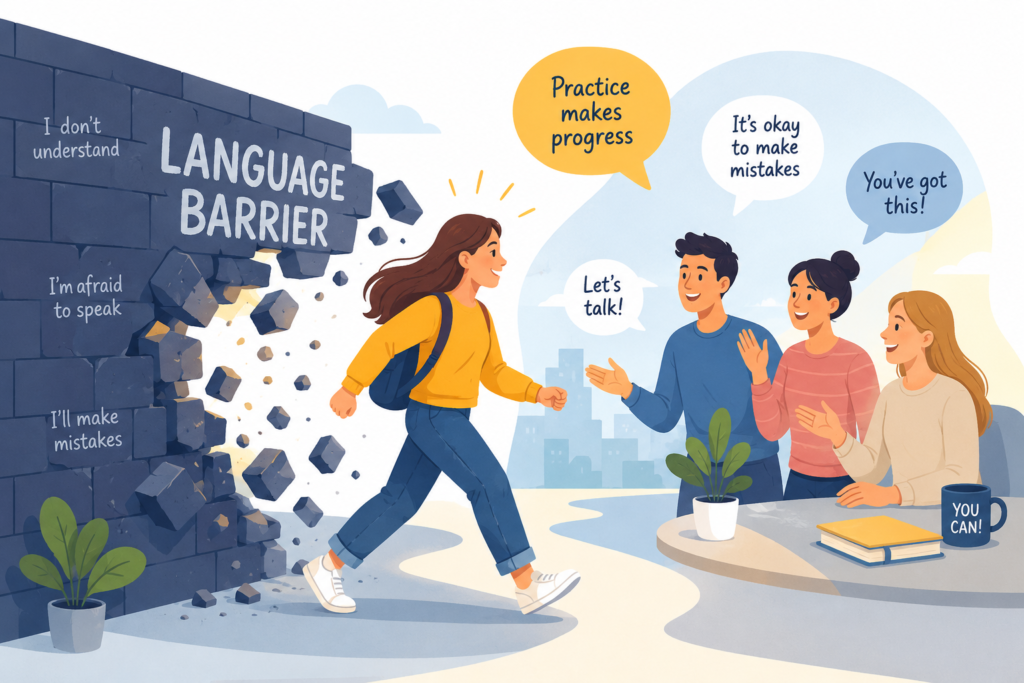
Psychological roots of speaking anxiety in adult learners
Speaking anxiety isn’t really about grammar. It’s about social evaluation. Your brain treats a mistake in conversation like a public failure and triggers a “freeze” response, hence the blank mind, the forgotten simple words, the urge to stay silent.
How to reframe it:
- Redefine what a mistake is. It’s a data point, not a failure. Even native speakers make several grammatical slips per minute of spontaneous speech, as Cambridge Dictionary notes when discussing natural spoken English versus written norms.
- Apply the 80% rule. If your listener understood 80% of what you said, communication succeeded. The rest can be clarified.
- Keep a mistake log instead of avoiding mistakes. Write down phrases that didn’t land, and look up the correct version after the conversation, not during it.
| Situation | What not to do | What to do instead |
| You forget a word | Freeze for 10 seconds | “It’s like… you know, the thing you use to…” |
| You use the wrong tense | Stop and correct yourself three times | Keep going, correct it naturally in the next sentence |
| You don’t understand the other person | Nod and hope for the best | “Sorry, could you say that again a bit slower?” |
Practical exercises: Shadowing and self-talk
Shadowing means listening to a native speaker and repeating almost simultaneously, copying their rhythm, intonation, and pronunciation. It’s one of the techniques British Council actively recommends for building spoken fluency and natural rhythm.
How to shadow correctly:
- Pick a short audio or video clip (30-60 seconds), a podcast, BBC news, a scene from a series.
- Listen once without repeating, just to catch the general meaning.
- Play it again and repeat out loud at the same time as the speaker, even if you miss some words.
- Repeat the same clip 3-5 times, gradually catching up to the natural pace.
Self-talk is the second most effective technique. Spend 5 minutes a day narrating your actions in English: “I’m making coffee, it smells amazing,” “I need to reply to this email before lunch.” There’s no audience, so there’s no fear but your speaking muscle still gets a workout.
How to focus on communication over perfection
The most common mistake is jumping straight into a high-stakes conversation with a native speaker, a job interview, a date, a business call. Start in low-risk environments instead:
- Language clubs for non-native speakers, everyone is in the same position, mistakes are normalized.
- Tandem language-exchange platforms, your partner is learning your language too and makes mistakes as well.
- Voice chats in gaming or hobby communities, the focus is on the topic, not on being judged.
- Talking to an AI assistant, zero social stakes, and you can practice the same phrase 20 times.
The progression rule: AI/mirror practice → beginner language partner → language club → 1-on-1 with a native speaker → real-life situation (work, travel). Skipping steps is the main reason people give up after one bad experience.
The role of guided conversation practice
You can score 8.0 on IELTS Writing and still freeze in a live conversation. That’s because spoken and written English rely on different cognitive processes.
Three reasons “knowing” doesn’t equal “speaking”:
- Retrieval speed. In conversation there’s no time to recall a rule, you need automaticity, which only builds through repeated spoken practice.
- Phonological memory. You might write a sentence correctly but fail to recognize it when spoken naturally, due to linking and connected speech.
- Working memory overload. Your brain juggles grammar, pronunciation, vocabulary, and content simultaneously, too much for a beginner, which is why basic structures need to become automatic first.
That’s why Grammarly recommends training written accuracy and spoken fluency separately, they’re different skills, and progress in one doesn’t automatically transfer to the other. Guided conversation with a tutor closes that gap fastest, because errors get corrected and replaced with better phrasing in real time, before they become habits.
FAQ
How long does it take to overcome the language barrier? With regular practice (15-20 minutes daily), noticeable progress appears within 3-4 weeks, and stable confidence within 2-3 months.
Can I overcome it without a tutor? Partly, using shadowing and self-talk. But live feedback from another person speeds up progress significantly, since it corrects mistakes before they become habits.
What should I do if I forget a word mid-conversation? Use the “describe, don’t translate” technique: instead of searching for the exact term, describe it in simple words (“the thing you use to open bottles” instead of “opener”).
Does watching TV shows help with the language barrier? It builds listening comprehension, but not speaking. Without active production (shadowing, conversation), passive watching only gets you part of the way there.

