



You meet a new word, understand it, and think, “Got it.” A week later you see it again and it feels strangely unfamiliar. Or you recognize it while reading, but it vanishes when you try to say it. This is normal, and it does not mean you have a bad memory.
Seeing a word several times is not the same as learning it. If you want to know how to remember English words for the long term, the key idea is this: memory is built by effort, not exposure. Words stay when you actively pull them out of your memory, meet them in meaningful contexts, review them at the right moments, and use them yourself. This article shows you how to do all of that with ten practical techniques, a step-by-step process, a weekly routine, and an exercise with an answer key.
Table of Contents
- Why Is It So Hard to Remember English Words?
- How Memory Works When You Learn Vocabulary
- 10 Techniques That Actually Help You Remember English Words
- How to Turn a New Word Into a Word You Can Actually Use
- Common Vocabulary-Learning Mistakes
- A Simple Weekly Vocabulary Routine
- Practice: Try These Vocabulary Techniques
- Answer Key
- Quick Summary
- FAQ
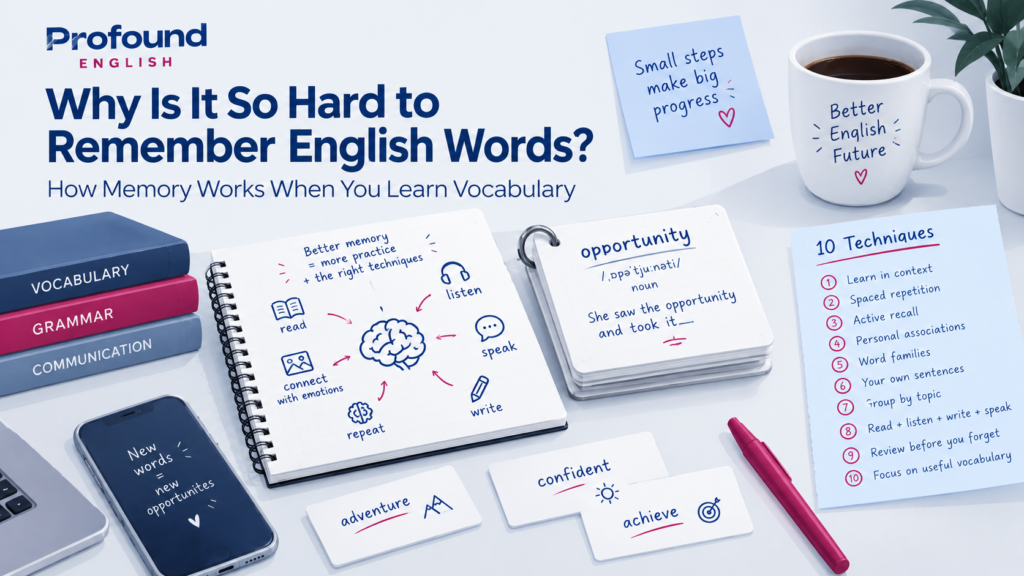
Why Is It So Hard to Remember English Words?
Most learners do not forget words because they are careless. They forget because of how the words were learned. Here are the most common reasons.
Recognition is easier than recall. You can read the word reliable in an article and understand it at once. But when you want to describe a trustworthy colleague in conversation, the word does not come. Your passive vocabulary (words you understand) is much larger than your active vocabulary (words you can produce). Remembering a word is not one skill but two, and the second is harder.
Forgetting starts quickly. Without review, a large part of what you learned in one session fades within days. This is not a flaw. It is how memory filters information it considers unimportant.
Isolated translations are fragile. A pair like “avoid = уникати” gives you one meaning but no grammar, no typical partners, and no sense of when to use the word. You have a label, not a usable tool.
Repetition without thinking does not help much. Reading the same list five times feels productive, but your brain is only recognizing the page, not retrieving the words.
Too many words at once. Learning thirty words in an evening usually means remembering very few of them a week later. A smaller number of words, handled properly, beats a long list handled badly.
How Memory Works When You Learn Vocabulary
You do not need neuroscience to learn vocabulary efficiently. A few simple principles explain most of what works.
- Repeated exposure. The more often you meet a word, the more familiar it becomes. But exposure alone only builds recognition.
- Active recall. Trying to remember a word without seeing the answer strengthens memory far more than looking at the answer again. The effort of searching is what makes the memory stronger.
- Spaced repetition. Reviewing a word just as it starts to fade works better than reviewing it many times in a row. A gap between reviews makes each review more effective.
- Meaningful context. A word connected to a sentence, a situation, or a personal experience has more “hooks” in your memory than a word on its own.
- Retrieval practice. This is simply active recall done regularly. Each successful retrieval makes the next one easier.
- Use over time. A word you use in speaking or writing, again and again over weeks, becomes part of your active vocabulary. Words you only recognize tend to stay passive.
If you want to read more on how researchers describe these ideas, there is a good body of research on vocabulary learning. Everything in the rest of this article is a practical application of these principles.
10 Techniques That Actually Help You Remember English Words
Each technique below works on its own, but they are strongest in combination. You do not need to use all ten at once. Start with two or three and add others gradually. If you are learning how to improve English vocabulary on your own, this is the core of the article.
1. Learn Words in Context
Why it works. A sentence tells you things a translation cannot: which grammar the word needs, which words commonly go with it, and what situation it fits. Your brain also stores a sentence as a small story, which is easier to retrieve than a bare word.
Example. Instead of memorizing:
avoid = уникати
learn:
I try to avoid checking my phone before bed.
From this one sentence you learn that avoid is followed by an -ing form (not “avoid to check”), that it is used for habits and things you prefer not to do, and that it sounds natural in everyday speech.
How to use it.
- Find the word in a real sentence from something you read or heard.
- Copy the whole sentence, not just the word.
- Underline the word and any words that regularly appear next to it.
Tip. If a dictionary gives several example sentences, choose the one that sounds most like something you might actually say.
2. Use Spaced Repetition
Why it works. Memory fades over time, but each well-timed review makes the memory last longer. The idea is to review a word at increasing intervals: soon after learning, then after a few days, then after a couple of weeks, then after a month.
Example of a simple schedule. You learn the word postpone on Monday.
- Review 1: the next day
- Review 2: three days later
- Review 3: one week later
- Review 4: about three weeks later
If you remember the word easily, the next gap gets longer. If you forget it, move it back to a shorter gap.
How to use it. You do not need technology. Paper flashcards in three boxes work well: a “new” box (check daily), a “learning” box (check every few days), and a “known” box (check every few weeks). A word moves forward when you recall it and back when you do not.
Tip. Write the date on the back of each card. It takes two seconds and removes the guesswork about what to review today.
3. Practice Active Recall
Why it works. Looking at a word and its meaning feels like learning, but it is mostly recognition. Active recall forces you to produce the answer from memory, and that struggle is exactly what builds retention.
Example.
- Recognition (easy): you see “reluctant: unwilling to do something” and nod.
- Recall, direction 1: you see “reluctant”, cover the meaning, and try to explain it or use it in a sentence.
- Recall, direction 2 (harder): you see only “feeling unwilling to do something” and try to produce the word reluctant.
How to use it.
- Write the English word on one side of a card and the meaning or an example sentence with a gap on the other.
- Look at one side only. Answer out loud or in writing before you check.
- Practice both directions: word to meaning, and meaning to word.
Tip. Do not check the answer too quickly. Wait at least five to ten seconds. Even a failed attempt helps the correct answer stick when you see it.
4. Create Personal Associations
Why it works. Memory connects new information to what you already know. A word linked to your own life is far more memorable than one learned from a stranger’s example.
Example. The word tedious (boring and repetitive). You could connect it to a real experience: “Filling in the same spreadsheet every Friday is tedious.” The word is now attached to a specific, slightly annoying memory, and that emotion helps it stay.
For a more visual learner, the word fragile can be linked to the image of a box of glasses you once carried upstairs, with the word FRAGILE written on it.
How to use it. Ask yourself three questions: When did I last feel this? Who or what does this word remind me of? Where would I use it in my own life?
Tip. Skip forced sound-alike tricks unless they come naturally. A real memory, even a small one, usually works better than a clever but artificial rhyme.
5. Learn Word Families and Related Forms
Why it works. English words come in groups. Learning one root with its forms gives you several useful words for the effort of one.
Example.
| Form | Part of speech | Example sentence |
| decide | verb | We need to decide by Friday. |
| decision | noun | It was a difficult decision. |
| decisive | adjective | She took decisive action. |
| indecisive | adjective | I am indecisive when I order food. |
Notice that the forms differ in both meaning and grammar. Decisive does not simply mean “connected with deciding”. It describes someone or something that makes clear, firm choices.
How to use it.
- When you learn a new word, check a dictionary for its other forms.
- Write one short example for each form that is useful to you.
- Do not collect forms you will never use. Two or three relevant forms are enough.
Tip. Pay special attention to endings such as -tion, -ive, -able, -ly and prefixes such as un-, in-, dis-. They help you guess unfamiliar words later.
6. Use New Words in Your Own Sentences
Why it works. Writing your own sentence forces you to decide on grammar, word order, and meaning. This is the first step from “I understand it” to “I can say it.”
Example sentences for the word struggle:
- I struggle to wake up before seven, even with two alarms.
- She struggled with the new software for the first week.
- Many people struggle to find time for hobbies.
Each sentence is built around a real life situation, and none of them could be copied from a dictionary.
How to use it.
- Write one sentence about your work, study, hobbies, routine, or opinions.
- Make it true. A true sentence is easier to remember than an invented one.
- If you are unsure about the tense, check it. For daily habits you will often need the present simple (see our Present Simple article).
Tip. Aim for one good sentence per word, not five weak ones.
7. Group Words by Topic or Meaning
Why it works. When words belong to one situation, they support each other. Thinking about “airport” also brings up boarding, delay, luggage, and check in.
Example topics. Travel, work, health, daily routines, shopping, feelings.
When it helps. Grouping is useful when you prepare for a specific situation: a trip, a job interview, a doctor’s appointment, a presentation.
When it hurts. Grouping very similar words together can confuse you. If you learn borrow and lend, or affect and effect, in the same session, you may mix them up. For these pairs, learn one word well first, then add the other a few days later and compare them directly.
How to use it. Choose a small topic (8 to 10 words at most) and build short example sentences, not a long list. Keep the topic tied to something you really need.
Tip. A mind map with a few branches is more useful than a full page of words.
8. Combine Reading, Listening, Writing, and Speaking
Why it works. Each skill stores a different trace of the same word: how it looks, how it sounds, how your hand writes it, how your mouth says it. The more traces, the easier it is to find the word later.
Mini example with the word efficient.
- Read: “A good routine makes you more efficient.”
- Listen: Find a short audio or video where someone uses it, or use the audio button in an online dictionary.
- Write: “I am most efficient in the morning.”
- Speak: Say your sentence aloud twice, with natural stress on the first syllable (ef-fi-cient).
How to use it. Take one word and give it four short touches in different formats during the same day or week. It takes under five minutes.
Tip. Even speaking alone counts. Say your sentence aloud while walking or washing dishes.
9. Review Words Before You Forget Them
Why it works. Technique 2 explains the principle of spacing. This technique is about the habit: building small reviews into your normal day so that you refresh words instead of relearning them from zero.
A realistic approach.
- Spend two minutes each morning or evening looking over words from the last week.
- Review the words you struggled with more often than the ones you know well.
- Keep your cards or notes in one place that you already open every day.
If you like short sessions, this fits well with the idea of Microlearning article: several tiny reviews usually work better than one long weekly session.
How to use it. Attach the review to an existing habit: coffee, commute, a break between tasks. A habit you already have is a reliable trigger.
Tip. If you miss a few days, do not restart. Take the oldest words you remember least and continue from there.
10. Focus on Useful Vocabulary Instead of Huge Word Lists
Why it works. Not all words are equally valuable. A small group of common words appears in most of what you read and hear. A word you meet every week is worth learning before a word you might meet once in a year.
What to consider when choosing words.
- Frequency: How often does the word appear in everyday English? Check a learner’s dictionary, which often marks common words.
- Usefulness: Can you use the word in many situations, or only in a very narrow one?
- Personal relevance: Does it relate to your job, studies, or hobbies?
- Your goals: A learner preparing for an office job needs different words from one planning to travel.
- Your real input: Words that keep appearing in the series, articles, or podcasts you actually enjoy are the best candidates.
Example. If you read about cooking, learn simmer, chop, and season before rare literary words. You will meet them again quickly, and each meeting is free review.
How to use it. Keep a short “words I keep meeting” list. When a word appears for the second or third time in different places, it is a good sign that it is worth learning.
Tip. If you learn a word and never meet it again in two or three months, it may not have been the best choice for you right now. Move on.
How to Turn a New Word Into a Word You Can Actually Use
There is a big difference between “I know this word when I see it” and “I can use this word.” The first is recognition, the second is production. To move a word from passive to active vocabulary, follow this process.
- Notice the word. Pick it up from something you read or heard, not from a random list.
- Understand it in context. Read the whole sentence and make sure you know what it means here, since many English words have several meanings.
- Check pronunciation. Listen to the word and repeat it. A word you cannot pronounce is much harder to recall when speaking.
- Learn a natural example. Keep one clear sentence, ideally with a common partner word (for example, make a decision, not do a decision).
- Recall it later. After a day or two, try to remember it without looking.
- Create your own sentence. Make it about your life.
- Use it again after some time. Include it in a message, a short note, a voice recording, or a conversation a week later.
Active vocabulary requires production because your brain strengthens whatever it practices. If you only read, you get better at reading. If you also say and write the word, you build the path you need for speaking and writing.
Common Vocabulary-Learning Mistakes
| Mistake | What to do instead |
| Memorizing long lists without context | Learn words inside sentences and keep the list short |
| Studying too many words at once | Start with 5 to 10 words per session and review them properly |
| Reviewing only by rereading | Cover the answer and try to recall it first |
| Learning only translations | Add an example sentence and common word partners |
| Never using new vocabulary | Write or say at least one sentence with each new word |
| Ignoring pronunciation | Listen and repeat the word when you first learn it |
| Learning rare words before everyday vocabulary | Prioritize frequent and personally useful words |
| Abandoning words after one or two reviews | Keep reviewing at longer intervals until the word feels automatic |
A Simple Weekly Vocabulary Routine
This routine is flexible. Adjust the number of words and the time to match your schedule. Fifteen to twenty minutes a day is enough.
| Day | Activity |
| Monday | Choose 5 to 10 useful words. Read each in a sentence and write the sentence down. |
| Tuesday | Recall the words without looking. Check only the ones you forgot. |
| Wednesday | Write your own sentence for each word. |
| Thursday | Look for the words in reading or listening: a short article, a video, a podcast. |
| Friday | Review all the words and mark the difficult ones. |
| Saturday | Write a short paragraph or record a one-minute voice message using as many of the words as sound natural. |
| Sunday | Rest, or review the difficult words for five minutes. |
When a word feels easy for two weeks in a row, remove it from your weekly cycle and keep it in a monthly review. If you plan to practice with grammar at the same time, a clear overview such as the English Tenses Explained article can help you choose the right tense in your sentences.
Nothing in this routine requires paid materials. A notebook, a free dictionary, and any English content you enjoy are enough.
Practice: Try These Vocabulary Techniques
Complete the exercises in order. Cover the answer key until you have tried each task.
Target words: reliable, postpone, reluctant, efficient, avoid, struggle
Exercise A. Infer the meaning from context. Read each sentence and guess what the underlined word means.
- The meeting was postponed until Monday because the manager was ill.
- He was reluctant to speak in front of the group, so he stayed quiet.
- My old car is very reliable. It has never broken down on a long trip.
Exercise B. Recall the word. Read each meaning and write the English word without looking at the list.
- To stay away from something, or try not to do it.
- To try very hard to do something difficult.
- Doing something well without wasting time or energy.
Exercise C. Choose the correct word. Fill the gaps with one of the target words.
- We had to ______ the trip because of the storm.
- She is a very ______ colleague. You can always count on her.
- I try to ______ coffee in the evening.
- A clear timetable makes you more ______.
- Many learners ______ with the pronunciation of “thorough”.
- He felt ______ to ask for help.
Exercise D. Word families. Complete the sentences with the correct form.
- I can’t ______ on this bus. It is always late. (rely / reliable)
- The ______ of the service is very poor. (reliable / reliability)
- The new system works much more ______. (efficient / efficiently)
- Without a plan, I am often ______. (efficient / inefficient)
Exercise E. Make it personal. Write three true sentences about your own life, each using one of the target words. Then say them aloud.
Answer Key
Exercise A.
- postponed = moved to a later time
- reluctant = unwilling, not wanting to do something
- reliable = can be trusted to work well or behave well
Exercise B.
- avoid
- struggle
- efficient
Exercise C.
- postpone
- reliable
- avoid
- efficient
- struggle
- reluctant
Exercise D.
- rely
- reliability
- efficiently
- inefficient
Exercise E. Answers will vary. Example: “I struggle to focus when my phone is on the desk.” Check that your sentence is true, uses the correct grammar after the word, and sounds like something you would really say.
Quick Summary
Knowing how to remember English words comes down to treating vocabulary as a skill you practice, not a list you read. Here are the ten techniques at a glance.
| Technique | Why it helps | How to use it |
| 1. Learn words in context | Shows meaning, grammar, and usage together | Copy a whole sentence and underline word partners |
| 2. Use spaced repetition | Reviews words as they start to fade | Review after 1 day, 3 days, 1 week, 3 weeks |
| 3. Practice active recall | Builds memory through effort | Cover the answer and try to recall it, in both directions |
| 4. Create personal associations | Connects words to your own experience | Link each word to a real situation or memory |
| 5. Learn word families | Multiplies vocabulary from one root | Note two or three useful forms with examples |
| 6. Use words in your own sentences | Moves words toward active use | Write one true sentence about your life |
| 7. Group words by topic | Helps in specific situations | Keep groups small and avoid grouping near-synonyms too early |
| 8. Combine the four skills | Creates several memory traces | Read, listen, write, and say the word aloud |
| 9. Review before you forget | Prevents relearning from zero | Do two minutes a day tied to an existing habit |
| 10. Focus on useful vocabulary | Saves time and gives natural repetition | Choose words by frequency, relevance, and your goals |
FAQ
What is the fastest way to remember English words?
There is no shortcut that skips repetition, but you can make each minute count. Combine active recall with context: read a word in a sentence, cover it, try to remember it later, and use it in your own sentence. This is faster than long reading sessions because it builds memory directly.
How many English words should I learn per day?
For most learners, three to five new words a day, or 15 to 25 a week, is realistic if you also review them. More is possible, but only if you have time to recall and use them. Quality matters more than quantity.
Why do I forget English words so quickly?
Usually because the words were met only once, without effort to recall them and without a later review. Forgetting is natural. The solution is not to study harder at once but to review at sensible intervals and use the words.
Is it better to learn words with translations or in context?
Context is better as the main method. A translation can help you understand a word at first, but a sentence shows how to use it. A good compromise is to keep a short translation or meaning plus one natural example sentence.
Does writing words down help you remember them?
Yes, when writing involves thinking, such as writing a sentence of your own. Copying a word ten times with no thought helps much less than writing it once in a meaningful sentence and recalling it later.
How often should I review new English vocabulary?
A good pattern is to review a new word the next day, then after about three days, a week, and three weeks. Adjust the gaps depending on how easy the word feels. Short daily reviews are better than rare long ones.
How can I remember English words without memorizing long lists?
Learn words from content you really read or listen to, keep your set small, and focus on words you meet repeatedly. Use sentences instead of lists and review a few words regularly rather than many words once.
How can I turn passive vocabulary into active vocabulary?
Add production. After you understand a word, write your own sentence, say it aloud, and use it again a few days later in a message or a spoken task. For this, it also helps to keep an eye on grammar: if you need to talk about past experience with a new word, the Present Perfect article can help you form natural sentences.
Learn at your own pace — and enjoy the journey with us!
Error: Contact form not found.

