


Almost every English learner asks the same question sooner or later: “How many words do I need to know?” It is a fair question, but the answer is more interesting than a single number. Your English vocabulary matters a great deal, yet two learners with the same number of words can communicate very differently. One can chat easily with a stranger. The other understands every word on the page but freezes when someone asks a simple question.
This guide gives realistic ranges, explains what “knowing a word” really means, and shows how to build vocabulary you can use in real conversations. All the figures here are rough estimates, not official requirements.
Table of Contents
- How Many English Words Do You Need to Speak Fluently?
- What Does "Knowing a Word" Actually Mean?
- Active vs Passive Vocabulary
- Vocabulary Size by English Level
- How Many Words Do You Need for Everyday English?
- Does Knowing More Words Mean You Speak English Fluently?
- What Vocabulary Should You Learn First?
- Words vs Phrases: Why Context Matters
- How to Build a Useful English Vocabulary
- How to Know If Your Vocabulary Is Improving
- Common Vocabulary Learning Mistakes
- How Many Words Should You Learn Per Day?
- FAQ
How Many English Words Do You Need to Speak Fluently?
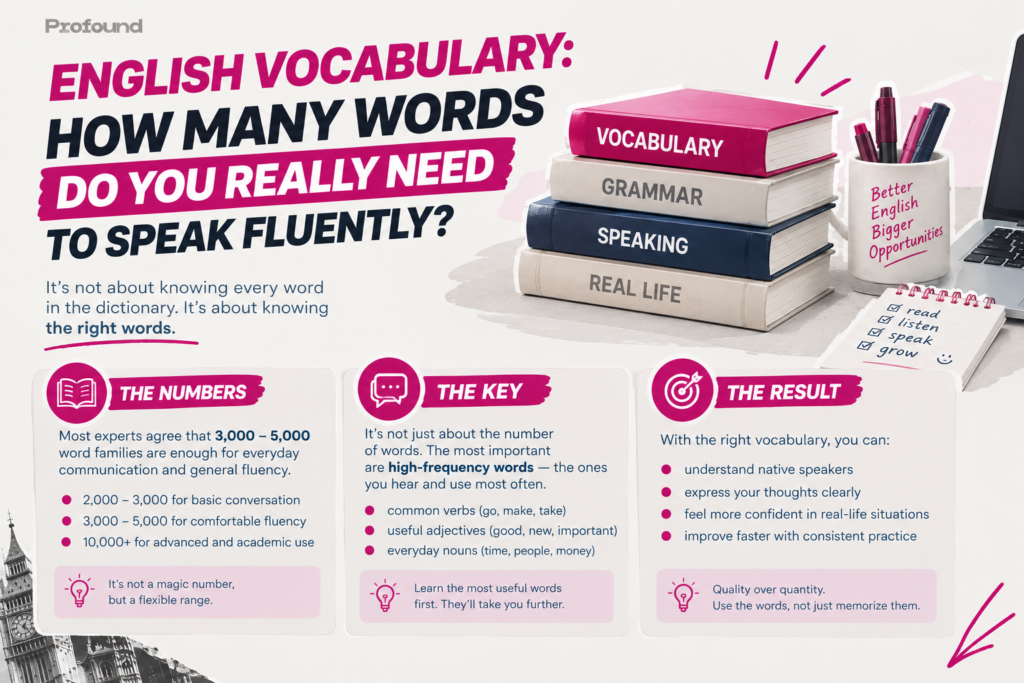
There is no magic number that guarantees fluency. Still, some approximate ranges are useful.
Some vocabulary studies suggest that the most frequent 2,000 to 3,000 word families cover a large share of everyday spoken English. Understanding most conversations, films and podcasts comfortably usually takes more, often somewhere around 5,000 to 7,000 word families. For comparison, educated native speakers are often estimated to know tens of thousands of words, but they do not use anywhere near that many in daily life.
These numbers vary a lot between studies. Researchers count words differently: as individual forms (walk, walks, walked), as word families (walk, walker, walking), or as separate meanings. Treat every figure here as a rough guide.
In practice, comfortable everyday communication in English is possible with a few thousand well-learned words, provided you can recall them quickly and combine them into natural sentences. A learner with 3,000 words they can use will often communicate better than one with 8,000 words they only half recognize.
What Does “Knowing a Word” Actually Mean?
Knowing a word is not a yes-or-no matter. It develops in stages, and a single word can involve several kinds of knowledge:
- Recognizing it: you see reluctant and realize you have met it before.
- Understanding it in context: you can work out its meaning in a sentence.
- Pronouncing it: you know that comfortable is usually said as three or four syllables, not five.
- Grammatical behavior: you know that advice is uncountable (some advice, not an advice) and that interested is followed by in.
- Different meanings: you know that run can mean to move fast, to manage a business (run a shop), or to operate (run a program).
- Using it naturally: you can say or write it without stopping to think.
Most learners “know” thousands of words only at the first or second stage. That is why a person can read an article easily and still struggle to speak. Recognition is only the beginning.
Active vs Passive Vocabulary
Linguists distinguish two kinds of vocabulary.
Passive (receptive) vocabulary is the language you understand when you read or listen. Active (productive) vocabulary is the language you can produce when you speak or write.
Passive vocabulary is almost always larger. Imagine you read this sentence: “The manager postponed the meeting because several colleagues were unavailable.” You understand postponed and unavailable without difficulty. A day later, someone asks why the meeting did not happen, and you answer, “Because… the meeting… was moved… no, not moved… changed to later.” The word postponed was in your passive vocabulary but never became active.
This matters most for speaking, where you have no time to search your memory. Active vocabulary is built by retrieving and using words, not only by seeing them. Saying a new word aloud in your own sentence does more for speaking than reading it five times.
Vocabulary Size by English Level
The Common European Framework of Reference (CEFR) describes what learners can do at each level, from A1 to C2. It does not set an official word count for any level. Published estimates differ between studies, word lists and textbooks.
The table below gives approximate ranges for receptive vocabulary, plus what learners can typically do. Treat the numbers as rough estimates rather than official CEFR requirements.
| Level | Approximate receptive vocabulary (estimate) | What learners can typically do |
| A1 | about 500 to 1,000 words | Introduce themselves, ask and answer very simple questions, handle basic needs with short phrases |
| A2 | about 1,000 to 2,000 words | Talk about routines, family and shopping; describe simple past events; handle short, familiar exchanges |
| B1 | about 2,000 to 3,500 words | Deal with most travel situations, express opinions simply, follow the main points of clear speech |
| B2 | about 3,500 to 5,000 words | Take part in discussions, understand longer texts and films, express ideas with reasonable detail |
| C1 | about 5,000 to 8,000 words | Use language flexibly for work and study, understand implied meaning, express ideas fluently |
| C2 | 8,000 words or more | Understand almost everything and express subtle shades of meaning with precision |
Two cautions apply. First, the number of words you know tells only part of the story, because skills such as listening, grammar and fluency also decide your level. Second, the higher the level, the more the quality of your vocabulary matters: collocations, register (formal or informal), and idiomatic use. For more on how levels are defined, see British Council.
At advanced levels, vocabulary growth goes hand in hand with more complex sentence construction, and exploring Advanced Grammar Structures can help you use sophisticated words accurately.
How Many Words Do You Need for Everyday English?
A surprisingly small core of words covers most daily communication. Think about common situations:
- Introducing yourself: name, job, city, age, languages, interests.
- Family and friends: relationship words, adjectives for character and appearance.
- Shopping: prices, sizes, colors, payment, polite requests.
- Travel: tickets, directions, hotels, delays, asking for help.
- Work and study: tasks, deadlines, meetings, subjects, explanations.
- Food: ingredients, restaurant phrases, preferences.
- Health: symptoms, parts of the body, appointments.
- Hobbies and plans: frequency, invitations, suggestions, agreeing and disagreeing.
- Opinions: I think, in my opinion, I agree, it depends.
What makes this small core powerful is flexibility. A learner who knows verbs such as get, make, take, have, go and put can say hundreds of things: get a ticket, get home, get tired, make a plan, take a taxi, have lunch. Learning how these words combine matters more than adding rare words.
You also need the grammar to place these words in time. Talking about habits and facts relies on the Present Simple, while telling a story about yesterday needs the Past Simple. Vocabulary and grammar work as a team.
Does Knowing More Words Mean You Speak English Fluently?
No. Fluency is the ability to use language effectively and automatically, and vocabulary is only one ingredient. Others include:
- Grammar: knowing words is not the same as building correct sentences. A good overview of English tenses helps you organize what you want to say.
- Pronunciation: a word you cannot pronounce clearly may not be understood, and a word you do not recognize by ear will be missed when you listen.
- Listening comprehension: real speech is fast, linked together and full of reduced sounds.
- Automatic retrieval: fluent speakers do not search for words. They come quickly because they have been used many times.
- Collocations: natural speech depends on words that go together (heavy rain, not strong rain).
- Sentence patterns: reusable frames such as I’d like to…, Would you mind…, It depends on… let you speak without building every sentence from scratch.
- Context and register: knowing when a word sounds friendly, formal or too strong. This includes slang and informal expressions, which change quickly and can sound odd or even rude in the wrong situation. If you want to understand how people really talk today, a look at modern English vocabulary can help you tell what is natural from what is outdated.
- Confidence and experience: speaking regularly reduces hesitation more than any word list.
A learner can know 10,000 words and still be slow in conversation. Another can know 3,000 and communicate smoothly because those words are active, flexible and connected to useful patterns.
What Vocabulary Should You Learn First?
Instead of memorizing a huge list, think in categories. Start with the language you will meet again and again:
- High-frequency verbs: be, have, do, go, get, make, take, give, find, think, want, need, feel, use, work.
- Everyday nouns: time, day, way, thing, place, person, family, money, job, food, home.
- Common adjectives: good, bad, easy, difficult, important, different, ready, busy, tired.
- Question words: what, where, when, why, who, how, which.
- Connectors: and, but, because, so, although, however, then, after that.
- Common adverbs: usually, often, always, already, still, quite, really.
- Functional phrases: Could you repeat that?, What do you mean?, I’m not sure.
- Collocations: make a decision, take a break, get ready, have a look, be interested in.
- Useful sentence patterns: I’m thinking of…, I used to…, It’s worth…
Chunks and phrases often beat isolated words. A chunk is a group of words you store and use as one unit. If you learn take a break as a whole, you do not need to decide in the moment which verb to use with break, which saves time and prevents mistakes.
Words vs Phrases: Why Context Matters
A word learned alone has a translation. A word learned with its partners has a use. Compare:
- decision → make a decision (not do a decision)
- interested → be interested in (not interested of)
- attention → pay attention (not give attention, in most contexts)
- photo → take a photo
- chance → take a chance, have a chance
When you learn decision only as “a choice,” you may know the meaning but still say something unnatural. When you learn make a decision, the correct verb arrives with the noun.
This helps in speaking because retrieval works through connections. When you want to talk about choosing something, one remembered phrase brings the next, and your speech becomes smoother and sounds more natural.
How to Build a Useful English Vocabulary
Here are strategies that work for most learners at any level.
- Learn words in context. Record a word in a short example sentence, not alone.
- Prioritize high-frequency vocabulary. Common words repay your effort far more than rare ones.
- Learn collocations and phrases. Note which words go together.
- Use spaced repetition. Review words at growing intervals (for example after one day, three days, a week), so you revisit them just before you would forget.
- Use new words in your own sentences. Personal sentences are easier to remember than textbook ones: I’m interested in photography beats a random example.
- Read material at the right level. Texts where you understand most words let you meet new ones naturally.
- Listen to natural English. Podcasts, interviews and series show how words sound and combine in real speech.
- Practice retrieval. Cover the answer and try to recall the word or phrase before checking.
- Revisit older vocabulary. Words you learned a month ago need reviewing too.
- Focus on what you need. A nurse, a developer and a student need different words. Build around your own life.
How to Know If Your Vocabulary Is Improving
Your word count is not the best measure. Look for these signs:
- You understand more of what you read without checking a dictionary.
- You follow more of what you hear, including faster speech.
- You find words faster during conversations.
- You can paraphrase a word you do not know (the thing you use to open bottles) and still keep talking.
- You use new vocabulary naturally, not only in exercises.
- You need fewer translations in your head.
- You recognize common collocations and notice when something “sounds wrong.”
Vocabulary growth is about depth and speed as well as quantity. A word you can use confidently counts for more than five you only half recognize.
Common Vocabulary Learning Mistakes
- Memorizing huge lists without context. Words tend to disappear when they have nothing to attach to.
- Learning rare words too early. Words like ubiquitous can wait until the basics are secure.
- Translating every word. This slows both understanding and speaking. Try to link words to meanings, images or situations.
- Ignoring pronunciation. If you do not know how a word sounds, you may not recognize it in speech.
- Learning words but never using them. Unused words stay passive.
- Focusing only on nouns. Verbs, adjectives, adverbs and connectors hold sentences together.
- Ignoring collocations. This leads to correct words in unnatural combinations.
- Forgetting earlier vocabulary. Without review, new words push out old ones.
- Trying to learn too many words at once. Overload usually leads to poor retention.
How Many Words Should You Learn Per Day?
There is no ideal number for everyone. Learning 30 words a day is pointless if you forget 25 of them, while learning 3 words and using them well can be far more effective. Retention and repeated use matter more than a daily target.
Here are a few realistic, sustainable routines:
- Light routine: learn 3 to 5 new words or phrases a day from something you read or heard, and review older ones for five minutes.
- Steady routine: learn about 10 items a day on weekdays, with a weekly review of everything from the past week. Short, regular sessions like this are the idea behind microlearning for English.
- Theme-based routine: choose one topic per week (travel, work, health) and gather 20 to 30 useful words and phrases for it, then use them in speaking or writing over the week.
Choose the routine you can maintain for months, not the one that sounds most impressive.
FAQ
How many English words do I need to speak fluently?
There is no exact figure. Some estimates suggest that a few thousand well-known words cover most everyday conversation, while comfortably understanding a wide range of speech often takes around 5,000 to 7,000 word families. Fluency also depends on grammar, pronunciation and practice.
How many words does an English speaker know?
Estimates for educated native speakers range widely, often from about 20,000 to 35,000 word families, and some studies report higher numbers depending on how a “word” is counted.
Is 5,000 English words enough to be fluent?
It can be enough for comfortable communication in many situations, especially if the words are active and you can combine them naturally. It is not a guarantee of fluency, and you will still meet unfamiliar words.
How many words do I need for B1 English?
A rough estimate is about 2,000 to 3,500 words. This is not an official CEFR requirement, and what you can do with the words matters more than the count.
How many words do I need for B2 English?
A rough estimate is about 3,500 to 5,000 words. At B2, collocations and the ability to discuss abstract topics matter as much as raw size.
What is the difference between active and passive vocabulary?
Passive vocabulary is what you understand when reading and listening. Active vocabulary is what you can use when speaking and writing. Most learners understand more than they can produce.
Can I speak English fluently with a small vocabulary?
You can communicate effectively with a modest vocabulary if you use it flexibly, know common phrases and can paraphrase. Speaking about complex or specialized topics will eventually require more words.
How can I increase my English vocabulary quickly?
Focus on frequent words, learn them in phrases, review with spaced repetition, and use new words in your own speaking and writing. Reading and listening at the right level also help. “Quickly” works best when it means consistently, not cramming.
How many words should I learn a day?
There is no single answer. A small number you review and use is better than a large number you forget. Many learners do well with 3 to 10 new items a day plus regular review.
Final Takeaway
English vocabulary matters, but the number of words you know is only part of the picture. A few thousand carefully learned words can carry you through most everyday situations, while a long list of half-remembered words rarely helps in conversation. What counts is whether you can understand words in context and use them actively, with the right grammar, pronunciation and natural combinations.
Build vocabulary around what you really need, learn words together with their partners, review them regularly, and use them in your own sentences. Fluency grows from words you can retrieve and use, not just words you have seen once.
Learn at your own pace — and enjoy the journey with us!
Error: Contact form not found.

