



You know the grammar rules by heart, yet native speakers still ask you to repeat yourself. The issue usually isn’t vocabulary, its pronunciation. This guide skips the theory and gives you five techniques you can apply tonight, plus a list of resources phonetics teachers actually use.
Table of Contents
- The Role of Pronunciation in Effective International Communication
- Common Pronunciation Errors and How to Fix Them
- Mastering Connected Speech Patterns
- Word Stress and Intonation: The Overlooked Detail
- Daily Drills and the Best Self-Check Tools
- Common Mistakes When Learning Pronunciation Alone
- FAQ
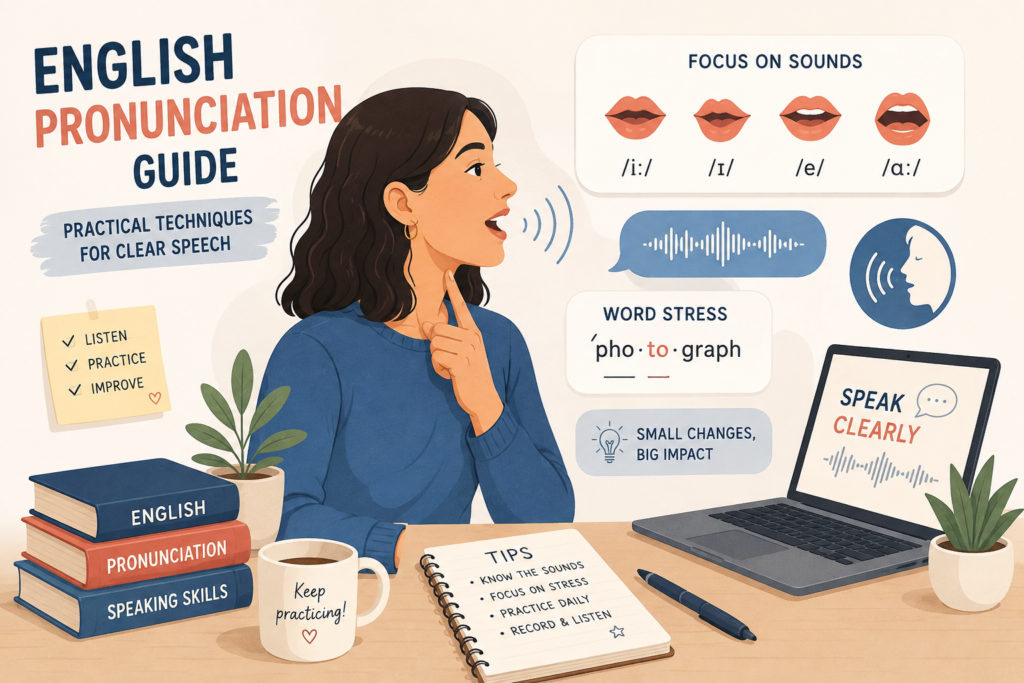
The Role of Pronunciation in Effective International Communication
A listener’s brain can auto-correct a wrong article or a misused tense using context. A wrong sound, however, often turns one word into another and context can’t always save you.
Minimal pairs that break comprehension:
| You said | They heard | What went wrong |
| ship [ʃɪp] | sheep [ʃiːp] | Vowel length |
| very [v] | wery [w] | v/w confusion |
| think [θ] | sink [s] | Interdental th |
| bad [æ] | bed [e] | Vowel openness |
| walk [wɔːk] | work [wɜːk] | Different vowel sound |
Key takeaway: grammar mistakes slow comprehension down; pronunciation mistakes can stop it altogether. From intermediate level onward, it’s worth shifting study time away from endless tense drills and toward phonetics.
A reliable way to check any word’s sound is the International Phonetic Alphabet (IPA), available for every entry in the Cambridge Dictionary, complete with native-speaker audio. Another solid resource is Oxford Learner’s Dictionaries, which lets you compare British and American pronunciation side by side.
Most Common Pronunciation Errors Made by English Learners and How to Fix Them
2.1. The [θ] and [ð] Sounds (th)
Many languages have no equivalent, so learners substitute [s], [z], or [t]. Correct technique:
- Lightly touch the tip of your tongue to the edge of your upper teeth (not fully between them).
- Exhale gently — you should hear a soft hiss, not a sharp “s”.
- Practice pairs: think/sink, three/tree, this/dis, bath/bass.
Quick test: hold a finger in front of your lips — a correct [θ] produces a visible puff of air; [s] doesn’t.
2.2. [v] vs. [w]
- [v] — upper teeth touch the lower lip.
- [w] — lips round into a small circle, teeth don’t touch the lip at all.
Practice: vine/wine, vet/wet, very well, west/vest — exaggerate the lip movement at first.
2.3. The English [r]
Unlike a rolled or trilled [r] in many languages, the English [r] is an approximant: the tongue tip curls back without touching the roof of the mouth. Rolling it is one of the clearest markers of a strong foreign accent.
- In British English, the [r] at the end of a word (car, far) is often silent; in American English, it’s always pronounced. Pick one standard and stay consistent.
2.4. Long vs. Short Vowels ([iː] vs [ɪ], [uː] vs [ʊ])
Ship vs sheep, full vs fool — the difference is both length and vowel quality. Short vowels sit more centrally and relaxed in the mouth; long vowels are more tense and pushed toward the edges of the articulation space.
2.5. Silent Letters and Vowel Reduction
Words like comb, knife, island, and Wednesday contain silent letters. Unstressed syllables collapse into the neutral schwa sound [ə] — the most frequent sound in English. In photograph, for example, only the first syllable is stressed; the rest reduce.
💡 Rule of thumb: an unstressed syllable almost always sounds like [ə], regardless of its spelling.
Mastering Stress, Intonation, and Connected Speech Patterns
Native speakers don’t pronounce words in isolation — they blend them, which is exactly why real conversations sound faster and blurrier than textbook audio.
3.1. Linking
When a word ends in a consonant and the next starts with a vowel, they merge:
- turn off → tur-noff
- an apple → a-napple
- far away → far-r-away (a linking [r] appears)
3.2. Elision
Certain sounds simply disappear in fast speech:
- next day → nex’ day (the [t] drops)
- must be → mus’ be
- friendship → frien’ship
3.3. Assimilation
Sounds shift under the influence of neighboring sounds:
- don’t you → don-chu
- did you → di-jya
- would you → wu-jyu
3.4. Weak Forms
Function words (to, for, of, and, at) are usually reduced to the neutral [ə] sound in natural speech rather than pronounced as spelled. “I want to go”, for instance, often sounds like “I wanna go” in casual speech.
How to practice: pick short subtitled clips from BBC Learning English or lessons on British Council LearnEnglish, listen to one sentence 5–7 times, then shadow it aloud at the speaker’s exact pace.
Word Stress and Intonation: The Overlooked Detail
Many learners ignore stress entirely, even though it often affects comprehension more than individual sounds do.
- Word stress changes meaning: REcord (noun, “a recording”) vs. reCORD (verb, “to record”).
- Sentence stress highlights the meaningfully important word: “I didn’t say she stole the money” (implying someone else did) vs. “I didn’t say she stole the money“ (implying she took something else).
- Intonation signals question type: rising at the end suggests a confirmation question (“You’re coming, right?”), falling suggests a statement or a wh-question.
You can practice stress patterns using Merriam-Webster, which provides audio pronunciation with stress marking for every entry.
Daily 10-Minute Drills to Build Muscle Memory for Correct Sounds
Progress stalls without feedback — your brain gets used to your own version of a sound and stops noticing the error.
A 10–15-minute daily routine:
- Pick 5 sentences on a topic you’re currently studying.
- Listen to a model — search the word on YouGlish (finds it in real YouTube clips) or Forvo (a crowd-sourced native pronunciation dictionary).
- Record yourself on your phone.
- Compare your recording to the model and spot 1–2 concrete differences — no more, or you’ll lose focus.
- Re-record, correcting exactly those points.
For a more structured approach, the free video lessons on Rachel’s English break down American English mouth movements frame by frame.
Do’s and Don’ts
| Don’t | Do |
| Learn 50 new words without checking transcription | Check IPA and audio for every new word immediately |
| Feel embarrassed recording your own voice | Record yourself daily, even just one minute |
| Copy pronunciation from phonetic “spelling” guesses | Rely strictly on IPA transcription |
| Try to fix every sound at once | Focus on 1–2 problem sounds per week |
Bonus: a grammar-checking tool like Grammarly won’t fix your pronunciation, but it removes grammatical guesswork — freeing up mental bandwidth to focus purely on sound.
Common Mistakes When Learning Pronunciation Alone
Even motivated learners often stall for a few predictable reasons:
- Ignoring transcription. Reading words “by eye” locks in wrong sound associations from day one.
- Practicing without an audio model. Without a reference sound, the brain builds its own version of a phoneme that’s harder to unlearn later.
- Chasing perfection too early. Trying to sound “fully native” right away is demotivating; aim for “clear and understandable” instead.
- Inconsistent practice. Ten minutes daily beats two hours once a week — muscle memory forms through repetition, not session length.
- Avoiding self-recording. It’s the single most useful self-correction tool, and skipping it means practicing blind.
FAQ
Can I fully get rid of my accent? Rarely, and it’s not really the goal. A more realistic target is clear, easily understood speech, not a 100% native imitation.
How long does it take to improve pronunciation? With consistent practice (10–15 minutes daily), noticeable changes appear in 4–6 weeks; lasting results typically take 3–4 months.
Should I learn a British or American accent? It doesn’t matter much — what matters is consistency: don’t mix the two within the same word or phrase.
Do movies without subtitles help? Yes, but later in the process. Start with subtitles and slowed-down audio, then gradually remove the support as your ear adapts.

