



You’ve memorized thousands of words and your grammar is solid, yet when a native speaker drops something like “that’s a piece of cake” or “I’m dead serious,” you’re lost. The issue isn’t your vocabulary size, it’s that textbooks teach “correct” but lifeless English. Real conversation runs on idioms, slang, and shortened constructions that classic courses barely touch.
This is a practical reference of expressions that actually show up in conversations, TV shows, and workplace chats in 2026. No filler just examples you can use today.
Table of Contents
- Why Textbook English Vocabulary Sounds Outdated
- 10 Idioms for Work and Casual Conversations
- Top 10 Slang Phrases from Shows and Social Media
- Expressions to Avoid in Formal Settings
- FAQ
Why Textbook English Vocabulary Sounds Outdated
Classic textbooks lean on neutral, “safe” vocabulary that rarely causes misunderstandings but also rarely sounds natural. Native speakers, on the other hand, rely heavily on idioms, fixed expressions whose meaning doesn’t come from the individual words.
Saying “I am very tired” to a coworker is grammatically fine, but it sounds a little textbook-ish. A native speaker is more likely to say “I’m beat” or “I’m running on empty.” The grammatical difference is tiny; the difference in how natural it sounds is huge.
According to British Council guidelines, understanding idiomatic expressions is one of the key markers of Advanced (C1) level and above, since idioms are exactly what gives language its natural “feel.”
10 Idioms for Work and Casual Conversations
These aren’t the textbook classics like “piece of cake” or “break the ice” that everyone already knows. Below are idioms that actually show up in modern work calls, team chats, and everyday conversations among native speakers.
| Idiom | Meaning | Example |
| Read the room | Pick up on the mood/atmosphere and react appropriately | “Maybe don’t joke right now, read the room.” |
| Move the needle | Make a real, measurable impact on a result | “This campaign didn’t really move the needle on sales.” |
| Circle back | Return to a topic later | “Let’s circle back to this after lunch.” |
| Low-hanging fruit | The easiest/quickest tasks or opportunities to tackle first | “Let’s start with the low-hanging fruit before the harder tasks.” |
| Throw someone under the bus | Blame someone else, betray them to protect yourself | “He threw his teammate under the bus during the meeting.” |
| Get your ducks in a row | Get everything organized and prepared in advance | “Get your ducks in a row before the presentation.” |
| Put a pin in it | Temporarily postpone a discussion | “Great idea, let’s put a pin in it for now.” |
| Drop the ball | Fail to do something important, mess up | “Sorry, I dropped the ball on that email.” |
| Boil the ocean | Try to do way too much at once, inefficiently | “We don’t need to boil the ocean, let’s focus on one thing.” |
| The elephant in the room | An obvious problem everyone avoids discussing | “Let’s talk about the elephant in the room, the budget cuts.” |
Tip: Don’t try to memorize all 10 at once. Pick 2–3 idioms a week and deliberately build them into your own sentences, that’s what moves them from passive to active vocabulary.
Top 10 Slang Phrases from Shows and Social Media
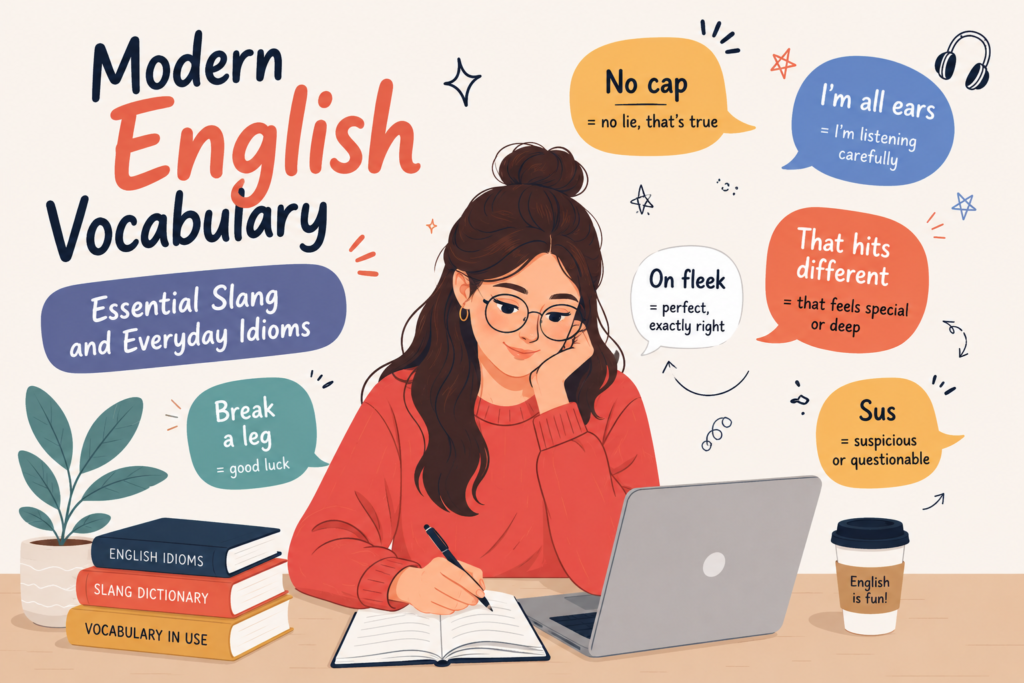
A quick heads-up: slang goes stale faster than any other type of vocabulary. Phrases like “no cap,” “slay,” or “sus” are still understood, but by 2026 native speakers already treat them as a bit overused, sometimes joking about them ironically. Below is a set of terms that are genuinely in active use right now, based on current 2026 language trends.
- Aura / aura points – charisma, coolness, a sense of effortless presence (you can “gain” or “lose” points). “He walked in so calm, that’s aura.”
- Delulu – knowingly indulging in wishful thinking or self-delusion (usually said jokingly). “I think my crush likes me back, I know I’m delulu.”
- Mid – mediocre, unimpressive. “Honestly, the new season was kind of mid.”
- Mogging – outshining someone so much in looks or presence that they fade into the background. “He was mogging everyone at the party.”
- Glazing – excessively and insincerely praising someone. “Stop glazing him, it’s getting awkward.”
- Standing on business – following through on what you said, acting decisively and reliably. “She said she’d finish it by Friday, and she’s standing on business.”
- Unc – a jokey way to call someone out of touch or “acting older” (not necessarily about actual age). “You don’t know that meme? That’s so unc of you.”
- Pop off – to perform impressively or do something attention-grabbing. “Your presentation really popped off today.”
- 404 coded – mentally checked out, not present (a play on the “404 Not Found” error). “It’s Monday, I’m fully 404 coded.”
- Cooked – in serious trouble, done for. “If the client sees this typo, we’re cooked.”
Even Cambridge Dictionary actively tracks these terms, adding new conversational entries to its online dictionary every year clear proof of how fast living language evolves. The most reliable way to stay current is watching short-form video and native comments in real time, not two-year-old “top slang” lists.
Expressions to Avoid in Formal Settings
The most common mistake learners make is carrying slang into situations where it doesn’t belong: interviews, official correspondence, presentations.
| Avoid (informal) | Better (neutral/formal) |
| “That’s sick!” (meaning “cool”) | “That’s impressive.” |
| “Gonna / wanna / gotta” in writing | “Going to / want to / have to” |
| “Yeah, no problem” to a client | “Certainly, that won’t be a problem.” |
| “My bad” | “I apologize for the mistake.” |
| “It’s lit” | “It’s excellent / outstanding.” |
The 20% rule: only use slang when you’re 100% sure of the context. In every other case, neutral vocabulary is safer and always sounds professional. For deeper style guidance, check Grammarly or the style section on Oxford English.
FAQ
Can I use slang in a job interview? No, stick to neutral vocabulary in formal settings. A light idiom or two (like “hit the ground running”) is fine, but obvious slang (“no cap,” “lit”) isn’t.
How many idioms should I learn per week? 3–5 is optimal, as long as you actively use them in your own sentences. Learning more than that usually leads to shallow memorization without real retention.
Does slang vary by country? Yes. British, American, and Australian slang differ significantly. The expressions above lean mostly toward American and general international usage.
How do I check if an expression is still current? Social media (TikTok, Reddit), current TV shows, and online dictionaries with informal/slang tags are the most reliable sources for staying up to date.

