



Understanding English tenses is one of the biggest challenges learners face, and for good reason. Unlike many languages, English uses a combination of verb forms, auxiliary verbs, and time expressions to show not just when something happens, but how it relates to other events in time. This guide breaks down the entire English tense system in a clear, practical way, so you can stop memorizing rules in isolation and start understanding how native speakers actually think about time.
By the end of this article, you will know all 12 main English tenses, how to choose between similar tenses, and how to avoid the mistakes that trip up even advanced learners.
Table of Contents
What Are English Tenses?
A tense is a verb form that tells us when an action happens and how it relates to other actions in time. It is important to separate two ideas that often get confused: time and tense. Time is a universal concept past, present, and future exist regardless of language. Tense, on the other hand, is a grammatical tool, a specific verb form that a language uses to express that time.
This distinction matters because English does not use one tense per time period. Instead, English grammar tenses combine two elements:
- Time past, present, or future
- Aspect simple, continuous (progressive), perfect, or perfect continuous
The aspect tells us more about the nature of the action: whether it is a single completed action, an action in progress, an action connected to another point in time, or an ongoing action with a result.
This is why English has so many ways to talk about the past, present, and future. A learner might ask, “Why do I need four different past tenses?” The answer is that each one answers a slightly different question. Past Simple tells us what happened. Past Continuous tells us what was happening. Past Perfect tells us what had already happened before something else. Once you see tenses as answers to different questions rather than abstract rules, the system becomes much easier to use.
The 12 Main English Tenses
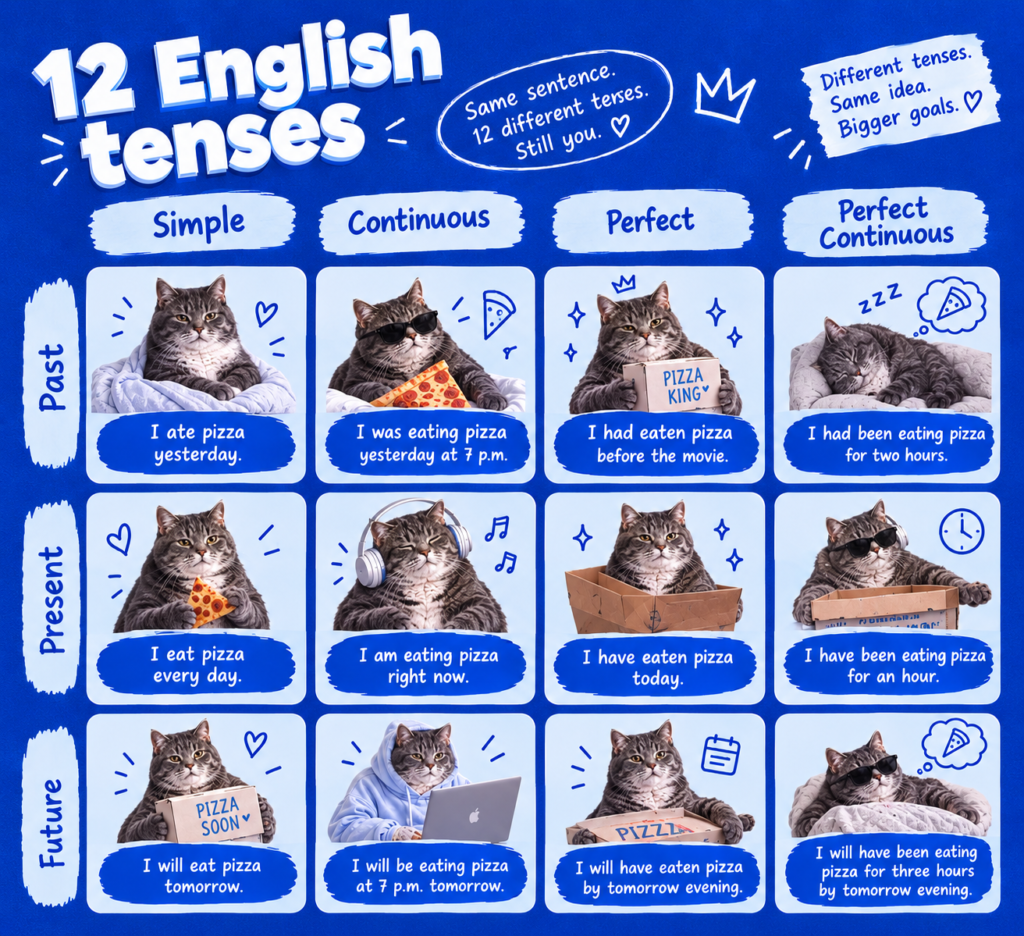
Traditional English grammar organizes the tense system into 12 core forms, divided across three time periods: present, past, and future. Each time period has four aspects: simple, continuous, perfect, and perfect continuous.
Present Tenses
Present Simple
What it is: The basic form of the verb, used for facts, habits, and permanent situations.
When to use it: For general truths, routines, schedules, and repeated actions.
Structure: Subject + base verb (+s/es for he/she/it)
- Positive: She works in a hospital.
- Negative: She doesn’t work on weekends.
- Question: Does she work every day?
Common time expressions: always, usually, often, sometimes, never, every day, on Mondays
Examples: The sun rises in the east. My train leaves at 7:45 every morning.
Common mistake: Learners often use Present Simple for actions happening right now instead of Present Continuous for example, saying “I work on my project now” instead of “I’m working on my project now.”
Present Continuous
What it is: The -ing form of the verb with am/is/are, used for actions in progress.
When to use it: For actions happening right now, temporary situations, and arranged future plans.
Structure: Subject + am/is/are + verb-ing
- Positive: They are discussing the budget.
- Negative: They aren’t discussing the budget yet.
- Question: Are they discussing the budget?
Common time expressions: now, at the moment, currently, this week, these days
Examples: I’m reading a fascinating book at the moment. We’re meeting the client on Thursday.
Common mistake: Using Present Continuous with stative verbs like know, believe, or want (saying “I’m knowing the answer” instead of “I know the answer”).
Present Perfect
What it is: Have/has + past participle, connecting the past to the present.
When to use it: For experiences without a specific time, recent actions with present relevance, and situations that started in the past and continue now. For a deeper look at this tense, see this guide to Present Perfect: Rules, Examples and Common Mistakes.
Structure: Subject + have/has + past participle
- Positive: I have visited Portugal twice.
- Negative: I haven’t visited Portugal this year.
- Question: Have you visited Portugal?
Common time expressions: already, yet, just, ever, never, since, for, so far
Examples: She has finished her report. We have known each other since university.
Common mistake: Using a specific past time marker with Present Perfect, such as “I have seen that film yesterday” instead of “I saw that film yesterday.”
Present Perfect Continuous
What it is: Have/has been + verb-ing, emphasizing the duration of an ongoing action.
When to use it: For actions that started in the past and continue up to now, with a focus on how long. A detailed breakdown is available in this Present Perfect Continuous: A Practical Guide.
Structure: Subject + have/has been + verb-ing
- Positive: He has been working here for six years.
- Negative: He hasn’t been working here for long.
- Question: Has he been working here long?
Common time expressions: for, since, all day, recently, lately
Examples: They have been renovating the kitchen since March. I’ve been trying to reach you all morning.
Common mistake: Using this tense with stative verbs, or confusing it with Present Perfect when the result, not the duration, is the focus.
Past Tenses
Past Simple
What it is: The basic past form of the verb, used for completed actions.
When to use it: For finished actions at a specific point in the past.
Structure: Subject + past form of verb (regular: -ed)
- Positive: We visited Rome last summer.
- Negative: We didn’t visit Rome last year.
- Question: Did you visit Rome last summer?
Common time expressions: yesterday, last week, in 2019, ago, when
Examples: She graduated in 2021. The meeting started at nine o’clock.
Common mistake: Mixing up Past Simple and Present Perfect — for example, saying “I have moved to this city in 2020” instead of “I moved to this city in 2020.”
Past Continuous
What it is: Was/were + verb-ing, describing an action in progress at a specific past moment.
When to use it: For background actions, interrupted actions, and two actions happening simultaneously in the past.
Structure: Subject + was/were + verb-ing
- Positive: I was cooking dinner when the phone rang.
- Negative: I wasn’t cooking dinner at eight.
- Question: Were you cooking dinner at eight?
Common time expressions: while, when, at that moment, all evening
Examples: She was driving to work when she saw the accident. They were arguing while I was trying to concentrate.
Common mistake: Using Past Continuous for a completed sequence of actions instead of Past Simple, such as “I was waking up, was getting dressed, and was leaving” instead of the simple past sequence.
Past Perfect
What it is: Had + past participle, showing an action that happened before another past action.
When to use it: To clarify the order of two past events, showing which one happened first.
Structure: Subject + had + past participle
- Positive: She had left by the time I arrived.
- Negative: She hadn’t left when I arrived.
- Question: Had she left before you arrived?
Common time expressions: already, before, after, by the time, never
Examples: He had finished the project before the deadline. We had never seen such a storm before that night.
Common mistake: Using Past Perfect when the order of events is already clear from context or from words like “before” and “after,” which can make the sentence unnecessarily complex.
Past Perfect Continuous
What it is: Had been + verb-ing, emphasizing the duration of an action before another past event.
When to use it: For an ongoing action that continued up to a specific point in the past, often explaining a cause.
Structure: Subject + had been + verb-ing
- Positive: They had been waiting for an hour when the bus finally came.
- Negative: They hadn’t been waiting long when the bus came.
- Question: Had they been waiting long?
Common time expressions: for, since, before
Examples: She had been studying French for years before she moved to Paris. I was tired because I had been working all night.
Common mistake: Confusing this with Past Perfect when duration, rather than simple completion, is the point being made.
Future Tenses
Future Simple
What it is: Will + base verb, used for predictions, spontaneous decisions, and promises. This tense is often compared with other forms in Future Simple vs Going to.
When to use it: For future facts, predictions without evidence, and decisions made at the moment of speaking.
Structure: Subject + will + base verb
- Positive: I will call you tomorrow.
- Negative: I won’t call you tonight.
- Question: Will you call me tomorrow?
Common time expressions: tomorrow, next week, soon, in the future
Examples: The company will launch the product next month. I think it will rain later.
Common mistake: Using “will” for plans that have already been arranged, where “be going to” or Present Continuous fits better.
Future Continuous
What it is: Will be + verb-ing, describing an action in progress at a specific future time.
When to use it: For actions that will be happening at a particular moment in the future, or for polite questions about plans.
Structure: Subject + will be + verb-ing
- Positive: This time tomorrow, I will be flying to Berlin.
- Negative: I won’t be working next Friday.
- Question: Will you be using the car this evening?
Common time expressions: at this time tomorrow, next week, by then
Examples: She will be presenting her research at the conference. We’ll be traveling when you arrive.
Common mistake: Using Future Simple instead of Future Continuous when describing an action in progress at a specific future moment, which changes the meaning slightly.
Future Perfect
What it is: Will have + past participle, showing an action that will be completed before a specific future time.
When to use it: To describe something that will already be finished by a certain point in the future.
Structure: Subject + will have + past participle
- Positive: By next year, I will have finished my degree.
- Negative: I won’t have finished the report by Friday.
- Question: Will you have finished the report by Friday?
Common time expressions: by, by the time, before, by next year
Examples: They will have completed the renovation by December. She will have saved enough money by the summer.
Common mistake: Forgetting the “have” and saying “will finished” instead of “will have finished.”
Future Perfect Continuous
What it is: Will have been + verb-ing, emphasizing the duration of an action up to a specific future point.
When to use it: For an action that will continue up until a certain moment in the future, focusing on duration.
Structure: Subject + will have been + verb-ing
- Positive: By June, I will have been working here for ten years.
- Negative: By June, I won’t have been working here for very long.
- Question: Will you have been working here for ten years by June?
Common time expressions: by, for, by the time
Examples: She will have been studying English for five years by the time she takes the exam. We will have been living here for a decade next spring.
Common mistake: Using this tense unnecessarily in everyday speech, where Future Perfect or Future Continuous is usually more natural and simpler.
English Tenses Chart
This English tenses chart summarizes all 12 tenses at a glance. Use it as a quick reference whenever you need to check a structure or usage.
| Tense | Structure | Main Use | Example |
| Present Simple | verb (+s/es) | Facts, habits, routines | She teaches English. |
| Present Continuous | am/is/are + verb-ing | Actions happening now | He is cooking dinner. |
| Present Perfect | have/has + past participle | Past action with present relevance | I have lost my keys. |
| Present Perfect Continuous | have/has been + verb-ing | Ongoing action, focus on duration | We have been talking for hours. |
| Past Simple | past form of verb | Completed past action | They arrived on Monday. |
| Past Continuous | was/were + verb-ing | Action in progress in the past | I was sleeping at midnight. |
| Past Perfect | had + past participle | Action before another past action | She had left before I called. |
| Past Perfect Continuous | had been + verb-ing | Ongoing action before a past event | He had been driving for hours. |
| Future Simple | will + base verb | Predictions, spontaneous decisions | It will snow tonight. |
| Future Continuous | will be + verb-ing | Action in progress in the future | I will be traveling next week. |
| Future Perfect | will have + past participle | Action completed before a future point | We will have finished by noon. |
| Future Perfect Continuous | will have been + verb-ing | Duration up to a future point | She will have been working here for a decade. |
Present Tenses: How to Choose the Right One
Present Simple vs Present Continuous
The key question is: is this a routine, or is it happening right now? For a closer comparison with examples, see Present Continuous vs Present Simple.
- “I usually walk to work” (a habit) versus “I’m walking to work right now” (happening at this moment).
- “The shop closes at nine” (a fact or schedule) versus “The shop is closing early today because of the holiday” (a temporary change).
Present Perfect vs Present Perfect Continuous
Both tenses connect the past to the present, but they answer different questions. Present Perfect often focuses on the result or the fact that something happened, while Present Perfect Continuous focuses on the duration or the process itself.
- “I have written three emails this morning” (focus on the completed result, and how many).
- “I have been writing emails all morning” (focus on the ongoing activity and how long it has taken).
Past Tenses: How to Choose the Right One
Past Simple vs Past Continuous
Past Simple describes a completed, often short action, while Past Continuous sets the scene or describes something in progress, frequently interrupted by a Past Simple action.
- “I was watching a movie when the power went out.” The continuous action (watching) was interrupted by the simple action (went out).
Past Simple vs Present Perfect
This is one of the most common areas of confusion for learners. Use Past Simple when the time is finished or specific. Use Present Perfect when the time is unfinished, unspecified, or when the result still matters now. This comparison is explored in more depth in Present Perfect vs Past Simple.
- “I saw that documentary last week” (specific, finished time Past Simple).
- “I have seen that documentary” (no specific time, relevant experience Present Perfect).
Past Perfect vs Past Simple
Use Past Perfect only when you need to make clear that one past action happened before another. If the sequence is already obvious, Past Simple alone is often more natural.
- “When I arrived, the meeting had already started” (arrival and start are two separate past points, and the start came first).
- “When I arrived, the meeting started” (this instead suggests the meeting started right as I arrived).
Past Perfect vs Past Perfect Continuous
Past Perfect focuses on completion before a past point; Past Perfect Continuous focuses on the duration of an action leading up to that point.
- “She had read the whole book by the time the film came out” (completed action).
- “She had been reading for three hours when I called” (ongoing action, focus on duration).
Future Tenses: How to Choose the Right One
English does not have a single dedicated future tense the way it has past tense forms. Instead, it uses several structures depending on the type of future meaning intended.
Will is typically used for predictions without strong evidence, promises, offers, and decisions made at the moment of speaking. Be going to, by contrast, is generally used for plans that have already been decided and for predictions based on present evidence. For a full comparison, see Future Simple vs Going to.
- “I think our team will win” (a prediction, no strong evidence).
- “Look at those clouds, it’s going to rain” (a prediction based on visible evidence).
- “We’re going to open a new office next year” (an already-made plan).
Future Continuous is useful for describing what will be in progress at a specific future moment, or for asking about someone’s plans in a polite, non-intrusive way (“Will you be using the printer this afternoon?”).
Future Perfect and Future Perfect Continuous are less common in everyday conversation but essential for describing what will be finished, or how long something will have continued, by a specific point in the future. They appear frequently in business and academic English, particularly around deadlines and milestones.
It’s worth remembering that English also expresses future meaning through Present Continuous (for fixed arrangements, such as “I’m flying to Madrid on Friday”) and Present Simple (for schedules and timetables, such as “The train departs at 6 p.m.”). Recognizing these patterns is part of mastering how to use English tenses naturally, rather than relying only on “will.”
Common English Tense Mistakes
Incorrect: “I am living here since 2015.”
Correct: “I have been living here since 2015.”
Stative or ongoing situations connected to the present generally require Present Perfect or Present Perfect Continuous, not Present Continuous, when paired with “since.”
Incorrect: “She has gone to Paris last year.”
Correct: “She went to Paris last year.”
A specific past time marker like “last year” cannot be combined with Present Perfect; it requires Past Simple.
Incorrect: “By the time we got there, the film already started.”
Correct: “By the time we got there, the film had already started.”
When one past action happens before another, the earlier action needs Past Perfect to show the correct sequence.
Incorrect: “I will finishing the report by Friday.”
Correct: “I will have finished the report by Friday.”
Future Perfect requires “have” plus the past participle, not the -ing form.
Incorrect: “He is knowing the answer.”
Correct: “He knows the answer.”
Stative verbs such as know, believe, understand, own, and prefer are rarely used in continuous forms because they describe states, not actions in progress.
How to Learn English Tenses More Easily
Memorizing formulas is only the first step. To actually use English tenses confidently, try these strategies:
- Learn tenses through context, not isolation. Read or listen to real English and notice which tense is used and why, rather than studying grammar tables alone.
- Compare similar tenses side by side. When two tenses seem close in meaning, like Past Simple and Present Perfect, study them together so the contrast becomes clear.
- Practice with real, personal sentences. Instead of generic textbook examples, write sentences about your own life, week, or plans.
- Pay close attention to time expressions. Words like since, for, already, yet, and by the time are strong signals for which tense to use.
- Create your own examples regularly. Producing language, not just recognizing it, is what builds lasting fluency.
- Practice speaking and writing consistently. Tenses become automatic through repeated use, not through repeated review of rules.
- Review your mistakes instead of only memorizing formulas. Keep a small log of tense errors you make and revisit it. Patterns in your mistakes usually reveal exactly what to focus on next.
According to the Cambridge Dictionary grammar reference, consistent exposure to authentic examples is one of the most effective ways to internalize verb tense usage over time.
FAQ
How many tenses are there in English?
Traditional grammar describes 12 main tenses, covering present, past, and future, each with simple, continuous, perfect, and perfect continuous forms.
What are the 12 English tenses?
Present Simple, Present Continuous, Present Perfect, Present Perfect Continuous, Past Simple, Past Continuous, Past Perfect, Past Perfect Continuous, Future Simple, Future Continuous, Future Perfect, and Future Perfect Continuous.
Which English tense should I learn first?
Present Simple and Past Simple are usually the best starting points, since they cover the most common everyday situations and form the foundation for the other tenses.
What is the difference between Present Perfect and Past Simple?
Present Perfect connects a past action to the present and is used without a specific time, while Past Simple describes a completed action at a specific, finished point in time.
What is the easiest way to learn English tenses?
Studying tenses in context, comparing similar forms, and practicing with your own sentences tends to work better than memorizing formulas alone.
Are “will” and “going to” the same?
Not exactly. “Will” is common for predictions without evidence and spontaneous decisions, while “be going to” is used for pre-existing plans and predictions based on visible evidence.
Do native speakers use all 12 tenses equally?
No. Present Simple, Past Simple, Present Continuous, and Present Perfect are used far more often in everyday speech, while forms like Future Perfect Continuous appear mainly in more formal or specific contexts.
Conclusion
The English tense system can feel overwhelming at first, but it becomes far more manageable once you stop thinking of it as 12 separate rules to memorize. Every tense exists to answer a specific question about time: is this finished or ongoing, is it connected to now, does it come before or after another event? When you focus on understanding why a tense is used in a given context, rather than only its formula, your English will start to sound natural rather than mechanical. Keep practicing with real examples, review the comparisons in this guide whenever you’re unsure, and the English tenses will gradually become second nature.

