



English articles are among the smallest words in the language, yet they cause some of the biggest problems for learners. Many languages, including Ukrainian and Polish, have no articles at all, so there is no habit to rely on. Even advanced students sometimes write “I have car” or “She is engineer” without noticing.
The good news is that English articles follow logical principles. The choice between a, an, the and no article depends on a few questions. Are we talking about something general or something specific? Does the listener already know which thing we mean? Is this the first time we mention it? Is the noun countable? This guide explains the rules in plain English, shows how they work in real sentences, and gives you exercises with an answer key so you can practise.
Table of Contents
- What Are Articles in English?
- A and An: Indefinite Articles
- A vs An: Quick Comparison
- The: The Definite Article
- When NOT to Use an Article: The Zero Article
- A, An, The or No Article? A Simple Decision Guide
- Common Mistakes with English Articles
- Difficult Cases and Exceptions
- How Articles Change Meaning
- English Articles: Practice Exercises
- Answer Key
- Quick Summary
- FAQ
What Are Articles in English?
Articles are short words that come before a noun (or before an adjective + noun) and show whether the noun is specific or not. In English grammar, articles belong to a larger group called determiners, along with words such as this, my and some.
English has three types of article:
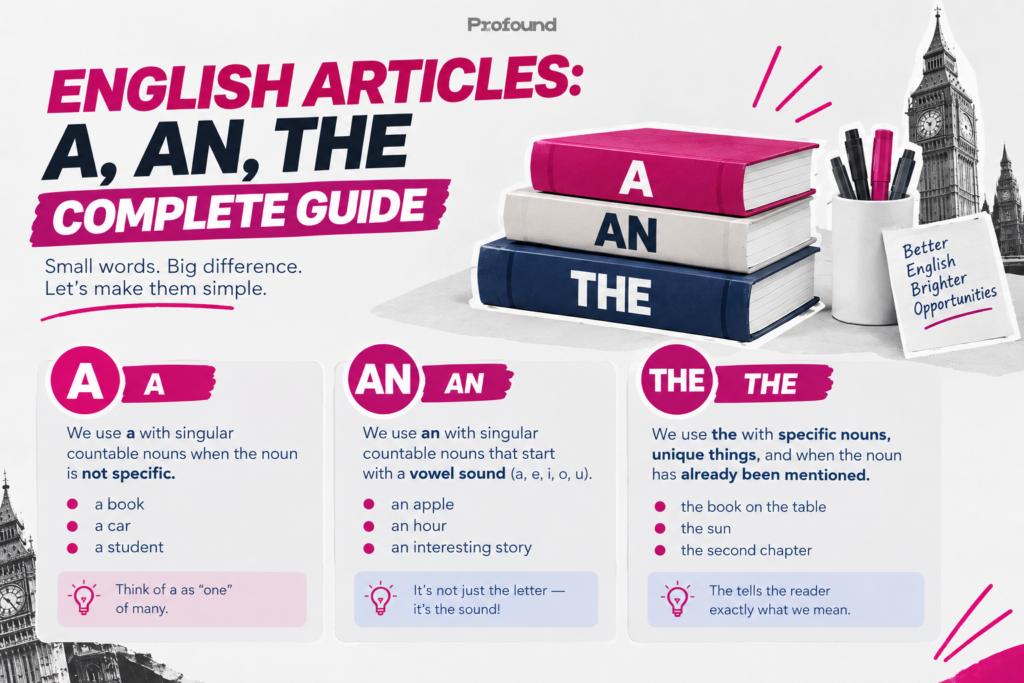
- Indefinite articles: a and an. We use them with singular countable nouns when the noun is not specific: a teacher, an idea.
- Definite article: the. We use it when the listener or reader knows exactly which person or thing we mean: the teacher (the one we both know).
- Zero article: no article at all. We use no article with plural and uncountable nouns in a general sense, and in many fixed expressions: Teachers work hard. I like music.
Why does English need articles? Because they carry information. Compare these two sentences:
- I saw a doctor yesterday. (Any doctor, and it is new information for you.)
- I saw the doctor yesterday. (The doctor we both know about, for example my family doctor.)
The nouns are the same, but the meaning is different. Ukrainian shows this difference through word order, context and words like “один” or “той”, while English uses articles. Once you learn to ask “is this specific for both of us?”, most article choices become much easier.
A and An: Indefinite Articles
We use a and an when we talk about one person, thing or idea that is not specific. Usually this means one example from a group, or something we mention for the first time. The listener does not need to know which one.
Two rules apply to both:
- They are used only with singular countable nouns. We say a book, but not a books or a water.
- A and an are two forms of the same article, and the difference between them is purely about sound.
When to Use A
Use a before a word that starts with a consonant sound.
- She bought a new phone. (first mention, any phone)
- I need a pen. (any pen will do)
- He is a doctor. (a profession)
- We live in a small town.
- It was a great idea.
We also use a to say what someone or something is, including professions and descriptions: My brother is a pilot. This is a difficult question.
It can also mean “per” in expressions of frequency and price: twice a week, ten euros a kilo.
When to Use An
Use an before a word that starts with a vowel sound.
This is the key point: the rule depends on sound, not spelling. English has five vowel letters (a, e, i, o, u), but what matters is the first sound you hear.
- an apple (vowel sound /æ/)
- an egg
- an umbrella
- an hour (the letter h is silent, so the word begins with the vowel sound /aʊ/)
- an honest person (silent h again)
- a university (begins with the consonant sound /j/, as in “you”)
- a European country (begins with /j/)
- a useful book (begins with /j/)
- an unusual story (vowel sound /ʌ/)
This is why “an university” is incorrect, even though university starts with the letter U. The word is pronounced “you-ni-VER-si-tee”, so it starts with the consonant sound /j/. We say a university, in the same way that we say a year or aunit.
The same logic works with abbreviations, because you follow the sound of the first letter as it is spoken:
- an MBA (pronounced “em-bee-ay”)
- an FBI agent (“ef-bee-eye”)
- a UN report (“you-en”)
The rule also applies to the word right after the article. If an adjective comes first, choose the article by the adjective:
- a car, but an old car
- an idea, but a great idea
- an orange, but a big orange
A vs An: Quick Comparison
| Word | First sound | Article | Example |
| apple | vowel | an | I ate an apple. |
| book | consonant | a | She lost a book. |
| hour | vowel (h is silent) | an | We waited for an hour. |
| house | consonant | a | They bought a house. |
| honest | vowel (h is silent) | an | He is an honest man. |
| university | consonant /j/ | a | She studies at a university. |
| umbrella | vowel | an | Take an umbrella. |
| European | consonant /j/ | a | Spain is a European country. |
| MBA | vowel (em) | an | He has an MBA. |
| one-hour | consonant /w/ | a | It was a one-hour lesson. |
Note that the word one begins with the sound /w/, which is a consonant sound, so we say a one-hour lesson and a once-in-a-lifetime chance.
The: The Definite Article
We use the when the listener or reader can identify exactly which person or thing we mean. It works with singular, plural and uncountable nouns. Ask yourself: “Do we both know which one I am talking about?” If the answer is yes, use the.
Pronunciation: the is usually pronounced /ðə/ before a consonant sound (the book) and /ðiː/ before a vowel sound (the apple).
Something mentioned before
The first time we introduce something, we use a/an. After that, both people know which one we mean, so we use the.
- I bought a jacket and a scarf. The jacket was expensive, but the scarf was cheap.
- There is a café near my office. The café serves excellent coffee.
Something clear from the situation
Sometimes we have not mentioned the thing before, but the situation makes it obvious.
- Could you close the door, please? (the door in this room)
- I’m going to the supermarket. (the one we usually use)
- The kitchen is on the left. (the kitchen in this house)
Something made specific by extra information
A phrase or clause after the noun can make it specific.
- The book on the table is mine.
- The woman who called you this morning is my aunt.
- The city where I was born is very small.
Unique things
We use the for things that are the only one of their kind in our world or context.
- The sun, the moon, the sky, the earth, the world
- The internet, the environment
- The president, the prime minister (in a given country)
- The capital of France is Paris.
Superlatives, ordinal numbers and similar words
- She is the best student in the class.
- It was the most interesting film I’ve seen this year.
- This is the first time I’ve been to Berlin.
- Take the second street on the right.
- We use the same word with the only, the next, the last: He was the only person who knew. See you the next day.
Geographical names
Rules for geographical names cause many mistakes, so here is a short guide. Use the with:
- rivers: the Thames, the Dnipro, the Nile
- seas and oceans: the Black Sea, the Atlantic Ocean
- mountain ranges: the Alps, the Carpathians
- groups of islands: the Canary Islands, the Bahamas
- deserts: the Sahara
- countries whose names are plural or include words like republic, kingdom, states: the Netherlands, the Philippines, the United Kingdom (the UK), the United States (the US), the Czech Republic
Most single countries, cities, continents, lakes and individual mountains take no article (see the next section).
Some organisations and institutions
We often use the with organisations, public services and some buildings.
- the police, the government, the army, the United Nations, the BBC
- the cinema, the theatre, the bank, the post office (as the ones in your town or life)
Example: I’m going to the cinema tonight. We say this even when there are several cinemas, because we mean the general idea of the place we go to.
Musical instruments
When we talk about playing an instrument, we normally use the.
- She plays the piano.
- He learned to play the guitar as a teenager.
In everyday American English you may also hear “play guitar” without an article, especially in casual speech or when talking about a profession or band role. Both are acceptable, but “play the + instrument” is the safest form for learners.
Groups of people
The + adjective can refer to a whole group of people.
- The rich should pay more tax.
- We must help the elderly.
- The unemployed need support.
We also use the with nationalities that end in -sh, -ch, -ese or that are plural: the English, the French, the Chinese, theUkrainians.
Other useful cases
- Decades and periods: the 1990s, the Middle Ages
- Time expressions: in the morning, in the afternoon, in the evening (but at night)
- the past, the present, the future
- Names with of: the University of Oxford, the Bank of England (compare Oxford University, which usually has no article)
When NOT to Use an Article: The Zero Article
The zero article means we use no article at all. It is very common, and knowing when to leave the article out is as important as knowing when to add one.
Plural nouns used in a general sense
- Dogs need regular exercise.
- Teachers often work late.
- I love mountains.
Uncountable nouns used in a general sense
- Water is essential for life.
- Music helps me relax.
- Information is easy to find online.
- Honesty is important in a friendship.
Languages
- She speaks Ukrainian, English and Polish.
- French is difficult for me.
We do use the when the word language follows: the English language.
School subjects
- I’m studying biology and history.
- Mathematics was my favourite subject.
Meals
- What time do you have breakfast?
- We usually eat dinner at seven.
But if we describe a particular meal, we use an article: We had a wonderful dinner. The dinner at the hotel was excellent.
Sports and games
- He plays football every weekend.
- She is good at tennis and chess.
Most countries, cities and continents
- I live in Ukraine. She works in Kraków. We travelled across Asia.
Exceptions are the plural or “union” names listed earlier (the Netherlands, the UK, the US).
Days, months and most holidays
- The meeting is on Monday. My birthday is in June. We celebrate Christmas with the family.
People’s names
- Anna is my colleague. Mr Brown called you.
Places used for their main purpose
When we talk about the main purpose of a place, not the building itself, we often use no article: school, university, college, hospital, prison, church, bed, work, home.
- The children are at school. (they are students there)
- He is in hospital. (British English: he is a patient)
- She goes to church on Sundays. (to pray)
- I go to bed at eleven.
- He is at work.
If we mean the physical building or a different purpose, we use the: I went to the school to speak to the teacher. (I am not a student, I am visiting the building.)
Same word, different meaning
Compare these pairs to see how the meaning changes.
| Sentence | Meaning |
| I like coffee. | Coffee in general (uncountable). |
| I’d like a coffee. | One cup of coffee, ordering it. |
| Children need sleep. | Children in general. |
| The children in this room are tired. | Specific children, the ones here. |
| I go to school. | I am a student. |
| I went to the school to speak to the teacher. | I visited the building for another reason. |
In the first sentence of each pair the noun is general or its main purpose matters. In the second, the noun is specific, known or counted.
For more about habitual actions such as I go to school every day, see Present Simple: Understand the Most Popular Tense in English.
A, An, The or No Article? A Simple Decision Guide
When you are unsure, ask these questions in order.
- Is it a proper name? A person, a city, most countries, a day, a month: usually no article (Anna, Paris, Monday). Check special groups such as rivers, seas and plural countries, which take the.
- Is it a language, a school subject, a meal or a sport? Usually no article (English, physics, lunch, tennis).
- Is the noun plural or uncountable? If you speak in general, use no article. If you mean specific ones, use the.
- Is the noun singular and countable? Then it cannot stand alone. It needs a/an, the, or another determiner such as my or this.
- Do both speaker and listener know which one? (It was mentioned before, it is unique, or the situation makes it clear.) Use the.
- Is it one non-specific example, a first mention or a profession? Use a before a consonant sound and an before a vowel sound.
Here is the same guide as a table.
| Type of noun | General or new | Specific or known |
| Singular countable | a / an (a car) | the (the car) |
| Plural countable | no article (cars) | the (the cars) |
| Uncountable | no article (water) | the (the water in this bottle) |
| Proper names, languages, subjects, meals, sports | no article | usually still no article (with exceptions) |
Practical tip: when you write, read each noun and ask “Which one?” If the reader can answer, use the. If the answer is “any one” or “one of many”, use a/an. If you are speaking about the whole category, use no article.
Common Mistakes with English Articles
Here are ten realistic mistakes with corrections.
1. Missing a/an before a singular countable noun
- Incorrect: I have car.
- Correct: I have a car.
- Explanation: Car is singular and countable, so it needs an article or another determiner (my car).
2. Missing an article with professions
- Incorrect: She is engineer.
- Correct: She is an engineer.
- Explanation: We use a/an to say what someone’s job is. Also note that engineer starts with a vowel sound, so we use an.
3. Using the when speaking generally
- Incorrect: The life is difficult.
- Correct: Life is difficult.
- Explanation: We mean life in general, so no article is needed. We would say The life of a student can be difficultbecause the phrase makes it specific.
4. Using the with plural nouns in general statements
- Incorrect: I like the dogs.
- Correct: I like dogs.
- Explanation: If you like dogs as a category, use no article. I like the dogs means specific dogs, for example the dogs we can both see.
5. Confusing a and an
- Incorrect: He bought a orange.
- Correct: He bought an orange.
- Explanation: Orange begins with a vowel sound, so we use an.
6. Using an because of spelling instead of sound
- Incorrect: She studies at an university.
- Correct: She studies at a university.
- Explanation: University begins with the sound /j/, which is a consonant sound. The same goes for a European cityand a useful tool.
7. Using a with an uncountable noun
- Incorrect: I need an advice.
- Correct: I need some advice. / I need a piece of advice.
- Explanation: Advice is uncountable in English, so it cannot take a/an or a plural form. Other common examples are information, news, furniture, luggage, homework.
8. Adding an unnecessary the
- Incorrect: I live in the Ukraine.
- Correct: I live in Ukraine.
- Explanation: Most countries take no article. Compare the Netherlands and the United Kingdom, which do take the.
9. Forgetting the with plural or “union” country names and other special geographical names
- Incorrect: They are travelling to Netherlands.
- Correct: They are travelling to the Netherlands.
- Explanation: Plural names, rivers, seas and mountain ranges normally take the: the Alps, the Black Sea, the Danube.
10. Using the with school/work/home when talking about their main purpose
- Incorrect: My daughter goes to the school every day. (meaning she is a pupil)
- Correct: My daughter goes to school every day.
- Explanation: Use no article when you talk about school as an activity or institution you attend. The school means a specific building.
11. Using an article with sports and instruments incorrectly
- Incorrect: He plays the football and a guitar.
- Correct: He plays football and the guitar.
- Explanation: Sports take no article. Instruments usually take the.
12. Forgetting the after first mention
- Incorrect: I bought a book and a pen. Book was interesting.
- Correct: I bought a book and a pen. The book was interesting.
- Explanation: After the first mention, the noun is known to both people, so we use the.
Difficult Cases and Exceptions
Here are the cases learners meet most often.
A university / an hour
Choose by sound: a university, a useful app, a one-day trip; an hour, an honest answer, an heir. The spelling is not the guide.
A European country / an English teacher
European starts with /j/, so we say a European country. English starts with a vowel sound, so we say an English teacher. Notice that an English teacher can mean either a teacher from England or a teacher of English.
The UK / the United States / the Netherlands
Names that are plural (the Netherlands, the Philippines) or include a word like kingdom, states, republic, union (the UK, the US, the Czech Republic, the European Union) take the. Most other countries do not (Germany, Japan, Ukraine).
Mount Everest / the Alps
A single mountain has no article: Mount Everest, Mount Etna, Hoverla. A mountain range takes the: the Alps, the Andes, the Carpathians.
Lake Baikal / the Black Sea
Lakes usually have no article: Lake Baikal, Lake Geneva, Lake Superior. Seas, oceans and rivers take the: the Black Sea, the Pacific, the Thames.
Go to school / go to the school
- The children go to school by bus. They are pupils, so we talk about the activity of going to school.
- I went to the school to speak to the teacher. I am not a pupil, I visited the building.
The same idea works with university, hospital, prison, church, work and bed.
Be in bed / sit on the bed
- He is in bed with a cold. This means he is resting or sleeping.
- She is sitting on the bed. This means the piece of furniture.
At home / at the house
- I’m at home. This is my home, in the general sense.
- We met at the house last week. This means a specific house or building.
Play football / play the piano
Sports take no article (play football, play chess), but musical instruments usually take the (play the violin, play the drums).
A note on British and American English: some expressions differ. British speakers say in hospital (as a patient), while American speakers usually say in the hospital. Both are correct in their own variety.
How Articles Change Meaning
Changing one small word can change the meaning of the whole sentence. Study these pairs.
“I have a dog.” / “I have the dog.”
- I have a dog. I own a dog. This is new information.
- I have the dog. A specific dog we both know about, for example the dog you were looking for. The listener knows which dog.
“She is at school.” / “She is at the school.”
- She is at school. She is a student and is attending classes.
- She is at the school. She is at the building, perhaps as a visitor, a parent or a teacher.
“I like coffee.” / “I’d like a coffee.”
- I like coffee. I enjoy coffee in general.
- I’d like a coffee. I want one cup now, for example in a café.
“Life is difficult.” / “The life of a student can be difficult.”
- Life is difficult. Life in general, as an idea.
- The life of a student can be difficult. A specific type of life, defined by the phrase “of a student”.
“He is a teacher.” / “He is the teacher.”
- He is a teacher. This is his job.
- He is the teacher. He is the specific teacher of this class or group, the one we mean.
“I saw a film.” / “I saw the film.”
- I saw a film. Any film, and I am mentioning it for the first time.
- I saw the film. The film we were discussing, or the one you recommended.
In every pair, a/an or no article signals general or new information, and the signals specific information that both people can identify.
English Articles: Practice Exercises
Try the exercises before you look at the answer key.
Part A. Fill in a, an, the, or leave the space blank (write X).
- I bought ___ umbrella and ___ jacket yesterday.
- ___ moon was very bright last night.
- My sister is ___ engineer.
- She plays ___ guitar and ___ tennis.
- We had ___ lunch at ___ café near my office.
- ___ Nile is longer than ___ Danube.
Part B. Choose the correct option.
- I’d like (a / the / X) coffee, please.
- (Children / The children) in my class are very friendly.
- He works for (a / an / the) European company.
- We live in (the / X) Netherlands.
- She goes to (school / the school) by bus every morning.
- Yesterday I went to (school / the school) to talk to my son’s teacher.
Part C. Correct the mistake in each sentence.
- She is best student in our group.
- I need an advice about my visa.
- I saw a man and a woman. Man was carrying a bag.
- He has been waiting for a hour.
Part D. Complete the short texts.
- Last week I bought ___ laptop. ___ laptop is very fast, but ___ battery is weak.
- Yesterday I visited ___ museum in ___ Paris. ___ museum was ___ old building near ___ Seine.
- “Where is Anna?” “She’s at (hospital / the hospital) visiting her grandfather.”
Answer Key
Part A
- an, a. An umbrella begins with a vowel sound. A jacket begins with a consonant sound. Both are first mentions.
- The. There is only one moon, so it is unique.
- an. We use a/an with professions, and engineer begins with a vowel sound.
- the, X. Musical instruments usually take the (the guitar), and sports take no article (tennis).
- X, a. Lunch is a general meal and takes no article. A café is any café near my office, mentioned for the first time.
- The, the. Rivers take the.
Part B
- a. I’d like a coffee means one cup, and we are ordering it.
- The children. The sentence talks about specific children, the ones in my class.
- a. European begins with the consonant sound /j/.
- the. The Netherlands is a plural country name and takes the.
- school. She is a pupil, so we use the zero article.
- the school. I am visiting the building for a different purpose, not as a pupil.
Part C
- She is the best student in our group. A superlative takes the.
- I need some advice (or a piece of advice) about my visa. Advice is uncountable.
- I saw a man and a woman. The man was carrying a bag. The man was mentioned before.
- He has been waiting for an hour. The letter h is silent, so the word begins with a vowel sound. For present perfect forms like has been waiting, see Present Perfect: Rules, Examples and Common Mistakes.
Part D
- a, The, the. A laptop is a first mention. The laptop is now known. The battery is clear because it belongs to that laptop.
- a, X, The, an, the. A museum is a first mention, Paris is a city name with no article, the museum is now known, an old building begins with a vowel sound, and the Seine is a river.
- the hospital. Anna is visiting, not staying as a patient, so we mean the building. Compare Her grandfather is in hospital (British English), which means he is a patient.
Quick Summary
| Article | Main use | Example |
| A | One non-specific singular countable noun, before a consonant sound | She bought a bike. It was a useful gift. |
| AN | One non-specific singular countable noun, before a vowel sound | He ate an apple. She waited for an hour. |
| THE | Something specific, known or unique to both speaker and listener | The book you gave me is great. The sun is bright. |
| Zero article | General plural or uncountable nouns, languages, subjects, meals, sports, most names | I love music. We play football. She lives in Poland. |
The central rule is simple. Use a/an for one non-specific example, the when the listener knows exactly which one you mean, and no article when you talk about things in general or use names, languages, subjects, meals and sports. Once you have this base, exceptions such as the Netherlands or go to school become easier to remember. For a wider look at how English grammar fits together, see English Tenses Explained: A Complete Guide for Learners and Advanced Grammar Structures: Level Up Your English Skills.
For a further reference, you can also read the British Council LearnEnglish guide to articles.
FAQ
What are the three articles in English?
English has two types of article, and one of them has two forms. The indefinite articles are a and an, and the definite article is the. Many teachers also talk about a “zero article”, meaning that no article is used in certain situations, such as I like music.
What is the difference between A and AN?
There is no difference in meaning. A is used before a consonant sound (a book, a university) and an before a vowel sound (an apple, an hour). It is a matter of pronunciation, so that the phrase is easier to say.
Is the choice between A and AN based on spelling or pronunciation?
Pronunciation. We look at the first sound of the next word. That is why we say an hour (silent h) but a university (starts with /j/). If you are unsure, say the word aloud and listen to its first sound.
When do I use THE, and when do I use no article?
Use the when both the speaker and the listener know which thing is meant: it was mentioned before, it is unique, or it is made specific by the situation or a phrase (the book on the table). Use no article for general plural and uncountable nouns (Books are useful. Water is important), and for names, languages, school subjects, meals and sports.
Why do we say “an hour” but “a university”?
Because articles follow sound. Hour begins with a silent h, so the first sound is a vowel (/aʊ/). University begins with the sound /j/, like “you”, which is a consonant sound.
Why do we say “go to school” but “go to the school”?
When we say go to school, we talk about the main purpose of the place: studying or teaching. When we say go to the school, we mean the building, for a different reason, for example visiting a teacher or repairing something. The same pattern works for hospital, church, prison, university and work.
Do country names use THE?
Most do not: Ukraine, France, Japan, Brazil. But names that are plural or contain a word like kingdom, states, republic or union usually take the: the United Kingdom, the United States, the Netherlands, the Philippines, the Czech Republic.
How can I stop making mistakes with English articles?
Start by checking every singular countable noun in your writing. Then ask: “Do we both know which one?” and “Am I talking in general?” Read model sentences aloud, keep a short list of your personal common mistakes, and review it weekly. Short daily practice works well, and you can find ideas in Microlearning: How to Learn English in Your Spare Time.

