



IELTS Academic and IELTS General Training measure the same four skills, but they are designed for different purposes. If you are comparing IELTS Academic vs General Training, the key point comes first: the right format is the one your receiving institution or authority accepts, and that depends on why you need the result.
Two sections, Listening and Speaking, are the same in both formats. Reading and Writing are where the tests differ. Below you will find a side-by-side comparison, a closer look at each section, a direct answer to the question of which test is harder, and a step-by-step way to confirm which format you need.
Table of Contents
- What Is IELTS Academic?
- What Is IELTS General Training?
- IELTS Academic vs General Training: Key Differences
- Reading: Academic vs General Training
- Writing: Academic vs General Training
- Listening and Speaking: What Stays the Same?
- Is IELTS Academic Harder Than General Training?
- Which IELTS Test Do You Need?
- How to Choose the Right IELTS Test
- Frequently Asked Questions
- Final Summary
What Is IELTS Academic?
IELTS Academic is the version of the test for people who need to show their English for study at undergraduate or postgraduate level, or for joining a professional association where English is a prerequisite. Its Reading and Writing sections reflect features of academic language: longer texts taken from books, journals, magazines and newspapers, and a Writing task that asks you to describe data or a process. You do not need specialist knowledge of any subject to answer the questions.
Who usually takes it
- Applicants to bachelor’s, master’s and doctoral programmes.
- Applicants to colleges and other institutions of higher education.
- Some professionals who must prove their English to a regulator or professional body.
Its role in higher education and professional registration
Many universities ask for IELTS Academic as evidence of English for admission, and some regulated professions name it for registration. A student applying to a master’s programme in engineering abroad will usually find the accepted tests and minimum scores on the programme’s admissions page. A health professional applying to register with a regulator will find the accepted tests in the regulator’s own guidance, and those rules may differ from what a university asks for.
Why you should not assume it is mandatory
Requirements vary. Some institutions accept both formats, some accept Academic only for certain programmes, and some pathway or foundation courses may accept General Training. IELTS Academic is a common pattern for higher education, not a rule that applies to every educational or professional application. The institution or regulator you are applying to has the final word.
What Is IELTS General Training?
IELTS General Training measures English in practical, everyday contexts. Instead of concentrating on academic language, it uses situations from daily life, the workplace and wider social settings: notices, advertisements, workplace documents, and letters written for a specific purpose.
Who usually takes it
- People going to an English-speaking country for secondary education, work experience or a training programme.
- Candidates for vocational or other non-degree training.
- Applicants to certain migration routes, where the relevant authority accepts the General Training format.
Migration and other uses
IELTS lists migration among the purposes of the General Training test. For example, Canada’s immigration authority names IELTS General Training among the tests it accepts for some programmes. Other countries and visa categories have their own rules, and some immigration systems require a specific variant of the test, such as IELTS for UKVI. IELTS also notes that certain professions require an Academic result for registration and migration purposes.
For that reason, General Training is not automatically sufficient for every immigration application. The country, the visa category and the current rules decide which test is needed.
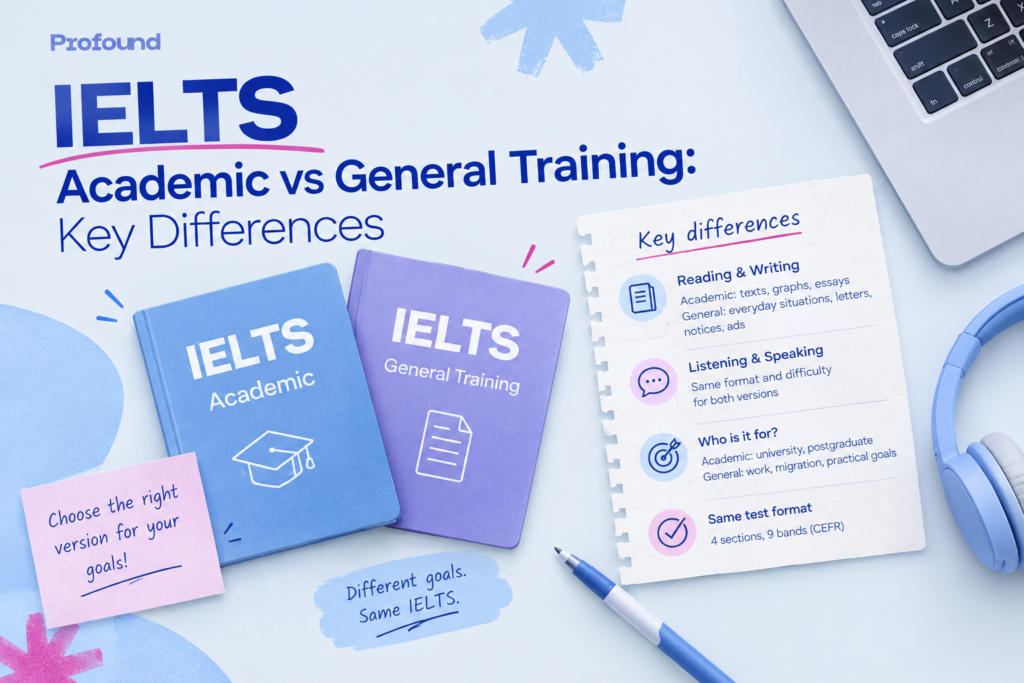
IELTS Academic vs General Training: Key Differences
The comparison below summarises the main points. You can check the official descriptions of both formats in the IELTS guide for teachers published by the British Council.
| Aspect | IELTS Academic | IELTS General Training |
| Main purpose | Study in higher education; some professional registration | Work, training, secondary education; some migration routes |
| Typical candidates | University applicants; some professionals | Trainees, workers, some migration applicants |
| Reading | Three long texts on academic-style topics | Three sections: everyday and workplace texts, then a longer general text |
| Writing Task 1 | Describe a graph, chart, table, diagram or process | Write a letter responding to a situation |
| Writing Task 2 | Essay | Essay |
| Listening | Same in both formats | Same in both formats |
| Speaking | Same in both formats | Same in both formats |
| Scoring scale | Band scale from 0 to 9 | Band scale from 0 to 9 |
| Who determines the required format? | The receiving institution or authority | The receiving institution or authority |
In plain terms, the tests split in half. Listening and Speaking are identical, so your preparation for those two skills carries over whichever format you choose. Reading and Writing change: Academic leans toward longer, more formal texts and the description of data, while General Training leans toward practical texts and a letter. Both formats include a Writing Task 2 essay, and both report results on the same band scale, so a band score does not carry a label that says one test is “worth more” in itself. What matters is whether the organisation receiving the score accepts that format.
The last row of the table is the one that settles the question. IELTS does not decide which format you need; the university, employer, regulator or immigration authority does. If you are also weighing other exams, you can see how IELTS compares with other English exams.
Reading: Academic vs General Training
Both Reading tests last 60 minutes and contain 40 questions, but the texts are different.
What you may read in Academic Reading
The Academic test includes three long texts taken from books, journals, magazines and newspapers. They are written for a general audience, yet they reflect the kind of material a university student meets. A candidate might read an article about how cities manage water supply, a discussion of how a scientific idea developed, or a report on changes in consumer habits. The texts are dense, and questions often test whether you can follow an argument, identify a writer’s opinion or match information to the right paragraph.
What you may read in General Training Reading
The General Training test draws on everyday and workplace material, including extracts from books, magazines and newspapers, notices, advertisements, and company handbooks and guidelines. A candidate might read a notice about gym opening hours, a job advertisement, a workplace policy on leave, or a longer magazine-style article on a topic of general interest. The test is built in three sections, and the last one is a longer text.
Why the strategies differ
Academic Reading rewards the ability to build a picture of a long, dense text quickly: understanding paragraph structure, tracking the writer’s position, and handling abstract vocabulary. General Training Reading asks you to move fast through many short, practical texts, locate specific details, and follow instructions precisely, and then to keep your concentration for a longer final passage.
Neither version should be treated as automatically easy. A short notice can hide a small detail that changes the answer, and a long academic text can be easier to follow than it looks if you read it for structure. Vocabulary breadth and time management matter in both, and some techniques for remembering new vocabulary can help with the first of these.
Writing: Academic vs General Training
The Writing test lasts 60 minutes in both formats and has two tasks. A certified examiner marks it, and Task 2 carries twice the weight of Task 1.
IELTS Academic Writing Task 1
You describe, summarise or explain visual information. This may be a line graph, bar chart, pie chart, table, a diagram of how something works, or a process. You write at least 150 words, and the recommended time is about 20 minutes. The skill is selecting the key features, making comparisons, and reporting trends accurately without adding your own opinion.
IELTS General Training Writing Task 1
You write a letter in response to a situation, again with at least 150 words in about 20 minutes. The purpose and tone depend on the task. You may need to request information, explain a problem, make a complaint, apologise, or invite someone. The recipient also matters: a letter to a manager or an official body calls for a formal tone, while a letter to a friend allows an informal one. Choosing the right register and covering every point in the task are central.
Writing Task 2 in both formats
Both formats ask for an essay responding to a point of view, argument or problem, with at least 250 words in about 40 minutes. The skills are shared: organising ideas into clear paragraphs, developing arguments with relevant support, using appropriate vocabulary, and keeping grammar accurate, for which a complete guide to English tenses can be a useful reference. Because Task 2 is weighted more heavily, it deserves a large share of preparation time in either format.
The two Writing sections are therefore not identical. They share the essay, but Task 1 requires different skills: data description in one case and functional letter writing in the other.
Listening and Speaking: What Stays the Same?
The Listening and Speaking components are the same across IELTS Academic and General Training. Whichever format you take, you prepare for these two sections in the same way.
Listening
The Listening test lasts about 30 minutes and has four parts with 40 questions in total. It assesses how well you follow main ideas and specific details, understand opinions and attitudes, and follow the development of an argument. The situations move from everyday to more academic: a conversation in a social setting, a monologue in a social context, a conversation in an educational or training setting, and a monologue on an academic subject. You hear each recording once, and the speakers may have accents from different English-speaking countries. Practice with varied accents and with note-taking while listening is useful for every candidate, and a step-by-step method for improving listening skills can structure that practice.
Speaking
The Speaking test is a conversation with a certified examiner and lasts 11 to 14 minutes. It has three parts:
- Introduction and interview. The examiner asks general questions about you and familiar topics such as home, work, studies and interests.
- Individual long turn. You receive a task card, have one minute to prepare, and then speak on the topic on your own for one to two minutes.
- Discussion. The examiner asks further questions linked to the topic of your long turn, and the conversation moves to more abstract ideas.
The Speaking test can be taken face to face, and some centres offer it by video call. The content, timing and scoring are designed to be the same in both arrangements.
Is IELTS Academic Harder Than General Training?
Neither test is universally harder. Many candidates assume Academic is the more difficult one because it sounds more demanding, but the formats test different things, and the level of English reported on the band scale is the same.
Perceptions of difficulty usually come from specific tasks:
- Academic Reading uses more academically oriented material, which suits candidates who read long, formal texts often.
- General Training Reading includes everyday and workplace contexts, which may feel familiar, but it asks you to process many short texts quickly and handle a longer final text.
- Academic Writing Task 1 requires describing visual information, which is difficult for candidates who rarely work with graphs or diagrams.
- General Training Writing Task 1 requires a letter in an appropriate tone, which can be difficult for candidates who are less confident with formal and informal registers.
- Both formats require good comprehension, vocabulary, grammar and time management.
Difficulty therefore depends on your strengths, your experience with each task type, and how well you have prepared. A candidate with a science background may find data description natural, while another may find letters easier. Choosing a format because it seems easier is also a poor approach in practice: if the receiving organisation does not accept the result, it has no value for your application. No format guarantees a higher score.
Which IELTS Test Do You Need?
The scenarios below show common patterns, not official rules. Each one also lists what you should confirm before choosing.
| Situation | Common pattern | What to verify |
| Applying to a university | Academic is often requested | The accepted formats, minimum scores and any section minimums listed by the institution |
| Applying to a postgraduate programme | Academic is often requested | Requirements of the specific programme, which may differ from the university’s general rules |
| Applying for professional registration | Some regulators ask for Academic | The regulator’s own list of accepted tests, formats and scores |
| Applying for migration | Some routes accept General Training | Country, visa category, accepted tests and any required test variant under current rules |
| Meeting an employer’s requirement | Varies by employer and role | Whether the employer requires IELTS at all, and in which format |
| Personal or general assessment | No fixed pattern | Why you need the result and whether any organisation will ask to see it |
A few points sit behind this table. University applicants often need Academic, but some institutions accept both formats and some courses at college level accept General Training, so the admissions page matters more than any general rule. For migration, the required test may depend on the country, the visa category and the rules in force at the time of application. For professional registration, the regulator’s requirements take priority over anything published elsewhere. For employment, the employer decides whether a particular test or format is needed. If you want a result simply to measure your level, first clarify whether anyone will later ask to see it, because that determines whether the format matters at all.
How to Choose the Right IELTS Test
Booking the wrong format can mean paying for a second test and losing weeks, so it is worth doing the research before you register. A practical order of steps:
- Identify the exact purpose of the test: admission, registration, a visa application, a job, or personal assessment.
- Find the official requirements published by the university, employer, regulator or immigration authority.
- Confirm whether IELTS Academic or General Training is accepted or required, and whether other tests or test variants are listed.
- Check the required overall band score and any minimum scores for individual sections.
- Verify any additional requirements about the type of test or how it is delivered, such as paper-based or computer-delivered.
- Confirm that the information is current before booking the exam, since requirements can change.
If a requirement is unclear, ask the organisation that will receive your result and keep the answer in writing. Guessing from a general article, including this one, is not a substitute for the receiving organisation’s own statement.
Frequently Asked Questions
What is the main difference between IELTS Academic and General Training?
The Reading and Writing sections. Academic uses longer texts with an academic orientation and a Writing Task 1 based on visual information. General Training uses everyday and workplace texts and a Writing Task 1 that is a letter. Listening and Speaking are the same.
Is IELTS Academic harder than General Training?
Not universally. The tests assess different kinds of tasks, and difficulty depends on a candidate’s strengths, preparation and familiarity with the task types. Both are reported on the same band scale.
Can I use IELTS General Training to apply to a university?
It depends on the institution and the programme. Many universities ask for Academic, and some accept both formats. Check the admissions requirements of each place you are applying to.
Which IELTS test is needed for migration?
There is no single answer. It depends on the country, the visa category and the current rules, and some routes require a specific test variant or a particular format for certain professions. Confirm the position with the official immigration authority.
Are Listening and Speaking the same in both IELTS tests?
Yes. The Listening and Speaking components are the same in IELTS Academic and General Training.
Is the IELTS scoring scale the same for both formats?
Yes. Both are reported on a band scale from 0 to 9, with a band score for each of the four sections and an overall band score. There is no official pass mark; organisations set their own required scores.
Can I change from IELTS Academic to General Training after booking?
The rules for transfers, changes and cancellations depend on the test provider and the test centre, and they may change. Check the current booking terms with the centre where you registered before assuming a change is possible.
How do I find out which IELTS test I need?
Ask the organisation that will receive your result, or read its official requirements. The university, employer, regulator or immigration authority decides, and its published guidance is more reliable than general advice.
Final Summary
The difference between IELTS Academic and General Training comes down to purpose. IELTS Academic is commonly associated with higher education and certain professional registration requirements. IELTS General Training focuses more on everyday, workplace and broader social contexts, and is used for some training, work and migration purposes.
Listening and Speaking are generally the same in both formats, so the main differences sit in Reading and Writing: the type of text you read, and whether Writing Task 1 asks you to describe data or write a letter. The Task 2 essay appears in both. Neither format is simply easier, and both use the same band scale.
In the end, the choice in the IELTS Academic vs General Training question is made by the institution or authority receiving your result. A short check of its current official requirements before registration is the most reliable way to choose the correct test.

