



Watching films and series in English is one of the best ways to hear the language as people really speak it: with contractions, hesitation, humour and a lot of speed. Subtitles can make that speech manageable. But switching them on does not guarantee progress. Many learners finish an episode having followed the plot by reading, while noticing very little about the spoken English.
The difference is strategy. This guide explains how to use subtitles for learning English on purpose: which type to choose at your level, how to work with a short clip step by step, which vocabulary is worth keeping, and how to rely on the text less over time. A note on terms: “subtitles” here means any on-screen text. Subtitles in the same language as the audio are also called English captions.
Table of Contents
- Why Use Subtitles to Learn English?
- English Subtitles vs Subtitles in Your Native Language
- How to Choose the Right Subtitle Strategy for Your Level
- How to Use Subtitles to Learn English: A Step-by-Step Method
- Example of a 15-20 minute session
- How to Learn Vocabulary from Subtitles
- Example vocabulary notes
- How to Improve Listening Without Becoming Dependent on Subtitles
- Movies, TV Series, or Short Videos: What Should You Choose?
- Common Mistakes When Learning English with Subtitles
- How Often Should You Practice?
- Frequently Asked Questions (FAQ)
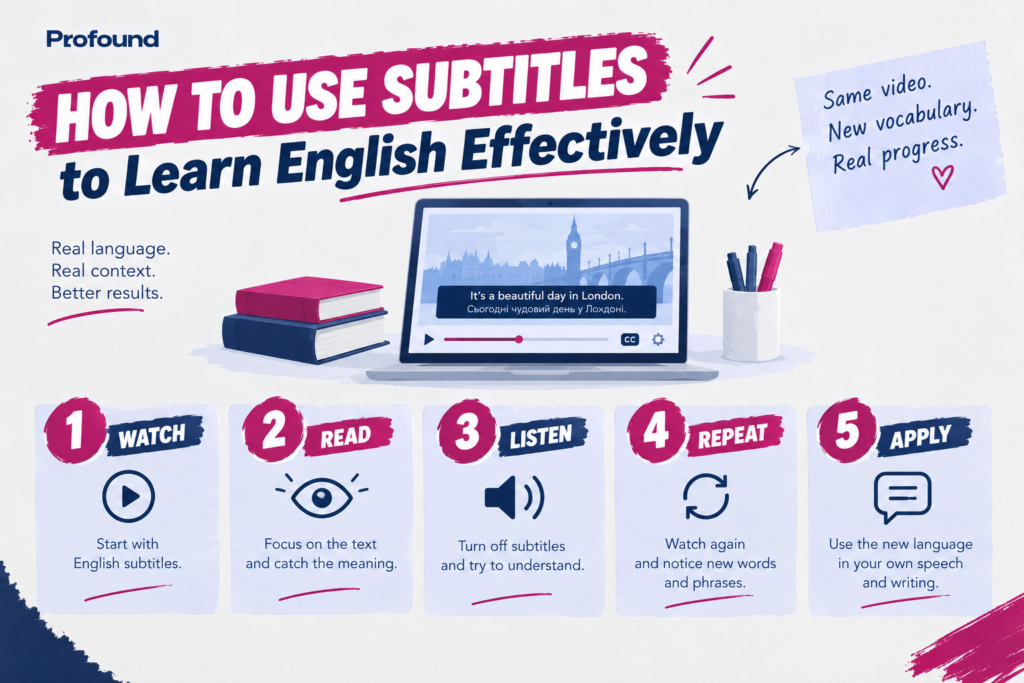
Why Use Subtitles to Learn English?
Subtitles do one thing very well: they show you the written form of what you are hearing. That link between sound and spelling helps in several ways.
- You connect written words with spoken English. Seeing a word while you hear it often shows you that you already know words you could not catch by ear alone.
- You recognise familiar words in connected speech. In natural speech, “What do you want to do?” can sound like “Whaddya wanna do?” With the text in front of you, you can see how known words change when they are spoken quickly.
- You notice contractions and common expressions. Forms such as “I’d”, “they’ve”, “gonna” and fixed phrases such as “to be honest” or “as far as I know” appear again and again in dialogue.
- You meet vocabulary in context. A word attached to a situation, a speaker and a tone of voice is easier to understand than a word on a list.
- You can follow fast dialogue. When speakers talk quickly, the text gives you a second chance to catch what was said.
- You become familiar with natural pronunciation and intonation. Subtitles do not show intonation, but you can compare the written line with what you hear and notice which words are stressed and where the speaker pauses.
Subtitles are a learning aid, not a replacement for listening practice. Reading is usually faster than listening, so your eyes can easily take over and your ears do very little. To train listening, you need moments when you listen without the text, which is why the method below ends with a no-subtitles viewing. If listening is your main goal, combine this method with other regular English listening practice.
English Subtitles vs Subtitles in Your Native Language
There are three basic ways to watch, and each has a place.
English audio with English subtitles. You see exactly the words you hear, which makes this the most direct way to connect sound and spelling. It works best when you can already follow the general story. One limitation is that subtitles are sometimes shortened or simplified, so the text may not match the audio word for word.
English audio with subtitles in your strongest language. This helps you understand the story, so it suits beginners and very difficult content. The limitation is that the translation is often condensed and worded differently from the English, so it gives you little information about the English words themselves. Your attention also moves to the translation.
English audio with no subtitles. This is the real listening test. It is useful for familiar scenes, easy material and review. The risk is frustration: if the content is too hard, you may miss both the details and the main idea, with no way to check.
A short note on dubbing. If a film is dubbed into your language, you hear no English at all, so it cannot help your listening. For learning, subtitles are the better choice because the original English audio stays in the soundtrack.
| Method | Best for | Main advantage | Potential limitation |
| English audio + English subtitles | Lower-intermediate and above; clips you partly understand | Shows exactly what is said and links spelling to sound | Reading can replace listening; text may differ slightly from audio |
| English audio + subtitles in your strongest language | Beginners; difficult or fast content; a first viewing | Makes the plot clear and reduces frustration | Little contact with English words; translation is often condensed |
| English audio, no subtitles | Familiar scenes; easier content; checking progress | Trains real listening and shows what you can now understand | Can be discouraging if content is too hard |
No single option is correct for everyone. The best choice depends on your current level, how difficult the content is, and what you want from the session: understanding a story, studying vocabulary, or practising listening.
How to Choose the Right Subtitle Strategy for Your Level
Level labels are only a rough guide. A more reliable test is how much you understand of the particular clip in front of you.
A quick comprehension check
Watch one minute of a scene with no subtitles, then ask yourself: Who is speaking? What is the situation? What is the problem or the topic?
- If you cannot answer, the clip is too hard to go straight to English subtitles. Use subtitles in your strongest language first, or choose easier content.
- If you understand the main idea but miss details, English subtitles are the right tool.
- If you understand most of it, try watching without subtitles and use them only to check difficult lines.
Beginners
Choose very short clips with clear situations: someone ordering food, asking for directions, introducing themselves. Watch first with subtitles in your strongest language to understand the situation, then watch again with English subtitles and focus on a few short sentences. Pick slow, clear speech. Fast comedy and overlapping dialogue can wait.
Lower-intermediate learners
English subtitles can become your main tool. Watch a short scene once for the story, then study it with English subtitles. Keep native-language subtitles for content that is too fast or too full of slang.
Intermediate learners
Make no subtitles the first step. Watch once without them, then switch on English subtitles to check what you missed. This gives your ears the first chance and keeps the text as a safety net.
Advanced learners
Keep subtitles off by default. Use English subtitles for difficult accents, specialised vocabulary, fast jokes, or when you want to check an expression you are unsure about.
Increasing difficulty gradually
Move up one step at a time, and only when the current step feels comfortable:
- Subtitles in your strongest language.
- English subtitles from the start.
- English subtitles after one watch without them.
- No subtitles first, then English subtitles to check.
- No subtitles, with subtitles only for specific lines.
You can use different steps for different content on the same day. An easy cooking video might be a step-4 video while a crime drama is still a step-2 one.
How to Use Subtitles to Learn English: A Step-by-Step Method
This routine turns passive watching into focused study. It works with a short clip rather than a full film.
- Choose a short, manageable clip. Pick a scene of one to three minutes with a clear situation. A short clip is easier to study than a whole film because you can replay it without losing the thread, and you can finish a full cycle in one sitting.
- Watch once to understand the main idea. Use no subtitles or the subtitles you need to follow the story. Do not pause after every unfamiliar word. The aim is to answer a simple question: what happened, and why?
- Watch again with English subtitles. Now follow the text while you listen. Pay attention to how sounds become words: where one word seems to join the next, which words are weak and which are stressed.
- Select a small number of useful expressions. Choose three to five phrases that you could use yourself. Resist the urge to note every unfamiliar word. A short list is one you will actually review.
- Replay difficult lines. Pick a line you could not catch and replay it two or three times, first with subtitles, then without. Repetition helps you notice word boundaries, reductions such as “gonna”, and connected speech.
- Repeat selected lines aloud. Say the line along with the speaker, copying the rhythm, the stress and the melody of the sentence. You are not trying to sound exactly like the actor. You are training your mouth and ears to work with natural rhythm.
- Watch the same section without subtitles. This is your check. Notice how much more you understand than in step 2. Even a small improvement shows the method is working.
- Review useful expressions later. Come back to your short list the next day and again a few days later. Try to recall the meaning and make one new sentence of your own for each phrase.
Example of a 15-20 minute session
| Time | Activity |
| 1 minute | Choose a two-minute clip |
| 2 minutes | Watch once for the main idea |
| 3 minutes | Watch with English subtitles |
| 3 minutes | Select four expressions and write a short example for each |
| 3 minutes | Replay two or three difficult lines |
| 2 minutes | Repeat the selected lines aloud |
| 2 minutes | Watch the clip without subtitles |
| 2 minutes | Quick check of your expressions without looking at the notes |
The whole session takes about 18 minutes. The review in step 8 happens on a later day and takes only a few minutes.
How to Learn Vocabulary from Subtitles
Learning English vocabulary through movies is possible, but it needs selection. Watching alone does not teach many words. In one exploratory study of learners of English in Flanders, Belgium, learning gains from watching video clips were generally low. The same study suggested that English captions can help learners notice the form of new words, and that viewers who watched with first-language subtitles did not do better on word meaning than those who watched with English captions. This was a small study of specific groups, so treat it as a reminder to be realistic rather than as a rule. Choosing a few useful items and reviewing them is more effective than hoping words will stick on their own.
What to choose
- Phrases rather than isolated words. “Run out of time” is more useful than “run” alone, because it shows the words that go together.
- Common, reusable expressions. Prefer phrases you could use in your own conversations over rare words tied to one plot.
- A short example sentence. Write one sentence of your own, not only the line from the clip.
- The situation. A few words about who said it and why (“asking politely for permission”) help you remember when to use it.
- A short list. Three to five items per clip is realistic. A list of thirty words from one episode is rarely reviewed.
Example vocabulary notes
| Expression | Meaning in context | Example sentence | Why it is useful |
| run out of | to have none left | We ran out of milk, so I’ll stop at the shop on my way home. | Works for time, money, patience and supplies |
| It turns out (that) | used when you discover something unexpected | It turns out the museum is closed on Mondays. | Introduces new information in stories and conversation |
| Do you mind if I…? | a polite request for permission | Do you mind if I open the window? | A polite everyday question; the usual answer is “Not at all.” |
| figure out | to find a solution or understand something | I can’t figure out how to connect to the Wi-Fi. | A very frequent informal phrasal verb |
For more ideas on keeping new words in your memory, see our guide on how to remember English words.
How to Improve Listening Without Becoming Dependent on Subtitles
The goal is to need the text less over time. These techniques help.
- Listen before you read. Give your ears the first attempt at every new line, even if you only catch a few words.
- Rewatch short sections without subtitles. A short section you have already studied is the best material for this. You know the story, so you can focus on the sounds.
- Switch subtitles off for familiar scenes. If you have seen the scene before, you do not need the text. Use this as a regular test.
- Listen for the general meaning first. Ask what the speakers want or feel before trying to catch each word.
- Use content at the right level. If you need subtitles for almost every sentence, the content is probably too difficult for independent listening practice. Choose something easier.
- Repeat short audio segments. Replaying five to ten seconds several times trains your ear more effectively than watching a long scene once.
Remember that not understanding every word is normal, including for fluent speakers watching unfamiliar accents or technical conversations. You do not need to catch every word to follow the main idea. If you understand what the scene is about and can pick up some of the details, you are practising effectively.
Movies, TV Series, or Short Videos: What Should You Choose?
All three can work. They differ in length, repetition and how much context they give you.
Movies
A film tells one complete story, so the plot gives you strong context. But films are long, the vocabulary changes with the genre, and one evening does not give much repetition. Films are best for pleasure viewing, or for taking a short scene to study.
TV series
Series are often easier to follow over time. The same characters speak in similar ways, the settings repeat, and certain expressions and topics come back from episode to episode. This repetition makes later episodes feel easier than the first one. Choose a series with everyday situations rather than specialised ones such as legal or medical dramas, which carry a lot of technical vocabulary.
Short educational or everyday videos
Short videos are easy to fit into a busy day, and a two-minute clip about a familiar topic is ideal for the step-by-step method. Look for clear speech and a topic you already know something about. Some informal videos have fast speech, slang or poor sound, so choose carefully.
Whichever you choose, familiar topics and recurring characters make content easier to follow. Pick material you find interesting, because you are far more likely to keep going with something you enjoy.
The goal is to need the text less over time. These techniques help. If you want more guided practice, try these free English video exercises from the British Council.
Common Mistakes When Learning English with Subtitles
1. Reading subtitles without listening
Why it limits learning: your eyes do the work and your ears stay passive, so listening skills do not develop.
What to do instead: listen once without the text, or cover the subtitles and read them only after you have tried to understand the line.
2. Watching content that is far too difficult
Why it limits learning: if you cannot follow the story, you spend your time deciphering rather than learning, and you may lose motivation.
What to do instead: use the comprehension check above and choose content where you understand the main idea.
3. Pausing after every unfamiliar word
Why it limits learning: constant pausing breaks the rhythm of speech, which is exactly what you need to get used to.
What to do instead: let the scene run, make a quick note if needed, and look things up after the clip.
4. Translating every sentence
Why it limits learning: translating word for word slows you down and keeps you thinking in your own language.
What to do instead: try to understand the idea of a whole sentence from the situation and the context.
5. Collecting too much vocabulary
Why it limits learning: a long list is tiring to review, so most of it is forgotten.
What to do instead: keep three to five expressions per clip and review them properly.
6. Never rewatching without subtitles
Why it limits learning: if you always watch with the text, you never find out how much you can understand by listening.
What to do instead: finish every study session with a no-subtitles viewing of the same section.
7. Choosing subtitles that do not match the audio
Why it limits learning: some subtitles are summaries or translations, and a mismatch between what you hear and what you read can be confusing.
What to do instead: check a few lines. If the text often differs from the audio, look for a closer version or rely on your own listening.
8. Watching passively without a goal
Why it limits learning: without a clear aim, an hour of viewing can pass without a single new thing noticed.
What to do instead: set a small goal before you start, for example “notice how people ask for help” or “learn three phrases for agreeing”.
How Often Should You Practice?
Short, regular sessions usually work better than one long weekly marathon. A 15-20 minute session several times a week gives you repeated contact with English and leaves time for review in between. A marathon session may feel productive, but concentration drops and little is reviewed afterwards. If your schedule is busy, our guide to learning English in short moments of spare time may help.
Here is one possible weekly pattern. Adjust it to your life.
- Monday: a new two-minute clip, steps 1-6 (about 20 minutes).
- Tuesday: review your expressions for five minutes, then rewatch Monday’s clip without subtitles.
- Wednesday: a new clip from the same series or topic, steps 1-6.
- Thursday: a short review of the week’s expressions, and say them aloud.
- Friday: rewatch both clips without subtitles.
- Weekend: watch something you enjoy for pleasure, with the subtitle setting you find most comfortable.
This is an example, not a promise of a particular result. Progress depends on your starting level, your material and how consistently you practise. If you can only manage two sessions a week, that is still useful.
Frequently Asked Questions (FAQ)
Are English subtitles good for learning English?
Yes, when you use them with a purpose. They help you connect spoken words with spelling and notice expressions. They work best when you can understand the main idea of the scene, and they should be combined with listening without text.
Should beginners use English subtitles or subtitles in their native language?
Beginners often do better starting with subtitles in their strongest language to understand the story, then moving to English subtitles on short, easy clips. If you can follow the general idea of a clip, you can try English subtitles earlier.
Is it better to watch movies with or without subtitles?
Both have a role. Subtitles help you study and understand details, and watching without them trains real listening. A useful pattern is to use both on the same short clip.
Can watching movies improve English listening skills?
It can help, especially when you choose suitable content, replay short sections and spend some time listening without subtitles. Watching alone, without attention to the audio, is less effective.
How many new words should I learn from one video?
Three to five useful expressions are enough for a short clip. A small number you review is better than a long list you do not.
Should I watch the same video more than once?
Yes. Repeated viewing is one of the main benefits of the method. The second and third viewings are when you notice pronunciation, word boundaries and expressions you missed the first time.
How can I stop relying on subtitles?
Reduce them step by step: first watch once without text before turning it on, then use subtitles only for difficult lines, and finally switch them off for familiar and easy content. Choosing content at the right level makes this much easier.
Is watching English content with subtitles enough to learn English?
No. It is a useful part of learning, especially for listening and vocabulary, but you also need speaking practice, reading, writing and the study of grammar. Think of subtitles as one tool among several.

