



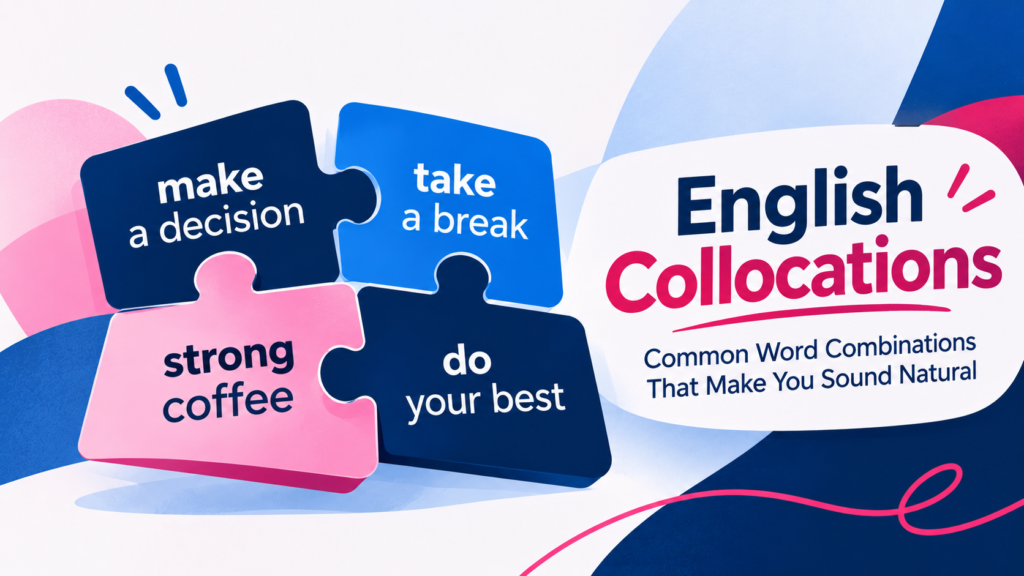
Many learners know every word in a sentence and still sound slightly unnatural. The cause is rarely grammar or vocabulary size. It is usually word partnership. English speakers say “make a decision”, not “do a decision”, and “heavy rain”, not “strong rain”. The grammar does not forbid the second versions, but speakers simply do not use them. Translating a phrase word for word from your own language often produces exactly this kind of combination.
English collocations are the word combinations that speakers use automatically. This guide explains what they are, shows the main types with natural examples, lists common English collocations by topic, covers frequent mistakes, separates collocations from idioms, and gives practical ways to remember them. A practice section with an answer key closes the article.
Table of Contents
- What Are Collocations in English?
- Why Are English Collocations Important?
- Main Types of English Collocations
- Common English Collocations You Should Know
- Common Collocation Mistakes English Learners Make
- Collocations vs. Idioms: What's the Difference?
- How to Learn and Remember English Collocations
- Practice: Test Your Knowledge of English Collocations
- Quick Summary
- Frequently Asked Questions (FAQ)
What Are Collocations in English?
A collocation is a pair or group of words that regularly appear together and sound natural to speakers of the language. Nothing logical decides which words go together. It is a matter of habit and usage.
Consider these pairs:
- make a mistake, not do a mistake
- fast food, not quick food
- deeply grateful, not highly grateful
- take a photo, not make a photo
All the “wrong” versions are understandable, so communication does not break down. They simply sound unusual, much like a sentence with a faint foreign accent.
This is why knowing individual words is not enough. You can know “make”, “do”, “strong” and “heavy” perfectly well and still not know which one belongs with “decision”, “homework”, “coffee” or “rain”. Collocations are the missing layer: knowing which words are partners.
Why Are English Collocations Important?
More natural speech. Using the expected partner word makes your English sound smoother, even when your grammar is simple.
Better fluency. When you know “reach an agreement” as one unit, you do not have to build it word by word. Speaking becomes faster and less tiring.
More accurate writing. Essays, emails and reports depend on precise combinations. “Conduct research”, “raise awareness” and “meet requirements” are what readers expect in formal texts.
Improved listening. Speakers often run familiar phrases together. If you recognize “take a look” or “pay attention” as units, you spend less effort decoding them and can follow the meaning.
Stronger vocabulary retention. A word learned inside a phrase comes with a context, a grammar pattern and a usage example, so it is easier to recall than a word on its own.
Main Types of English Collocations
Collocations are usually grouped by the parts of speech involved. These are the five patterns you will meet most often.
Verb + Noun
This is the most useful pattern for learners, because the verb is where mistakes happen most often.
- make a decision: After a long discussion, the team made a decision.
- take a break: You look tired. Why don’t you take a break?
- do homework: My son does his homework right after school.
- catch a bus: I usually catch the 8:15 bus to work.
- pay attention: Please pay attention to the safety instructions.
Each of these pairs uses a verb that a literal translation might not predict. Note that English uses “catch” for buses and trains, but “take” is also common: “I take the bus to work.”
Adjective + Noun
- heavy rain: Heavy rain caused delays on the roads.
- strong coffee: I need a strong coffee to start the day.
- deep sleep: The baby fell into a deep sleep.
- high expectations: Her parents have high expectations of her.
- fast food: Fast food is convenient but not always healthy.
The adjectives here are not interchangeable. English does not say “strong rain” or “heavy coffee”.
Noun + Noun
- traffic jam: We were stuck in a traffic jam for an hour.
- language barrier: The language barrier made the trip difficult at first.
- job interview: She has a job interview on Monday.
- data analysis: Data analysis showed a clear trend.
In this pattern the first noun works like an adjective and describes the second.
Adverb + Adjective
- highly unlikely: It is highly unlikely that the flight will be cancelled.
- deeply concerned: Doctors are deeply concerned about the rise in cases.
- fully aware: I am fully aware of the risks.
- bitterly disappointed: He was bitterly disappointed by the result.
Adverbs that intensify an adjective are very selective. “Bitterly” suits disappointment, but you would not say “bitterly happy”.
Verb + Adverb
- apologize sincerely: He apologized sincerely for the delay.
- whisper quietly: The children whispered quietly during the film.
- increase significantly: Prices increased significantly last year.
- strongly recommend: I strongly recommend the second option.
Here too, certain adverbs attach to certain verbs. “Strongly recommend” is far more common than “heavily recommend”.
Common English Collocations You Should Know
The groups below are organized by situation. Learn a few from each group and use them in your own sentences rather than memorizing the whole list.
Everyday Life
| Collocation | Example sentence |
| get up early | I get up early on weekdays. |
| have breakfast | We usually have breakfast at seven. |
| do the laundry | She does the laundry on Sundays. |
| make the bed | He never forgets to make the bed. |
| go shopping | We went shopping for winter coats. |
| book a flight | I booked a flight to Lisbon for May. |
| pack a suitcase | Remember to pack a suitcase the night before. |
| thick fog | Thick fog covered the whole valley. |
| strong wind | A strong wind blew the umbrella away. |
Daily routines are normally described in the present simple, which is why sentences like “I get up early” and “She does the laundry” appear so often.
When you plan trips, you often combine travel collocations with future forms: “I’m going to book a flight tonight” sounds different from “I’ll book a flight now”.
Work and Business
| Collocation | Example sentence |
| meet a deadline | We worked late to meet the deadline. |
| make progress | The project is making good progress. |
| gain experience | Interns gain experience in a real office. |
| take responsibility | He took responsibility for the error. |
| reach an agreement | Both sides reached an agreement on Friday. |
| hold a meeting | The manager holds a meeting every Monday. |
| give a presentation | She gave a presentation to the board. |
| run a business | They run a small family business. |
“Make progress” is often used with a result in mind: “We have made progress this quarter.” That sentence needs the present perfect, which links past actions with the present.
Education and Learning
| Collocation | Example sentence |
| take an exam | Students take an exam at the end of each term. |
| make a mistake | Everyone makes a mistake sometimes. |
| do research | She is doing research on sleep and memory. |
| gain knowledge | Reading helps you gain knowledge of other cultures. |
| meet requirements | Applicants must meet the requirements for the course. |
| pass a test | He passed the driving test on his first attempt. |
| hand in an assignment | Please hand in your assignment by Friday. |
| learn by heart | We had to learn the poem by heart. |
Feelings and Emotions
| Collocation | Example sentence |
| feel disappointed | I felt disappointed when the trip was cancelled. |
| deeply regret | He deeply regrets his words. |
| have mixed feelings | I have mixed feelings about moving abroad. |
| lose confidence | She lost confidence after the first failure. |
| make someone happy | Small gifts make her happy. |
| burst into tears | The child burst into tears. |
| feel under pressure | Many students feel under pressure before exams. |
| take pride in | He takes pride in his work. |
Communication and Relationships
| Collocation | Example sentence |
| keep in touch | Let’s keep in touch after the course. |
| have a conversation | We had a long conversation about our plans. |
| pay a compliment | He paid her a compliment on her speech. |
| break the news | I didn’t know how to break the news to them. |
| reach out to someone | If you need help, reach out to your teacher. |
| give feedback | Good managers give feedback regularly. |
| make a suggestion | May I make a suggestion? |
| express an opinion | Everyone is free to express an opinion. |
Common Collocation Mistakes English Learners Make
Most collocation mistakes come from translating each word separately. Grammar mistakes involve forms such as tense or word order. Collocation mistakes involve choosing a different word than speakers normally choose. The sentence is grammatical but sounds odd.
| Unnatural | Natural | Why |
| do a decision | make a decision | “Make” is used when you create or produce something, including choices, plans and suggestions. |
| strong rain | heavy rain | English describes the amount of rain with “heavy” and “light”. “Strong” is used for wind, tea or coffee. |
| make homework | do homework | “Do” is used for tasks and duties: do homework, do the dishes, do your best. |
| say a story | tell a story | “Say” focuses on words being spoken. “Tell” is used for stories, jokes, lies and the truth. |
| make a photo | take a photo | Photos are “taken”, like a snapshot of a moment. |
| open the light | turn on the light | “Open” is for doors and windows. Devices are turned on or switched on. |
| make a shower | take a shower | Washing activities use “take” or “have”: take a shower, have a bath. |
| do a party | have a party or throw a party | “Do” does not describe organizing an event. “Have” is neutral and “throw” is informal. |
| make research | do research | Academic work uses “do” or “conduct” research. |
| big mistake | big mistake (natural) | This one is correct. “Big mistake” is a common collocation, along with “huge mistake” and “serious mistake”. |
The last row matters because not every adjective-noun pair is a problem. “Big” is flexible and works with “mistake”, “problem” and “difference”. It becomes unnatural with some other nouns, which is why you should check combinations rather than assume.
Collocations vs. Idioms: What’s the Difference?
A collocation is a combination in which the words keep their usual meanings. You can understand “heavy rain” or “make a decision” even if you have never seen the phrase before. It simply has a preferred form.
An idiom is a fixed expression whose meaning differs from the meanings of its separate words. “It’s raining cats and dogs” has nothing to do with animals. It means that it is raining very heavily. You cannot work out an idiom from its parts.
| Collocation | Idiom | |
| Meaning | Clear from the words | Different from the words |
| Example | heavy rain | its coming down in sheets |
| Flexibility | Often some variation: heavy, torrential, pouring rain | Usually fixed |
| Use | Everyday and formal English | Mostly informal and spoken English |
Both are part of natural English, but collocations are more frequent and more useful for learners at B1 and B2 levels. They appear in all registers, from emails to academic essays.
How to Learn and Remember English Collocations
Learn words in phrases, not alone. Instead of writing “decision”, write “make a decision, reach a decision, a difficult decision”. This approach works alongside general memory techniques.
Keep a personal collocation notebook. Use one page per key word, such as “make”, “take” or “heavy”, and list the partners you meet. Add a short sentence about your own life next to each: “take a break: I take a break at 3 p.m.”
Notice repeated combinations when you read. If you see “raise awareness” three times in one week, it is a collocation worth saving. Watching films or series with English subtitles also shows how phrases appear in real speech.
Use example sentences. A sentence shows the grammar around the phrase, for example that you “apologize for something” and “apologize to someone”.
Practice active recall. Cover the second word and try to produce it: “pay ___ attention”, “meet a ___”. Recalling is stronger practice than rereading.
Review at regular intervals. Short, frequent sessions work well for this, and even five minutes a day helps.
Group collocations by topic. Learn “work” collocations in one set and “travel” collocations in another, so that you can retrieve them in the right situation.
Use new combinations in your own sentences. After learning “gain experience”, write three sentences about your job or studies. Combinations you have produced yourself are far easier to remember.
Practice: Test Your Knowledge of English Collocations
Choose the correct word.
- She ___ a decision after a long discussion. (made / did / took)
- We had ___ rain all weekend. (strong / heavy / big)
- Please ___ attention to the instructions. (pay / give / make)
Complete the missing word.
- You look tired. You should take a ___.
- We must ___ the deadline on Friday.
- He ___ me a compliment on my presentation.
- I am ___ aware of the problem. (Use an adverb that means completely.)
Identify the natural collocation.
- a) do a mistake b) make a mistake
- a) strong coffee b) heavy coffee
- a) highly unlikely b) strongly unlikely
Correct the unnatural combination.
- He said a funny story to the children.
- I did a photo of the sunset.
Answer Key
- made. “Make a decision” is the standard collocation.
- heavy. “Heavy rain” is natural; “strong rain” is not.
- pay. “Pay attention” is fixed.
- break. “Take a break” means to stop and rest.
- meet. “Meet a deadline” means to finish on time.
- paid. “Pay a compliment” is the normal verb.
- fully. “Fully aware” is a standard adverb-adjective pair.
- b. “Make a mistake” is natural.
- a. Coffee is described as “strong” or “weak”.
- a. “Highly unlikely” is the usual combination.
- He told a funny story to the children.
- I took a photo of the sunset.
Quick Summary
| Topic | Key point |
| Definition | Collocations are word combinations that sound natural together. |
| Why they matter | They improve fluency, accuracy and listening skills. |
| Main types | Verb + noun, adjective + noun, noun + noun, adverb + adjective, verb + adverb. |
| Typical mistakes | Choosing the wrong verb or adjective: do a decision, strong rain. |
| Collocations vs. idioms | Collocations keep their literal meaning; idioms do not. |
| Best learning method | Learn phrases, write example sentences, review regularly. |
Frequently Asked Questions (FAQ)
What are collocations in English?
They are words that commonly go together, such as “make a decision” or “heavy rain”. Using them makes your English sound natural.
What are the most common English collocations?
Verb collocations with “make”, “do”, “take”, “have” and “pay” are among the most frequent, for example make progress, do research, take a break, have a conversation and pay attention.
How many collocations should I learn?
There is no fixed number. A practical goal is a small group per study session, chosen from topics you really use, and reviewed regularly.
What is the difference between collocations and idioms?
In a collocation the words keep their normal meaning; in an idiom the meaning differs from the words.
How can I improve my use of collocations?
Record them in phrases, write your own example sentences, notice them in reading and listening, and review them often.
Are collocations important for speaking fluently?
Yes. Familiar combinations let you speak in larger units instead of building every phrase word by word, so speech becomes smoother.
Where can I find reliable examples of English collocations?
A specialized collocations dictionary is the most reliable source. The Oxford Collocations Dictionary resources page offers study pages and exercises:

