



Imagine you are talking about your hobby and say “PHO-to-gra-phy”, with the strongest beat on the first syllable. Many listeners will pause for a moment, because the word they expect is pho-TOG-ra-phy. Every sound in your version may be correct, yet the word is hard to recognise. The problem is word stress in English.
In English, each word with more than one syllable has a pattern of strong and weak syllables. Listeners use that pattern to identify words, much as they use the letters when reading. If the pattern is wrong, understanding slows down, even when your grammar and vocabulary are excellent.
This article explains how English word stress rules work, which patterns are common, where the exceptions are, and how you can practise on your own. It is written for learners from A1 to B2, so the explanations are simple and every pattern comes with examples. Throughout the article, stress is shown in two ways: capital letters (be-LIEVE) and IPA symbols (/bɪˈliːv/). IPA transcriptions follow standard British pronunciation unless stated otherwise.
Table of Contents
- What Is Word Stress in English
- Why Is Word Stress Important?
- Basic Word Stress Rules in English
- How Suffixes Affect Word Stress
- Word Stress Changes the Meaning of a Word
- Word Stress in Compound Words
- Common Word Stress Mistakes
- How to Identify Word Stress
- How to Improve Your English Word Stress
- Practice: Word Stress Exercises
- Answer Key
- Quick Summary
- FAQ
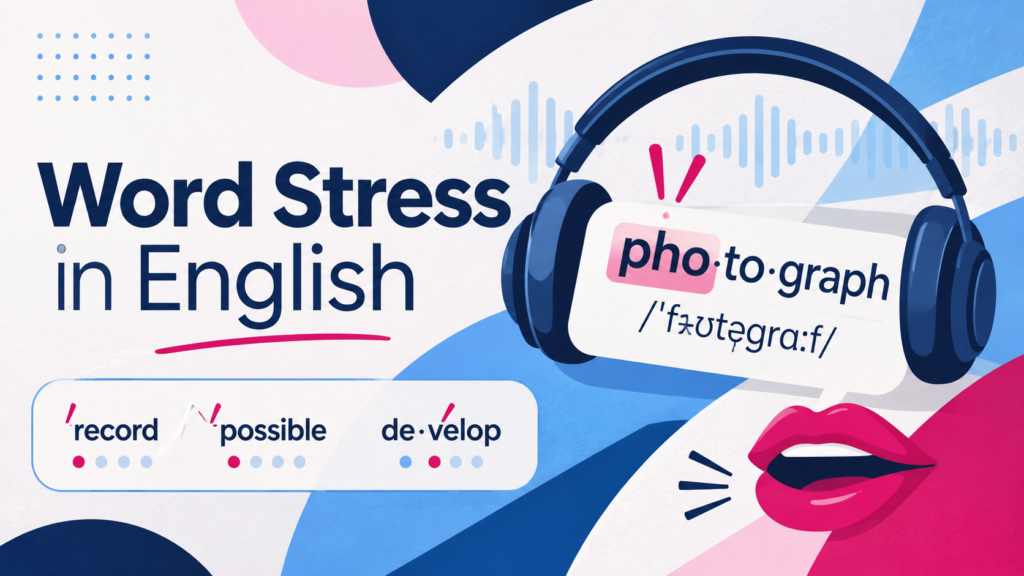
What Is Word Stress in English
Syllables
A syllable is a unit of sound built around a vowel sound. The word “cat” has one syllable. “Ta-ble” has two, “ba-na-na” has three, and “in-for-ma-tion” has four.
Stressed and unstressed syllables
In a word with two or more syllables, one syllable is the most prominent. This is the primary stress. Learners often say “the stressed syllable” or “the stressed syllable of the word”. The other syllables are unstressed syllables.
Compare:
- ba-NA-na: the second syllable is stressed.
- TA-ble: the first syllable is stressed.
What makes a syllable sound stressed?
A stressed syllable usually differs from its neighbours in four ways:
- Length: it is held a little longer.
- Loudness: it is pronounced with more energy.
- Pitch: it is usually higher or carries a pitch movement.
- Vowel clarity: its vowel is pronounced fully and clearly.
The last point is the most important for English pronunciation. In unstressed syllables, vowels often become short and weak. The most common weak vowel is the schwa /ə/, as in the first syllable of “a-BOUT” /əˈbaʊt/ or the last syllable of “TA-ble” /ˈteɪ.bəl/. If you pronounce every vowel fully, English sounds unnatural and is harder to follow.
How stress is shown in dictionaries
Pronunciation dictionaries use IPA marks:
- The mark ˈ goes before the syllable with primary stress.
- The mark ˌ goes before a syllable with secondary stress, a weaker stress found in longer words.
- A dot (.) separates syllables.
| Word | Syllables (stress in capitals) | IPA |
| table | TA-ble | /ˈteɪ.bəl/ |
| believe | be-LIEVE | /bɪˈliːv/ |
| banana | ba-NA-na | /bəˈnɑː.nə/ |
| education | e-du-CA-tion | /ˌedʒ.uˈkeɪ.ʃən/ |
In “education”, the main stress falls on “ca”. The first syllable has a weaker secondary stress, marked ˌ.
Why Is Word Stress Important?
Intelligibility. Listeners recognise a word partly by its rhythm. Research and teaching experience both show that a wrong stress pattern can hurt understanding more than a slightly inaccurate individual sound.
Listening comprehension. If you know that “important” is im-POR-tant, you will recognise it faster in fast speech. Stress knowledge helps you find word boundaries in a stream of sound.
Natural-sounding speech. English rhythm depends on strong and weak syllables. Correct stress gives your speech a natural flow and makes the weak syllables, with their schwa sounds, fall into place.
Distinguishing words. Some words differ only in stress. “REcord” is a thing and “reCORD” is an action (see section 5). Stress can also help you tell apart similar-sounding words, such as “DEsert” (a dry region) and “deSERT” (to abandon).
A useful comparison is the word “banana”. If you say “BA-na-na”, most listeners will still guess what you mean, but it takes more effort. Multiply that effort across a whole conversation and it becomes tiring for the listener.
Basic Word Stress Rules in English
English word stress is not fully predictable. The patterns below are tendencies, not laws. Many English words come from Germanic, French, Latin and Greek, and each source tends to follow its own habits. Use the tendencies to make good first guesses, and check a dictionary when the word is new or important.
Two-syllable nouns: often the first syllable
| Word | Syllables | IPA |
| table | TA-ble | /ˈteɪ.bəl/ |
| doctor | DOC-tor | /ˈdɒk.tər/ |
| window | WIN-dow | /ˈwɪn.dəʊ/ |
| money | MO-ney | /ˈmʌn.i/ |
Some two-syllable nouns are stressed on the second syllable, for example hoTEL /həʊˈtel/, maCHINE /məˈʃiːn/ and poLICE /pəˈliːs/.
Two-syllable verbs: often the second syllable
| Word | Syllables | IPA |
| decide | de-CIDE | /dɪˈsaɪd/ |
| believe | be-LIEVE | /bɪˈliːv/ |
| relax | re-LAX | /rɪˈlæks/ |
| enjoy | en-JOY | /ɪnˈdʒɔɪ/ |
Common exceptions are verbs stressed on the first syllable, such as LISten /ˈlɪs.ən/, VISit /ˈvɪz.ɪt/, ANswer /ˈɑːn.sər/ and OFfer /ˈɒf.ər/.
Two-syllable adjectives: often the first syllable
| Word | Syllables | IPA |
| happy | HAP-py | /ˈhæp.i/ |
| clever | CLEV-er | /ˈklev.ər/ |
| simple | SIM-ple | /ˈsɪm.pəl/ |
| nervous | NER-vous | /ˈnɜː.vəs/ |
There are many exceptions, especially adjectives that begin with a weak prefix: aLONE /əˈləʊn/, aFRAID /əˈfreɪd/, poLITE /pəˈlaɪt/, corRECT /kəˈrekt/.
Words with three or more syllables
For longer words there is no single simple rule, but some patterns are common:
- Many common everyday words are stressed on the first syllable: BEAU-ti-ful /ˈbjuː.tɪ.fəl/, DIF-fi-cult /ˈdɪf.ɪ.kəlt/, YES-ter-day /ˈjes.tə.deɪ/.
- Many words are stressed on the second syllable, especially those with a prefix: com-PU-ter /kəmˈpjuː.tər/, to-MOR-row /təˈmɒr.əʊ/, re-MEM-ber /rɪˈmem.bər/, im-POR-tant /ɪmˈpɔː.tənt/.
- Endings change the pattern strongly, which is why suffixes are so useful (see section 4).
Notice that the weak syllables in these words usually contain /ə/ or /ɪ/: com-PU-ter, to-MOR-row. When you stress the right syllable, the rest tends to reduce naturally.
How Suffixes Affect Word Stress
A suffix is an ending added to a word, such as -tion or -ness. Suffixes are among the most reliable guides to English stress patterns, because they work like a signal for the stress position. They fall into three groups according to their effect.
Group A: suffixes that carry the stress themselves
| Suffix | Examples | IPA |
| -ee | train-EE, ref-u-GEE, ref-er-EE | /ˌtreɪˈniː/, /ˌref.juˈdʒiː/, /ˌref.əˈriː/ |
| -eer | en-gi-NEER, vol-un-TEER | /ˌen.dʒɪˈnɪər/, /ˌvɒl.ənˈtɪər/ |
| -ese | Chi-NESE, Jap-a-NESE, Viet-nam-ESE | /ˌtʃaɪˈniːz/, /ˌdʒæp.əˈniːz/, /ˌvjet.nəˈmiːz/ |
Exceptions: “coffee” /ˈkɒf.i/ and “committee” /kəˈmɪt.i/ do not follow this pattern. In phrases such as “Chinese food”, speakers often move the main stress earlier for rhythm, so listen for it in context.
Group B: suffixes that put the stress on the syllable before them
| Suffix | Examples | IPA |
| -tion / -sion | e-du-CA-tion, in-for-MA-tion, de-CI-sion | /ˌedʒ.uˈkeɪ.ʃən/, /ˌɪn.fəˈmeɪ.ʃən/, /dɪˈsɪʒ.ən/ |
| -ic | e-co-NOM-ic, fan-TAS-tic, e-LEC-tric | /ˌiː.kəˈnɒm.ɪk/, /fænˈtæs.tɪk/, /ɪˈlek.trɪk/ |
| -ical | po-LIT-i-cal, his-TOR-i-cal, TYP-i-cal | /pəˈlɪt.ɪ.kəl/, /hɪˈstɒr.ɪ.kəl/, /ˈtɪp.ɪ.kəl/ |
| -ity | pos-si-BIL-i-ty, per-son-AL-i-ty, re-AL-i-ty | /ˌpɒs.əˈbɪl.ə.ti/, /ˌpɜː.sənˈæl.ə.ti/, /riˈæl.ə.ti/ |
| -graphy | pho-TOG-ra-phy, ge-OG-ra-phy, bi-OG-ra-phy | /fəˈtɒɡ.rə.fi/, /dʒiˈɒɡ.rə.fi/, /baɪˈɒɡ.rə.fi/ |
Two things are worth knowing:
- In -ical words, the stress is on the syllable before -ical (po-LIT-ical, TYP-ical), so it is not always the same position counted from the start of the word.
- Stress can move when you add a suffix to a base word: PHO-to-graph /ˈfəʊ.tə.ɡrɑːf/, pho-TOG-ra-phy /fəˈtɒɡ.rə.fi/, pho-to-GRAPH-ic /ˌfəʊ.təˈɡræf.ɪk/. The same shift happens in “ECo-nomy” /ɪˈkɒn.ə.mi/ and “e-co-NOM-ic”.
Exceptions exist, for example POL-i-tics /ˈpɒl.ə.tɪks/ (not po-LIT-ics), LUN-a-tic and TEL-e-vi-sion /ˈtel.ɪ.vɪʒ.ən/, where the stress stays further from the ending.
Group C: suffixes that generally do not change the stress
| Suffix | Base word and result | IPA |
| -ment | de-VEL-op → de-VEL-op-ment; GOV-ern → GOV-ern-ment | /dɪˈvel.əp.mənt/, /ˈɡʌv.ən.mənt/ |
| -ness | HAP-py → HAP-pi-ness; KIND → KIND-ness | /ˈhæp.i.nəs/, /ˈkaɪnd.nəs/ |
| -ful | CARE → CARE-ful; WON-der → WON-der-ful; de-LIGHT → de-LIGHT-ful | /ˈkeə.fəl/, /ˈwʌn.də.fəl/, /dɪˈlaɪt.fəl/ |
The practical idea: for these endings, find the stress of the base word and keep it. The same is true of many other common endings, such as -ing, -ed, -er, -ly and -less. “Environment” /ɪnˈvaɪ.rən.mənt/ is stressed on “vi” because the base verb is en-VI-ron.
When you meet a word with -tion, -ic, -ity, -graphy or -ical, ask: “Is the stress on the syllable before this ending?” For a word with -ee, -eer or -ese, ask: “Is the ending itself stressed?” For -ment, -ness and -ful, look at the base word.
Word Stress Changes the Meaning of a Word
Some English words keep the same spelling but change stress depending on their grammatical role. In many two-syllable noun and verb pairs, the noun is stressed on the first syllable and the verb on the second. In the verb forms, the unstressed first syllable often has a weak vowel such as /ɪ/ or /ə/.
| Word | Noun (first syllable) | Verb (second syllable) |
| record | REC-ord /ˈrek.ɔːd/ | re-CORD /rɪˈkɔːd/ |
| present | PRES-ent /ˈprez.ənt/ | pre-SENT /prɪˈzent/ |
| object | OB-ject /ˈɒb.dʒekt/ | ob-JECT /əbˈdʒekt/ |
| permit | PER-mit /ˈpɜː.mɪt/ | per-MIT /pəˈmɪt/ |
| conduct | CON-duct /ˈkɒn.dʌkt/ | con-DUCT /kənˈdʌkt/ |
| produce | PRO-duce /ˈprɒd.juːs/ | pro-DUCE /prəˈdjuːs/ |
American English has slightly different vowels in some of these (for example “produce” /ˈproʊ.duːs/ and /prəˈduːs/), but the noun-first, verb-second stress pattern is the same.
record
- Noun: a written account or a recorded piece of data or music. “The school keeps a record of every student’s attendance.”
- Verb: to store sound or images, or to write something down. “I want to record my voice and listen to it.”
present
- Noun (also adjective): a gift, or the time now. “She gave me a lovely present.”
- Verb: to give or show formally. “They will present the results tomorrow.”
object
- Noun: a thing. “There is a strange object on the table.”
- Verb: to disagree or protest. “Nobody objected to the new plan.”
permit
- Noun: an official document that allows something. “You need a permit to park here.”
- Verb: to allow. “The school does not permit mobile phones in class.”
conduct
- Noun: behaviour. “His conduct at the meeting was very professional.”
- Verb: to carry out or lead. “Scientists conduct experiments to test their ideas.”
produce
- Noun: fresh farm products, especially fruit and vegetables. “The shop sells local produce.”
- Verb: to make or create. “The factory produces a thousand chairs a day.”
Other pairs follow the same pattern: INcrease /ˈɪŋ.kriːs/ and inCREASE /ɪnˈkriːs/, IMport /ˈɪm.pɔːt/ and imPORT /ɪmˈpɔːt/. It is a strong tendency but not a rule for every word: “ANswer”, “VISit” and “REply” have no such change in the way the pattern predicts.
Word Stress in Compound Words
A compound word is made from two or more words. The main stress depends on the type of compound, and tendencies are useful, but they have exceptions.
Compound nouns: often the first part
| Word | Stress | IPA |
| blackboard | BLACK-board | /ˈblæk.bɔːd/ |
| toothbrush | TOOTH-brush | /ˈtuːθ.brʌʃ/ |
| bookshop | BOOK-shop | /ˈbʊk.ʃɒp/ |
| greenhouse | GREEN-house | /ˈɡriːn.haʊs/ |
Compare “a GREENhouse” (a building for plants) with “a green HOUSE” (a house that is green). The stress shows whether the two words form one compound or an adjective plus a noun. Not every compound noun follows this tendency: “apple PIE” /ˌæp.əl ˈpaɪ/ is stressed on the second part.
Compound adjectives: often the second part
| Word | Stress | IPA |
| well-known | well-KNOWN | /ˌwel ˈnəʊn/ |
| old-fashioned | old-FASH-ioned | /ˌəʊld ˈfæʃ.ənd/ |
| home-made | home-MADE | /ˌhəʊm ˈmeɪd/ |
| good-looking | good-LOOK-ing | /ˌɡʊd ˈlʊk.ɪŋ/ |
Some compound adjectives are stressed on the first part, for example HOME-sick /ˈhəʊm.sɪk/.
Compound verbs: often the second part
| Word | Stress | IPA |
| understand | un-der-STAND | /ˌʌn.dəˈstænd/ |
| overcome | o-ver-COME | /ˌəʊ.vəˈkʌm/ |
Phrasal verbs often put strong stress on the particle: give UP, turn OFF, look AFTER. Always confirm in a dictionary, because there are many exceptions.
Common Word Stress Mistakes
These are common English pronunciation mistakes. The pronunciations below are British standard forms; check a dictionary for American variants.
| Word | Correct stress | Common mistake | Explanation |
| comfortable | COM-for-ta-ble /ˈkʌm.fə.tə.bəl/ | com-FOR-ta-ble | Stress the first syllable. The middle syllables are weak. |
| interesting | IN-tre-sting /ˈɪn.trə.stɪŋ/ | in-te-RES-ting | Stress the first syllable. Many speakers use only three syllables. |
| important | im-POR-tant /ɪmˈpɔː.tənt/ | IM-por-tant | The prefix im- is weak. Stress the second syllable. |
| development | de-VEL-op-ment /dɪˈvel.əp.mənt/ | DE-vel-op-ment | The suffix -ment does not move stress, and the base verb is de-VEL-op. |
| environment | en-VI-ron-ment /ɪnˈvaɪ.rən.mənt/ | EN-vi-ron-ment | The base is en-VI-ron, and -ment keeps that stress. |
| education | e-du-CA-tion /ˌedʒ.uˈkeɪ.ʃən/ | ED-u-ca-tion with no main stress on “ca” | -tion pulls the main stress to the syllable before it. |
| photography | pho-TOG-ra-phy /fəˈtɒɡ.rə.fi/ | PHO-to-gra-phy | -graphy attracts stress to the syllable before it. |
| university | u-ni-VER-si-ty /ˌjuː.nɪˈvɜː.sɪ.ti/ | U-ni-ver-si-ty | -ity puts stress on the syllable before it. |
| vegetable | VEG-ta-ble /ˈvedʒ.tə.bəl/ | ve-ge-TA-ble | Stress the first syllable. It is usually pronounced with three syllables. |
| hotel | ho-TEL /həʊˈtel/ | HO-tel | An exception to the two-syllable noun tendency. |
How to Identify Word Stress
Use this five-step method for any new word.
- Divide the word into syllables. Count the vowel sounds, not letters. “Vegetable” has three syllables in careful speech (veg-ta-ble), not four.
- Check the word class and suffixes. Is it a noun, a verb or an adjective? Does it end in -tion, -ic, -ity, -graphy, -ical, -ee, -eer, -ese, or a neutral ending such as -ment or -ness?
- Look for familiar stress patterns. Use sections 3-6. Make a prediction, such as “this verb probably has second-syllable stress”.
- Check a reliable dictionary. Cambridge Dictionary and Oxford Learner’s Dictionaries show IPA with stress marks and provide UK and US audio. Find the mark ˈ and note which syllable follows it.
- Listen and repeat. Play the audio, say the word aloud three or four times, and then use it in a short sentence.
How to read a dictionary entry: in /ɪmˈpɔː.tənt/, the mark ˈ comes before “pɔː”, so the second syllable is stressed. In /ˌedʒ.uˈkeɪ.ʃən/, the mark ˈ before “keɪ” shows the primary stress, and the mark ˌ at the start shows the weaker secondary stress on “e”.
How to Improve Your English Word Stress
- Listen and repeat. Choose five new words each day, listen to a dictionary recording, and repeat the word immediately. Copy the rhythm, not only the sounds.
- Shadow native speakers. Play a short video or podcast clip, and speak along a fraction of a second behind the speaker. Choose slow, clear speech at first. Read “learning English through movies and series”.
- Use pronunciation dictionaries. Check the stress every time you meet a new multi-syllable word, not only when you are unsure.
- Mark the stress when you write vocabulary. Write new words with the stressed syllable in capitals or underlined, together with IPA if possible. For example: “environment: en-VI-ron-ment”. Read “vocabulary learning techniques“.
- Record and compare. Record yourself saying ten words, then listen to a dictionary recording. Notice which syllable sounds stronger in your version.
- Practise words in sentences. Words sound different in sentences than in isolation. Say “I have an important meeting” several times rather than only “important”.
- Group words by pattern. Learn all -tion words together, or all words with -ity. A group pattern is easier to remember than ten separate facts.
Start small: ten words a week, checked carefully, is better than a hundred words checked quickly.
Practice: Word Stress Exercises
Exercise 1. Identify the stressed syllable. Write 1st, 2nd or 3rd.
- table
- decide
- happy
- hotel
- listen
Exercise 2. Choose the correct stress pattern.
- important: (A) IM-por-tant (B) im-POR-tant
- vegetable: (A) VEG-ta-ble (B) ve-ge-TA-ble
- interesting: (A) IN-tre-sting (B) in-te-RES-ting
- photography: (A) PHO-to-gra-phy (B) pho-TOG-ra-phy
Exercise 3. Words with -tion / -sion. Write the stressed syllable in capitals.
- information
- decision
- communication
- celebration
Exercise 4. Words with -ic, -ical and -ity. Write the stressed syllable in capitals.
- electric
- economic
- typical
- possibility
- personality
Exercise 5. Suffixes that attract stress. Mark the stressed syllable.
- trainee
- engineer
- Japanese
- refugee
- volunteer
Exercise 6. Suffixes that keep the base stress. Write the stress pattern of each word.
- management (base: MAN-age)
- wonderful (base: WON-der)
- kindness (base: KIND)
- government (base: GOV-ern)
Exercise 7. Group by stress pattern. Put each word in the right column: stress on the first syllable (Oo) or on the second syllable (oO).
table, begin, window, agree, money, relax, doctor, enjoy
Exercise 8. Group three-syllable words. Stress on the first syllable (Ooo) or on the second syllable (oOo)?
beautiful, difficult, computer, tomorrow, remember, yesterday
Exercise 9. Noun or verb? Decide which word class the underlined word is, and mark the stress.
- The school keeps a record of every student.
- I want to record my voice.
- She gave me a present.
- They will present the results tomorrow.
- Do you have a permit?
- The city will not permit parking here.
Exercise 10. Compound words. Mark the main stressed syllable.
- blackboard (a board for writing)
- a black board (a board that is black)
- toothbrush
- well-known
- understand
- home-made
Exercise 11. Correct the mistake. The stress is wrong in each sentence. Give the correct pattern.
- I stayed in a HO-tel near the station.
- It is very IM-por-tant.
- The GOV-ern-MENT announced a new plan.
- I like PHO-to-gra-phy.
- We bought some ve-ge-TA-bles.
Exercise 12. Odd one out. Which word has a different stress pattern from the others?
- education, information, celebration, television
- beautiful, wonderful, careful, delightful
- economic, electric, photographic, politics
Exercise 13. Read the IPA. Which syllable is stressed?
- /dɪˈsaɪd/
- /ˈmʌn.i/
- /əˈfreɪd/
- /ˌedʒ.uˈkeɪ.ʃən/
- /ˈhæp.i.nəs/
Exercise 14. True or false?
- The suffix -ity usually puts the stress on the syllable before it.
- Every two-syllable verb is stressed on the second syllable.
- Unstressed syllables often contain the schwa /ə/.
- Compound nouns are often stressed on the first part.
- The suffix -ness changes the stress of the base word.
Answer Key
Exercise 1. 1. 1st (TA-ble). 2. 2nd (de-CIDE). 3. 1st (HAP-py). 4. 2nd (ho-TEL), an exception to the two-syllable noun tendency. 5. 1st (LIS-ten), an exception to the two-syllable verb tendency.
Exercise 2. 1. B. 2. A. 3. A. 4. B. Notes: “important” has a weak prefix im-. “Vegetable” and “interesting” are usually reduced to three syllables. “Photography” has -graphy, which attracts stress.
Exercise 3. 1. in-for-MA-tion. 2. de-CI-sion. 3. com-mu-ni-CA-tion. 4. cel-e-BRA-tion. The stress is on the syllable before -tion/-sion.
Exercise 4. 1. e-LEC-tric. 2. e-co-NOM-ic. 3. TYP-i-cal. 4. pos-si-BIL-i-ty. 5. per-son-AL-i-ty. Stress is on the syllable before the suffix.
Exercise 5. 1. train-EE. 2. en-gi-NEER. 3. Jap-a-NESE. 4. ref-u-GEE. 5. vol-un-TEER. These suffixes carry the stress.
Exercise 6. 1. MAN-age-ment. 2. WON-der-ful. 3. KIND-ness. 4. GOV-ern-ment. The stress stays on the base word.
Exercise 7. Oo: table, window, money, doctor. oO: begin, agree, relax, enjoy.
Exercise 8. Ooo: beautiful, difficult, yesterday. oOo: computer, tomorrow, remember.
Exercise 9. 1. noun, REC-ord. 2. verb, re-CORD. 3. noun, PRES-ent. 4. verb, pre-SENT. 5. noun, PER-mit. 6. verb, per-MIT.
Exercise 10. 1. BLACK-board. 2. black BOARD. 3. TOOTH-brush. 4. well-KNOWN. 5. un-der-STAND. 6. home-MADE. The first two show how stress separates a compound noun from an adjective plus noun.
Exercise 11. 1. ho-TEL. 2. im-POR-tant. 3. GOV-ern-ment. 4. pho-TOG-ra-phy. 5. VEG-ta-bles.
Exercise 12. 1. television, which is TEL-e-vi-sion, an exception to the -sion pattern. 2. delightful, which is de-LIGHT-ful because its base de-LIGHT is stressed on the second syllable. 3. politics, which is POL-i-tics, an exception to the -ic pattern.
Exercise 13. 1. 2nd. 2. 1st. 3. 2nd. 4. 3rd (primary, “ca”), with secondary stress on the 1st. 5. 1st.
Exercise 14. 1. True. 2. False: there are many exceptions, such as LIS-ten and VIS-it. 3. True. 4. True. 5. False: -ness keeps the original stress.
Quick Summary
| Category | Tendency | Examples |
| Two-syllable nouns | First syllable | TA-ble, DOC-tor |
| Two-syllable verbs | Second syllable | de-CIDE, be-LIEVE |
| Two-syllable adjectives | First syllable | HAP-py, CLEV-er |
| -tion / -sion, -ic, -ical, -ity, -graphy | Syllable before the suffix | e-du-CA-tion, e-co-NOM-ic, pos-si-BIL-i-ty, pho-TOG-ra-phy |
| -ee, -eer, -ese | The suffix itself | train-EE, en-gi-NEER, Jap-a-NESE |
| -ment, -ness, -ful | No change to the base word | de-VEL-op-ment, HAP-pi-ness, CARE-ful |
| Noun/verb pairs | Noun first, verb second | REC-ord / re-CORD |
| Compound nouns | Often first part | BLACK-board |
| Compound adjectives | Often second part | well-KNOWN |
| Compound verbs | Often second part | un-der-STAND |
A practical principle to keep: always learn the stress as part of the word, and check any new word for its ending, its word class and a dictionary recording.
FAQ
What is word stress in English?
Word stress is the extra prominence given to one syllable in a word with two or more syllables. The stressed syllable is longer, louder, often higher in pitch, and has a clearer vowel.
How do you know which syllable to stress in a word?
Divide the word into syllables, check its word class and ending, compare it with common patterns, and confirm in a dictionary. The dictionary shows the stressed syllable with the mark ˈ.
What are the basic rules of word stress in English?
Two-syllable nouns and adjectives are often stressed on the first syllable, and two-syllable verbs often on the second. Longer words depend heavily on their endings. These are tendencies with exceptions.
Do suffixes affect word stress?
Yes. Endings such as -tion, -ic, -ical, -ity and -graphy move the stress to the syllable before them. Endings such as -ee, -eer and -ese carry stress. Endings such as -ment, -ness and -ful usually leave the stress where it was.
Can word stress change the meaning of a word?
Yes. In pairs such as REC-ord (noun) and re-CORD (verb), the stress marks the grammatical function and the meaning changes.
What is the difference between word stress and sentence stress?
Word stress is the strong syllable inside a single word. Sentence stress is the emphasis within a sentence, which usually falls on important content words such as nouns, main verbs and adjectives. Word stress stays inside each word even when sentence stress changes.
How can I improve my English word stress?
Check the stress of every new word, listen and repeat, shadow native speakers, record yourself, and practise the word inside sentences. Mark the stressed syllable in your vocabulary notes.
Is English word stress always predictable?
No. Patterns help you make good guesses, but English has many exceptions, so a dictionary remains the final authority.

