


Imagine telling a new colleague in London, “I’ll be at the magazine in ten minutes.” You mean that you are about to step into a shop. Your colleague, however, pictures you walking into a stack of glossy periodicals and wonders why you have announced it. Nothing about your grammar was wrong, and the word is real English. The problem is that it means something different from the Ukrainian word it resembles.
These are English false friends: words that look or sound like a word in your own language but carry a different meaning. For Ukrainian-speaking learners they are especially tricky, because English and Ukrainian share a large layer of international vocabulary taken from Latin, Greek and other European languages. When a word looks familiar, the brain happily skips the checking step and assumes the meaning is the same. Most of the time that works, and it is exactly why the exceptions catch people out.
This article explains how false friends in English work and why they appear. It also gives you a verified collection of 24 English words that look like Ukrainian words but mean something else, along with realistic examples, practice exercises with a full answer key, and practical ways to stop these English vocabulary mistakes from becoming habits.
Table of Contents
- What Are False Friends in English?
- Common English False Friends for Ukrainian Speakers
- False Friends That Can Completely Change the Meaning of a Sentence
- False Friends vs. True Cognates: How to Tell the Difference
- Why Ukrainian Speakers Often Confuse These Words
- How to Avoid False Friends When Learning English
- Practice: Can You Identify These False Friends?
- Answer Key and Explanations
- Quick Summary
- FAQ About English False Friends
- Conclusion
What Are False Friends in English?
A false friend is a pair of words from two languages that look or sound alike but differ, partly or completely, in meaning. The English word actual and the Ukrainian word актуальний are a classic pair. The English word means “real, existing in fact”, while the Ukrainian word means “relevant, up to date”. Learners who see actual and think актуальний will produce sentences that English speakers read in a completely different way.
You will sometimes see the term false cognates used for the same phenomenon. Strictly speaking, linguists tend to reserve “false cognates” for words that look related but have no common origin, and “false friends” for any misleading pair, whether or not the words are related. In everyday learning, the practical issue is the same: similar form, different meaning.
False friends are not the same as ordinary vocabulary mistakes. A learner who says “He go to work” has made a grammar error. A learner who says “I work in a big fabric” has made a false-friend error: the word was chosen because of a resemblance, not because of a gap in grammar. That is why these errors are so consistent. Thousands of learners with the same first language make the same ones, for the same reason.
It also helps to separate false friends from genuine cognates. Cognates are words in different languages that descend from a common ancestor, such as English night and Ukrainian ніч. Many cognates keep a similar meaning, but not all. Words can drift apart over centuries, so a pair can share an origin and still end up with different meanings. Whether two words are related is one question, and whether they mean the same thing today is another. Only the second one matters when you are trying to communicate.
Finally, false friends come in degrees. Some pairs have nothing in common in meaning (data and дата). Others overlap in some contexts but not in others (artist and артист). The next section marks which is which.
Common English False Friends for Ukrainian Speakers
The tables below contain 24 English words that Ukrainian speakers are likely to misread. Each entry gives the real English meaning, the Ukrainian word it is commonly confused with, a correct Ukrainian translation, an example sentence with its translation, and a short reason why the confusion happens.
The words were selected because the Ukrainian association is genuinely misleading. Where meanings overlap in some contexts, this is noted in the last column. Before relying on any word, it is worth checking it in a reliable dictionary. The entry for actual in Oxford Learner’s Dictionaries is a good example of how a learner’s dictionary presents meaning, grammar and example sentences together.
People and personality
| English word | Actual English meaning | Often confused with | Correct Ukrainian translation | Example sentence | Ukrainian translation | Why the confusion happens |
| intelligent | clever; able to learn and understand quickly | інтелігентний (cultured, well-mannered) | розумний, тямущий | She is an intelligent student who asks excellent questions. | Вона розумна студентка, яка ставить чудові запитання. | The forms match, but інтелігентний describes manners and education. For that, English uses well-mannered, cultured or polite. |
| sympathetic | feeling or showing understanding of someone’s problems; also favourable towards an idea | симпатичний (pleasant, attractive) | співчутливий; прихильний | The teacher was sympathetic when he explained why his homework was late. | Учитель поставився з розумінням, коли він пояснив, чому здав домашнє завдання із запізненням. | The Ukrainian word is about liking someone or finding them attractive. The English word is about compassion. For “nice”, say nice or likeable. |
| genial | friendly, warm and cheerful | геніальний (brilliant, of genius) | привітний, добродушний | Our host was a genial man who made everyone feel at home. | Наш господар був привітним чоловіком, який дбав про те, щоб усі почувалися як удома. | The words resemble each other, but only the Ukrainian one is about exceptional talent. English uses genius or brilliant for that. |
| lunatic | informal and offensive: a person seen as crazy or reckless; dated term for a mentally ill person | лунатик (sleepwalker) | божевільний (offensive); a sleepwalker is a sleepwalker | That driver is a complete lunatic. | Той водій цілковитий божевільний. | Both words are linked to the Moon in their history, but they developed differently. Treat the English word as insulting and avoid it for describing real people. |
| pathetic | arousing pity; also, informally, very poor or useless | патетичний (solemn, emotionally elevated) | жалюгідний | His excuse was pathetic, and nobody believed it. | Його виправдання було жалюгідним, і ніхто йому не повірив. | The Ukrainian word describes passionate, lofty speech. The English word is usually negative, and the informal sense is often an insult. |
| artist | a person who creates art, especially paintings and drawings; also used for musicians in “recording artist” | артист (performer, actor) | художник, митець | My sister is an artist, and her paintings hang in a local gallery. | Моя сестра художниця, і її картини висять у місцевій галереї. | A partial overlap, not a complete mismatch. For an actor on stage or screen, use actor, actress or performer. |
| chef | a professional cook, especially the head cook in a restaurant | шеф (boss, head of a department) | шеф-кухар, кухар | The chef changes the menu every season. | Шеф-кухар змінює меню щосезону. | The word entered both languages from the same source but narrowed differently. In English it only refers to cooking. A boss is a boss or a manager. |
Words and information
| English word | Actual English meaning | Often confused with | Correct Ukrainian translation | Example sentence | Ukrainian translation | Why the confusion happens |
| accurate | exact and correct; free from errors | акуратний (neat, tidy, careful) | точний, правильний | The weather forecast was surprisingly accurate. | Прогноз погоди виявився на диво точним. | The spelling is nearly the same, but a neat person is neat or tidy in English. |
| actual | real; existing in fact (often used to emphasise reality) | актуальний (relevant, up to date) | справжній, фактичний, реальний | The actual price was higher than the one in the advertisement. | Фактична ціна була вищою, ніж у рекламі. | For “up to date” English uses current, up to date or relevant. Note that actually means “in fact”, not “currently”. |
| data | facts and figures collected for analysis or reference | дата (a calendar date) | дані | We need more data before we make a decision. | Нам потрібно більше даних, перш ніж ухвалювати рішення. | The words look identical apart from one letter. A calendar date is date in English. |
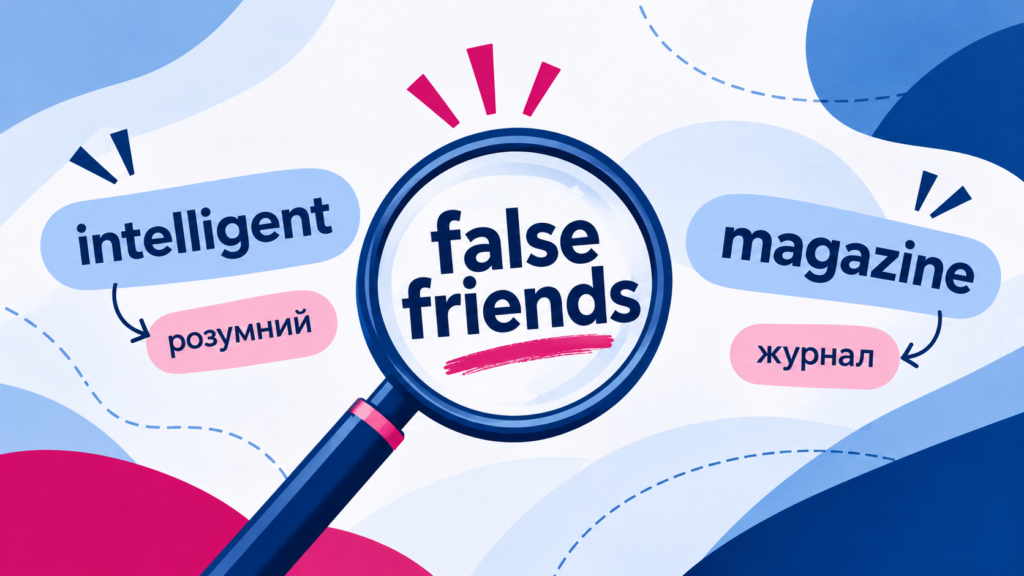
| magazine | a periodical with articles and photographs | магазин (shop) | журнал | I read a travel magazine on the plane. | У літаку я читав журнал про подорожі. | Identical sound at the start, different meaning entirely. A shop is a shop or a store. |
| novel | a long fictional book | новела (short story, novella) | роман | She is writing a historical novel. | Вона пише історичний роман. | The Ukrainian word points to something shorter. English has novella and short story for that. As an adjective, novel means “new and original”. |
| resume (verb) | to begin again after a pause | резюме (CV; summary) | відновлюватися, продовжуватися | The meeting will resume after lunch. | Нарада відновиться після обіду. | The verb is pronounced rɪˈzjuːm. The noun résumé, mainly American English for a CV, is a separate word with different stress. |
Places, objects and everyday life
| English word | Actual English meaning | Often confused with | Correct Ukrainian translation | Example sentence | Ukrainian translation | Why the confusion happens |
| fabric | cloth; material used to make clothes or curtains | фабрика (factory) | тканина | This fabric is soft but very durable. | Ця тканина м’яка, але дуже міцна. | The first syllables match. A factory is a factory. |
| cabinet | a cupboard with shelves or drawers; also the group of senior ministers in a government | кабінет (office, study) | шафка, шафа; кабінет міністрів (government) | The plates are in the kitchen cabinet. | Тарілки лежать у кухонній шафці. | A partial overlap: the government sense matches. A room for working is an office or a study. |
| baton | a short stick, such as one passed in a relay race, used by a conductor, or carried by police | батон (long loaf of bread) | естафетна паличка; диригентська паличка; кийок | She passed the baton to the next runner. | Вона передала естафетну паличку наступному бігунові. | The words are almost identical. A loaf of bread in English is a loaf. |
| prospect | the possibility that something will happen; prospects means chances of future success | проспект (avenue) | перспектива, можливість | The prospect of moving abroad made her nervous. | Перспектива переїзду за кордон її хвилювала. | An avenue or wide city street is an avenue or a boulevard in English. |
| gymnasium | a large room or building for sports and exercise, often shortened to gym | гімназія (a type of school) | спортивний зал | The basketball game will be held in the school gymnasium. | Баскетбольний матч відбудеться в шкільному спортивному залі. | In English the word is about sport. For a school, use secondary school or grammar school, depending on the context. |
Food, health and everyday meanings
| English word | Actual English meaning | Often confused with | Correct Ukrainian translation | Example sentence | Ukrainian translation | Why the confusion happens |
| marmalade | a preserve made from citrus fruit, especially oranges | мармелад (jelly-like sweets) | цитрусовий джем, апельсиновий конфітюр | She spread orange marmalade on her toast. | Вона намазала на тост апельсиновий джем. | The Ukrainian word names a type of confectionery. The English word names a jam-like spread. |
| biscuit | in British English, a flat, crisp, sweet baked snack; in American English, a soft bread-like roll | бісквіт (sponge cake) | печиво (UK) | Would you like a biscuit with your tea? | Хочете печиво до чаю? | A sponge cake in English is a sponge cake. In the United States, a biscuit is a different food again. |
| angina | chest pain caused by reduced blood flow to the heart | ангіна (tonsillitis, sore throat) | стенокардія | The doctor said the chest pain was angina. | Лікар сказав, що біль у грудях це стенокардія. | The same word names two different conditions. For a throat infection, English says tonsillitis or sore throat. |
| complexion | the natural colour and condition of the skin on the face | комплекція (build, physique) | колір обличчя, стан шкіри обличчя | She has a fair complexion, so she uses sunscreen every day. | У неї світла шкіра обличчя, тому вона щодня користується сонцезахисним кремом. | The beginning of the words is the same. Body build is build or physique. |
| familiar | well known; seen or heard before | фамільярний (overly casual, too informal) | знайомий | The street looked familiar, but I couldn’t remember why. | Вулиця здавалася знайомою, але я не могла згадати чому. | The Ukrainian word carries a negative flavour of rudeness. The English word is neutral, as in familiar with a topic. |
| pretend | to behave as if something is true when it is not | претендувати (to claim, to aspire to) | вдавати, прикидатися | He pretended not to notice the mistake. | Він удав, що не помітив помилки. | A claim in English is claim, and to aspire to is aspire to. |
False Friends That Can Completely Change the Meaning of a Sentence
A false friend does not always produce a sentence that sounds wrong. Sometimes it produces a sentence that sounds perfectly normal but means something else. Here are seven everyday situations where this can happen.
- Shopping
Incorrect: “Can I have one baton and a litre of milk, please?”
What it communicates: The shop assistant may think you want a stick, or may simply be confused. English does not use baton for bread.
Correct: “Can I have a loaf of bread and a litre of milk, please?”
Ukrainian: “Можна мені батон і літр молока, будь ласка?”
- Work
Incorrect: “Our chef approved the budget yesterday.”
What it communicates: The person who decided on the budget appears to be the cook of the company.
Correct: “Our manager approved the budget yesterday.”
Ukrainian: “Наш керівник учора затвердив бюджет.”
- Studying
Incorrect: “Please write the data at the top of your essay.”
What it communicates: The teacher is asked to receive facts and figures at the top of the page, which is not what you meant.
Correct: “Please write the date at the top of your essay.”
Ukrainian: “Будь ласка, напишіть дату вгорі вашого есе.”
- Conversation
Incorrect: “I met your sister yesterday. She is very sympathetic.”
What it communicates: She is compassionate and ready to understand other people’s problems. This is a different compliment from “pleasant to talk to”.
Correct: “I met your sister yesterday. She seems very nice.”
Ukrainian: “Вчора я познайомився з твоєю сестрою. Вона здається дуже симпатичною.”
- Travel
Incorrect: “Our hotel is on the prospect near the station.”
What it communicates: A listener will hear a word about future possibilities in the middle of a street description, which makes no sense.
Correct: “Our hotel is on a wide avenue near the station.”
Ukrainian: “Наш готель розташований на широкому проспекті біля вокзалу.”
- Health
Incorrect: “I can’t come today. I have angina.”
What it communicates: A serious heart condition, which may alarm your listener.
Correct: “I can’t come today. I have a sore throat.” (or “I have tonsillitis.”)
Ukrainian: “Я не зможу прийти сьогодні. У мене ангіна.”
- Work
Incorrect: “Is this information still actual?”
What it communicates: A listener may understand that you are asking whether the information is real, not whether it has been updated.
Correct: “Is this information still up to date?”
Ukrainian: “Ця інформація ще актуальна?”
In each case the learner’s thought was reasonable and the word was familiar. The danger lies in the fact that a recognised word feels safe.
False Friends vs. True Cognates: How to Tell the Difference
Learners often use the word “similar” to describe three quite different situations.
True cognates are words in different languages that descend from a shared ancestor. English and Ukrainian are both Indo-European languages, so a number of everyday words are inherited from the same source and still resemble each other. Examples are mother and мати, brother and брат, night and ніч, three and три. These pairs are reliable.
True friends are not strictly cognates, but they are equally useful. They are international words borrowed into both languages, mostly from Latin and Greek, which kept the same meaning. University and університет, student and студент, music and музика, problem and проблема are good examples. A large part of the vocabulary that looks familiar to Ukrainian speakers belongs here, which is why the strategy “guess from the Ukrainian word” works so often.
False friends look equally familiar, but the meanings no longer match. This group includes words with no overlap at all, such as data and дата.
Partial or context-dependent similarities sit in between. For example, argument can mean a reasoned point, which matches аргумент, but in everyday English it more often means a quarrel. Cabinet matches кабінет in the sense of a government cabinet (кабінет міністрів), but not for a room. Artist overlaps with артист in “recording artist”, but not for an actor.
| Category | Example pair | What to remember |
| True cognate | night and ніч | Shared ancestry and meaning |
| True friend (borrowed word) | university and університет | Shared meaning through borrowing |
| False friend | magazine and магазин | Similar form, different meaning |
| Partial similarity | cabinet and кабінет | Meaning matches only in some contexts |
Shared origin does not guarantee shared meaning. Some false friends have a common root and some resemble each other by pure accident. Do not try to decide this by looking at spelling. Check the meaning in context every time.
Why Ukrainian Speakers Often Confuse These Words
There are five main reasons, and understanding them makes the mistakes easier to prevent.
The first is a large layer of shared international vocabulary. English and Ukrainian have both taken words from Latin, Greek and other European languages. This gives Ukrainian English learners a large head start, but it also creates a habit of trusting every familiar-looking word.
The second reason is that borrowed words arrived by different routes and at different times. A word that entered Ukrainian through one language and English through another may have carried a different sense on arrival, or may have been used in a different field.
Third, meanings develop independently. Once a word is borrowed, it lives its own life. It can narrow (chef now means only a cook in English), broaden, or shift in tone. Ukrainian фамільярний acquired a negative flavour that English familiar does not have.
Fourth, word-for-word translation hides these differences. If you translate a Ukrainian sentence into English one word at a time and pick the closest-looking English form, the resulting sentence may be grammatical but still mean something different.
Fifth, dictionaries and memory can mislead. A learner who remembers only the first translation they saw, or who notices only that the first letters match, may never get the chance to check the real meaning. This is one of the most common causes of confusing English vocabulary.
None of this means that similarity is a bad guide. It is a good guide most of the time and a poor one in a limited number of cases, which is why it is worth learning those cases specifically.
How to Avoid False Friends When Learning English
These eight strategies work well for independent learners.
- Learn words in context. Write each new word inside a complete sentence, not on its own. A sentence such as “The actual price was higher” teaches the meaning, the grammar and the typical position of the word at once.
- Check example sentences in a reliable dictionary. Do not stop at the translation. Read the definition and at least two examples to see what the word really does. A learner’s dictionary such as Oxford Learner’s Dictionaries shows grammar, register and example sentences in one place.
- Notice collocations. Words work in partnerships: you make a decision, you do homework, you collect data. If a word does not fit its usual partners, your meaning may be wrong.
- Keep a personal list of confusing words. Write the English word, its real meaning, the Ukrainian word that tempted you, and one sentence of your own. Add to it whenever you catch a mistake. The techniques in vocabulary memory techniques can help you organise such a list.
- Compare meanings, not spelling. When a new word looks like a Ukrainian word, make it a habit to ask “Does it really mean the same?” before using it.
- Practise translating whole sentences. A single-word translation hides context. Translating a full sentence in both directions shows quickly where a word does not fit. This also reveals grammar problems, for example with the choice of tense, and English Tenses Explained is a useful companion for that.
- Use a monolingual English dictionary when you are ready. An English definition tells you what the word means in English, not what it resembles in Ukrainian, which removes the influence of the translation.
- Review with spaced repetition. Go back to your list after one day, one week and one month. Short sessions fit well into a busy day, and microlearning in spare time explains how to use them.
Practice: Can You Identify These False Friends?
The exercises become more difficult as you go. Try to answer without looking back at the tables.
Part 1: Multiple choice
- “We need more data to finish the report.” In this sentence, data means:
A. a calendar day
B. facts and figures
C. a meeting - “This fabric is perfect for curtains.” Fabric means:
A. a factory
B. cloth
C. a furniture shop - Which English word best describes a person who is polite, well-mannered and cultured (інтелігентна людина)?
A. intelligent
B. well-mannered
C. sympathetic - “The doctor told him the chest pain was angina.” Angina is:
A. a sore throat
B. a heart-related chest pain
C. an allergy
Part 2: Choose the correct translation
- Ця інформація вже неактуальна.
A. This information is no longer actual.
B. This information is no longer up to date.
C. This information is no longer accurate. - У дитини ангіна.
A. The child has angina.
B. The child has tonsillitis.
C. The child has asthma.
Part 3: Correct the misleading sentence
- “Please send me the data of the meeting.”
- “My father works in a big fabric near Lviv.”
- “She is a famous artist; she plays the lead role in a new TV series.”
Part 4: Matching
- Match each word with its meaning.
Words: 1. baton, 2. cabinet, 3. genial, 4. pathetic, 5. resume (verb)
Meanings:
A. friendly and cheerful
B. to start again after a pause
C. a stick passed from one runner to another in a relay race
D. a cupboard with shelves or doors
E. very poor, or deserving pity
Part 5: Advanced
- Which two sentences are correct?
A. “The prospects for the new project look promising.”
B. “We walked along the main prospect.”
C. “He has a strong, athletic complexion.”
D. “Her complexion was pale after the long flight.” - Translate into English, paying attention to two false friends: “Мій колега дуже акуратний, і його звіт теж дуже точний.”
Answer Key and Explanations
- B. Data means facts and figures. A calendar day is a date.
- B. Fabric means cloth. A factory is a factory.
- B. Well-mannered (or polite, cultured) describes the quality that the Ukrainian word інтелігентний has. Intelligent means clever, and sympathetic means compassionate.
- B. Angina is chest pain from reduced blood flow to the heart. The Ukrainian ангіна, a throat infection, is a different condition.
- B. “Up to date” is the natural way to say that information is current. Actual would mean “real”, and accurate would mean “correct”, which are different ideas.
- B. Tonsillitis is the English name for the condition. Angina in English refers to the heart.
- “Please send me the date of the meeting.” The writer wanted a calendar date, not facts and figures.
- “My father works in a big factory near Lviv.” Fabric is cloth, and a place where goods are made is a factory.
- “She is a famous actress; she plays the lead role in a new TV series.” Artist usually means a painter or creator of art. For performers on screen, use actor or actress.
- 1 – C, 2 – D, 3 – A, 4 – E, 5 – B. Baton is the relay stick. Cabinet is a cupboard. Genial is friendly. Pathetic means very poor or deserving pity. Resume as a verb means to begin again.
- A and D. In A, prospects means chances of success, which is correct. In B, prospect is not a street. Say avenue or boulevard. In C, complexion refers to facial skin, not body build, so athletic build would be correct. In D, complexion is used correctly.
- “My colleague is very neat (or tidy), and his report is very accurate too.” Акуратний describes neatness, and the English word for exactness is accurate. Here the two Ukrainian words are very close in sound to a single English word, and they need different translations.
Quick Summary
The key ideas from this article can be reduced to five points.
- A false friend looks like a word in your own language but has a different meaning. It is different from a grammar mistake.
- A familiar-looking word is a reliable guide most of the time, but not always. This is why unfamiliar-looking exceptions matter.
- Some pairs are completely different (data and дата), while others overlap only in some contexts (cabinet and кабінет).
- Context, collocations and example sentences are more trustworthy than spelling.
- A short personal list of confusing words, reviewed regularly, prevents most repeat mistakes.
| English word | Correct meaning | Not to be confused with |
| data | дані | дата |
| magazine | журнал | магазин |
| fabric | тканина | фабрика |
| actual | справжній, фактичний | актуальний |
| accurate | точний | акуратний |
| sympathetic | співчутливий | симпатичний |
| intelligent | розумний | інтелігентний |
| chef | шеф-кухар | шеф (керівник) |
| cabinet | шафка | кабінет (кімната) |
| resume (verb) | продовжуватися | резюме |
FAQ About English False Friends
What are false friends in English?
They are words in English that look or sound like words in another language, here Ukrainian, but have a different meaning. Examples include magazine and магазин, or data and дата.
What is the difference between false friends and cognates?
Cognates share a common ancestor, such as night and ніч. False friends look similar but differ in meaning today. A pair can be both, if the words share an origin but their meanings have drifted apart.
What are the most common English false friends for Ukrainian speakers?
Among the most frequent are magazine, actual, accurate, data, fabric, sympathetic, intelligent, chef and prospect. The tables above give 24 verified examples.
Why do English and Ukrainian have similar-looking words with different meanings?
Both languages have borrowed vocabulary from Latin, Greek and other European languages. Borrowed words arrived at different times, through different routes, and then developed independently in each language.
How can I remember false friends?
Link each word to a sentence of your own, keep a short personal list, and review it at spaced intervals. Remembering the Ukrainian word that tempts you, together with the correct English word for that meaning, is especially effective.
Are false friends always completely different in meaning?
No. Some are completely different, such as data and дата. Others overlap in some contexts, such as cabinet, which can mean a government cabinet as well as a cupboard, or artist, which can include performers in “recording artist”.
Can one English word have several translations depending on context?
Yes. Cabinet can be шафка or кабінет міністрів. Biscuit can be печиво in British English or a soft bread roll in American English. A word should always be translated in context, not in isolation.
Conclusion
English false friends are not a sign of poor vocabulary. They are a natural by-product of the fact that English and Ukrainian share so many words. The same similarity that helps you recognise university or problem instantly can also lead you to read magazine as a shop. The approach that works is neither distrusting every familiar word nor trusting every one, but checking meaning in context, especially when a word looks suspiciously easy.
If you keep sentences, collocations and short personal lists at the centre of your learning, spelling similarity becomes a helpful hint instead of a trap. Over time the exceptions in this article will stop looking like surprises and start looking like a small, predictable group of words you already know how to handle.

