



Few parts of grammar cause as much frustration as English prepositions. You know the words, but you still hesitate: is it “in the morning” or “at the morning”? “Arrive in London” or “arrive to London”? “Good in English” or “good at English”? Many learners solve this by guessing, and often they guess wrong.
The good news is that English prepositions follow patterns. Some are logical, some you have to memorize, but most are easier once you see how they work. This guide covers the most common and confusing ones (in, on, at, to and for), explains time and place with clear comparisons, shows typical mistakes, and gives you exercises with an answer key.
Table of Contents
- What Are Prepositions in English?
- Prepositions of Time: In, On, At
- IN vs ON vs AT: Time Comparison Table
- Prepositions of Place: In, On, At
- IN vs ON vs AT: The Most Common Confusion
- How to Use TO
- How to Use FOR
- TO vs FOR: What's the Difference?
- Other Common English Prepositions
- Common Mistakes with English Prepositions
- Prepositions That Commonly Go Together with Certain Words
- How to Learn English Prepositions More Easily
- Practice: English Prepositions Exercises
- Answer Key
- Quick Reference: English Prepositions
- FAQ
- Conclusion
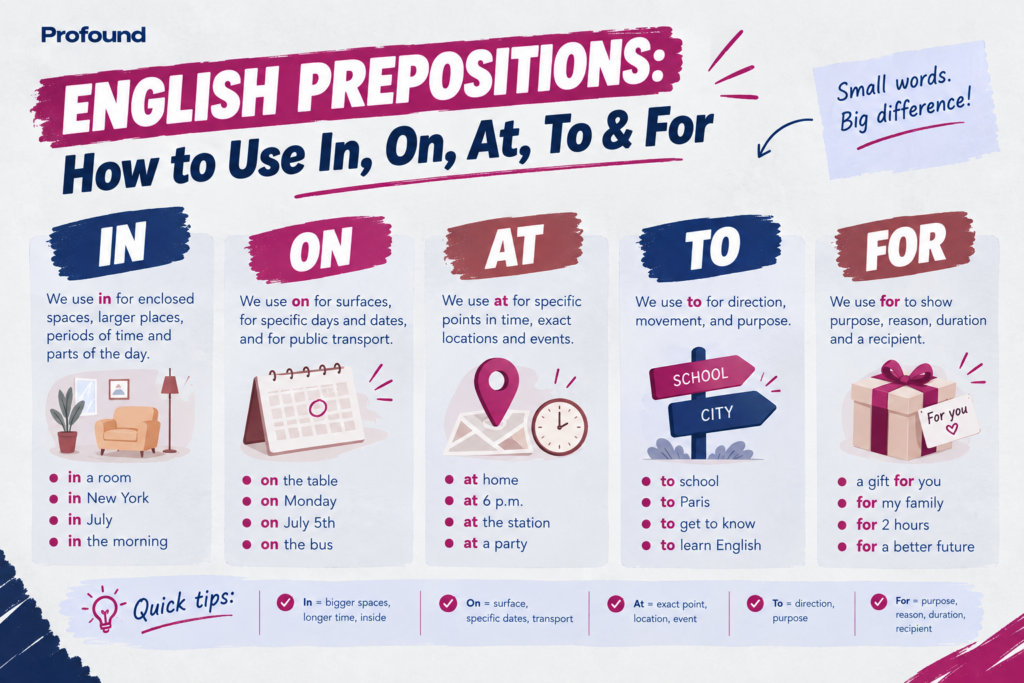
What Are Prepositions in English?
A preposition is a short word that shows the relationship between a noun or pronoun and another part of the sentence. It usually answers questions such as where, when, who for, or how.
- The keys are on the table.
- We have a lesson at 6 o’clock.
- She is walking to the park.
- This coffee is for you.
Prepositions matter because changing one word can change the meaning completely. “I’m waiting for you” and “I’m waiting with you” are different situations. A wrong preposition rarely stops people from understanding you, but it makes your English sound unnatural.
Prepositions in English grammar usually describe:
- place: in the kitchen, on the wall, at the station;
- time: in July, on Monday, at noon;
- direction and movement: to the airport, into the room, through the tunnel;
- relationships between things: a book about history, a cup of tea, a house with a garden;
- purpose or reason: a gift for a friend, a room for rent.
A preposition is almost always followed by a noun, a pronoun or an -ing form: “at school”, “with her”, “interested in learning”. Each preposition has a core idea, and once you know it, most examples start to make sense.
Prepositions of Time: In, On, At
The three most common English prepositions of time are in, on and at. A helpful way to remember them is to think of them as a funnel that goes from large to small:
- IN is used for longer periods (years, months, seasons).
- ON is used for specific days and dates.
- AT is used for exact times and specific moments.
When to Use IN for Time
Use in for periods of time that have some length: months, years, seasons, centuries, and parts of the day.
- My birthday is in October.
- She was born in 1998.
- We often go skiing in winter.
- This building was built in the 19th century.
- I study in the morning and work in the afternoon.
IN is also used to say how long until something happens: “The train leaves in ten minutes” (ten minutes from now).
When to Use ON for Time
Use on for days, dates, and a particular day combined with a part of the day.
- The lesson is on Tuesday.
- Her birthday is on 5 May.
- We have a party on New Year’s Eve.
- I’ll see you on Friday morning.
- They got married on a sunny Saturday afternoon.
Notice the difference: “in the morning” is general, but “on Friday morning” names a specific day, so it needs ON.
When to Use AT for Time
Use at for exact clock times and specific points in time.
- The film starts at 8:15.
- I wake up at 7 o’clock.
- We have lunch at noon.
- The shop closes at midnight.
- I don’t like driving at night.
- They are always busy at the weekend. (In American English, people usually say on the weekend.)
Expressions such as at night, at noon, at midnight, at the moment and at the weekend are fixed, so learn them as phrases. Compare “in the morning / in the afternoon / in the evening” with “at night”. This is one of the exceptions you simply have to remember.
IN vs ON vs AT: Time Comparison Table
| Preposition | When to use it | Examples |
| IN | Months, years, seasons, centuries, parts of the day, time until something happens | in June, in 2025, in summer, in the evening, in five minutes |
| ON | Days of the week, dates, special days, a specific day plus part of the day | on Monday, on 12 April, on my birthday, on Sunday morning |
| AT | Exact clock times, specific points in time, fixed expressions | at 6:30, at noon, at midnight, at night, at the weekend |
Notice that you never use prepositions before “tomorrow”, “yesterday”, “today”, “next week” or “last year”. We say “I’ll call you tomorrow”, not “on tomorrow”.
If you are still building a sense of how time works in English, our guide to English tenses will help, and the Present Simple is the tense you will use most often with these time expressions.
Prepositions of Place: In, On, At
Prepositions of place work in a similar way to the time prepositions.
- IN means inside something or within an area.
- ON means on a surface or a line.
- AT means at a point or location.
IN for Place
Use in for enclosed spaces, and for cities, countries, regions and other large areas.
- The milk is in the fridge.
- She is in her bedroom.
- We live in Munich, in Germany.
- He works in a bank.
- There is a small lake in the park.
ON for Place
Use on for surfaces, lines, floors of a building, and many forms of public transport.
- The book is on the desk.
- There is a picture on the wall.
- They live on the second floor.
- Our house is on Baker Street. (British English also uses “in the street”, which is also fine.)
- I’m on the bus, on the train, on a plane.
For public transport you stand or walk inside, use ON: on a bus, on a train, on a ship. For small private vehicles, use IN: in a car, in a taxi.
AT for Place
Use at when you think of a place as a point on a map, or when you talk about the activity that normally happens there.
- I’ll meet you at the bus stop.
- She is waiting at the entrance.
- We were at the cinema last night.
- He lives at 25 Green Road.
- Turn left at the traffic lights.
Learn these common fixed expressions: at home, at work, at school, at university, at the airport, at the station.
| Preposition | When to use it | Examples |
| IN | Enclosed spaces, cities, countries, large areas | in a box, in the kitchen, in Paris, in Ukraine |
| ON | Surfaces, lines, streets, floors, public transport | on the table, on the wall, on the third floor, on the bus |
| AT | Specific points, addresses, events, institutions | at the door, at 10 Main Street, at the station, at a concert |
IN vs ON vs AT: The Most Common Confusion
The key idea is this: the preposition shows how you see the place or time. The same location can take different prepositions, depending on what you want to say.
- I am in the office. You are physically inside the building or room.
- I am at the office. You are there as a place of work. It is a point where you do your job.
- The book is on the desk. It is lying on the surface.
- The book is in the desk. It is inside a drawer.
More contrasts:
- “She is in the hospital” means she is a patient, and the building matters. In British English, people often say “She is in hospital”. “She is at the hospital” means she is visiting or working there, and the location is just a point.
- “We are in the cinema” focuses on the room. “We are at the cinema” simply states where we are.
- “He is waiting in the car” means inside the car. “He is waiting on the car” would mean on the roof, which is strange. “He is waiting at the car” means standing next to it.
When two prepositions are both possible, the choice often depends on whether you are thinking of an enclosed space (in), a surface (on) or a point (at).
How to Use TO
The main meaning of to is direction or movement toward something. It shows where someone or something is going.
- I am going to school.
- She walked to the station.
- They flew to Rome last week.
- Please send this letter to the manager.
TO is also used for transfer, when something passes from one person to another:
- I gave the book to my friend.
- He explained the rule to us.
- She sent a message to her parents.
Important difference: “to” as a preposition vs “to” in the infinitive.
- Preposition: I’m going to the shop. (followed by a noun or pronoun)
- Infinitive marker: I want to learn English. (followed by a base verb)
A simple test: if you can put “the” or a noun after it, it is a preposition. If it is followed by a verb like “learn”, “go” or “see”, it is part of the infinitive.
Be careful with expressions where “to” is a preposition but looks like part of an infinitive. After these, use an -ing form: “I’m looking forward to seeing you”, “She is used to getting up early”. In these cases, “to” is a preposition, so a verb after it takes -ing.
Also note that we do not use “to” with “home”: “I’m going home”, not “going to home”.
How to Use FOR
For has several important meanings.
Purpose or use
- This tool is useful for learning English.
- What is this button for?
Intended recipient or benefit
- This gift is for you.
- She cooked dinner for her family.
Duration
- I studied for two hours.
- They have lived here for five years.
Reason
- He was famous for his paintings.
- Thank you for your help.
FOR is also used with some verbs and adjectives, such as wait for, look for, ask for, and responsible for.
For duration, learners often confuse for and since. Use “for” with a length of time (for three days), and “since” with a starting point (since Monday). This is very common with the Present Perfect.
TO vs FOR: What’s the Difference?
These two prepositions are easy to mix up because both can be used with a person. The key difference is the idea behind them.
- TO shows direction or transfer. Something moves toward someone or something.
- FOR shows benefit or purpose. You do something to help someone or to achieve something.
| Preposition | Core idea | Examples |
| TO | Direction, destination, giving or sending to someone | I gave the book to Anna. He sent a letter to his bank. We are going to Paris. |
| FOR | Benefit, purpose, duration, reason | I bought the book for Anna. She made tea for us. I waited foran hour. |
Compare these two sentences:
- I gave the book to Anna. The book was handed over to her directly.
- I bought the book for Anna. I bought it for her benefit, perhaps as a gift, but I did not necessarily hand it over at that moment.
Verbs like give, send, show, tell, lend and explain usually take TO. Verbs like buy, make, cook, find and save often take FOR when you do something to benefit someone.
- Could you show your passport to the officer?
- Could you open the door for me?
Other Common English Prepositions
You do not need a dictionary of every preposition, so here are the most useful ones in groups.
Direction and source: from, to, into, out of
- She comes from Poland.
- He walked into the room.
Connection and relation: with, without, about, of, by
- I live with my brother.
- She left without saying goodbye.
- We talked about music.
- It is a cup of tea.
- The book was written by a famous author. (BY can also mean “next to” or “not later than”.)
Position: under, over, between, among
- The cat is under the table.
- A plane flew over the city.
- The shop is between the bank and the café. (between two things)
- She was sitting among her friends. (among three or more)
Time: before, after, during, since, until
- Wash your hands before dinner.
- I’ll call you after the lesson.
- He fell asleep during the film. (during + event)
- I have known her since 2015.
- Wait here until six o’clock.
As these prepositions refer to time sequences, you can see more examples in the Past Simple, for finished actions, and in the Present Perfect, for connections with the present.
Common Mistakes with English Prepositions
Many mistakes come from translating directly from your own language. Here are some of the most frequent ones.
Wrong: I am good in English.
Correct: I am good at English.
Explanation: The fixed phrase is “good at” a skill or subject.
Wrong: I arrived to London yesterday.
Correct: I arrived in London yesterday.
Explanation: After “arrive”, use IN for cities and countries, and AT for smaller places such as the airport, the hotel or the station.
Wrong: She is interested on music.
Correct: She is interested in music.
Explanation: “Interested” is always followed by IN.
Wrong: I’m afraid from spiders.
Correct: I’m afraid of spiders.
Explanation: “Afraid” takes OF.
Wrong: I live here since three years.
Correct: I have lived here for three years.
Explanation: Use FOR with a period of time and SINCE with a starting point.
Wrong: I will finish the report until Friday.
Correct: I will finish the report by Friday.
Explanation: BY means “not later than”. UNTIL means “continuing up to that time”: “I’ll work until Friday” means I’ll keep working and stop on Friday.
Wrong: I was in the gym during two hours.
Correct: I was in the gym for two hours.
Explanation: FOR answers “how long?”. DURING answers “when?” and is followed by an event: “during the lesson”.
Wrong: I’m going to home.
Correct: I’m going home.
Explanation: “Home” works as an adverb here, so no preposition is needed.
Wrong: We met at Monday.
Correct: We met on Monday.
Explanation: Days of the week need ON.
Prepositions That Commonly Go Together with Certain Words
Some English words are always used with a particular preposition. These combinations are sometimes called collocations or prepositional phrases, and there is often no logical reason for them, so it is best to learn them together.
- interested in art
- good at drawing
- afraid of the dark
- depend on the weather
- listen to music
- wait for a friend
- belong to a club
- think about the future
- look at this photo
- worry about exams
- different from (or “different to” in British English)
Do not be surprised if your own language uses a different preposition for the same idea. In English you “listen to” something, but in many languages you listen without any preposition. Learn the English pattern as it is. If you want to go further with fixed structures, take a look at Advanced Grammar Structures.
For a reliable, detailed reference on how prepositions work and how they are classified, the Cambridge Dictionary grammar section is a helpful resource.
How to Learn English Prepositions More Easily
- Learn prepositions in phrases, not alone. Do not memorize “at = в/на”. Remember “good at maths”, “at the bus stop”, “at 6 o’clock”.
- Notice prepositions when you read and listen. When you see “depend on” in an article, write down the whole phrase.
- Compare similar examples. Put “in the office”, “at the office” and “on the desk” side by side and ask what is different.
- Create your own sentences. Write about your real life: “I wake up at 7. I work in Kyiv. I study on Tuesdays.”
- Practice a little each day. Five minutes of daily review works better than one long session each month. See our article on Microlearning for ideas. [INTERNAL LINK: Microlearning article]
- Keep a mistakes notebook. When you notice a wrong preposition, write the correct version with a short example.
If you already use the Present Continuous and Present Simple, try writing example sentences with each preposition in both tenses.
Practice: English Prepositions Exercises
Part 1. Fill in the blank.
- The meeting starts ___ 9:30.
- My sister was born ___ 14 June.
- We usually have dinner ___ the evening.
- She is very good ___ maths.
- I’m waiting ___ the bus.
Part 2. Choose the correct preposition.
- I’ll see you ___ Friday. (in / on / at)
- They arrived ___ Munich late at night. (in / at / to)
- He gave the keys ___ his neighbour. (to / for)
- I’ve lived here ___ 2019. (since / for / during)
- Please stay here ___ I come back. (until / by / during)
Part 3. Correct the mistake.
- I’ll finish the report until Friday.
- She is afraid from dogs.
- We arrived to the airport at six.
- I’m interested on history.
Part 4. Choose between IN / ON / AT.
- Let’s meet ___ the corner of Main Street.
- She lives ___ the third floor.
- I never sleep well ___ night.
Part 5. Choose between TO / FOR.
- I bought a present ___ my mother.
- Can you send this email ___ the manager?
Part 6. Mixed.
- We stayed in a hotel ___ three nights, and then we went ___ the mountains.
Answer Key
- at (an exact time)
- on (a date)
- in (part of the day)
- at (good at + subject)
- for (wait for)
- on (a day of the week)
- in (arrive in + city)
- to (give something to someone, a transfer)
- since (a starting point in the past)
- until (continuing up to that moment)
- I’ll finish the report by Friday. (not later than)
- She is afraid of dogs.
- We arrived at the airport at six. (arrive at + smaller place)
- I’m interested in history.
- at (a point on a map)
- on (floors of a building)
- at (a fixed expression: at night)
- for (a benefit to someone)
- to (the email goes toward the manager)
- for (duration) and to (direction)
Quick Reference: English Prepositions
| Preposition | Main use | Example |
| IN | Inside, cities, countries, months, years, parts of the day | in the box, in Italy, in May |
| ON | Surfaces, days, dates, floors, public transport | on the table, on Monday, on the bus |
| AT | Specific points, exact times, addresses | at the door, at 5 o’clock, at school |
| TO | Direction, destination, giving to someone | go to work, give it to me |
| FOR | Purpose, benefit, duration, reason | a gift for you, for two hours |
| FROM | Starting point, origin | from Spain, from 9 to 5 |
| WITH | Together, using | with my friend, with a pen |
| ABOUT | Subject, topic | a book about animals |
| BY | Author, method, deadline, near | written by her, by bus, by Friday |
| OF | Belonging, parts, content | a cup of coffee, the end of the day |
| UNDER | Lower than, beneath | under the bed |
| OVER | Above, across | over the bridge |
| BETWEEN | In the middle of two | between the bank and the shop |
| AMONG | In a group of three or more | among my friends |
| BEFORE | Earlier than | before lunch |
| AFTER | Later than | after the lesson |
| DURING | Within an event or period | during the film |
| SINCE | From a point in the past until now | since 2020 |
| UNTIL | Up to a certain time | until Friday |
FAQ
What are prepositions in English?
Prepositions are short words such as in, on, at, to and for that show relationships of place, time, direction, purpose and more. They are usually followed by a noun, a pronoun or an -ing form.
What are the most common English prepositions?
The most common are in, on, at, to, for, of, with, by and from. Learning these first will help you in most everyday situations.
What is the difference between in, on and at?
In is for enclosed spaces and longer periods, on is for surfaces and specific days, and at is for specific points and exact times.
How do I know whether to use in, on or at?
Think of size and type. For time, go from large to small: in the year, on the day, at the hour. For place, think of inside (in), surface (on) or point (at). Then learn the exceptions as phrases.
What is the difference between to and for?
To shows direction or transfer (“I gave it to Anna”), while for shows purpose, benefit or duration (“I bought it for Anna”, “I waited for an hour”).
What are prepositions of time?
They show when something happens. The most common are in, on, at, for, since, during, before, after, by and until.
What are prepositions of place?
They show where something or someone is, such as in, on, at, under, over, between and among.
Why are English prepositions so difficult to learn?
Many of them do not follow strict logic, and each language uses them differently. Learning them as part of phrases and practicing regularly makes them much easier.
Conclusion
English prepositions become manageable once you know the core ideas behind them:
- IN = inside, longer periods and larger areas
- ON = surfaces, days and dates
- AT = specific points and exact times
- TO = direction, destination, movement
- FOR = purpose, benefit, duration, reason
Do not try to memorize everything at once. Learn prepositions in phrases, read real English, and review your mistakes. With regular practice, the right preposition will start to feel natural, and you will stop having to think about it.

