



Many learners know a word perfectly well on the page, yet fail to recognise it when someone says it in a sentence. You can read an article without difficulty and still lose the thread of a two-minute conversation. This gap is normal, and it does not mean your English is weak. Listening is a separate skill from reading, and it needs its own kind of practice.
Understanding speech takes more than vocabulary. In natural speech, words blend together, small words are pronounced quickly and weakly, speakers have different accents, and nothing waits for you to catch up. Learners who mostly study from books or screens often have little contact with real, unscripted English.
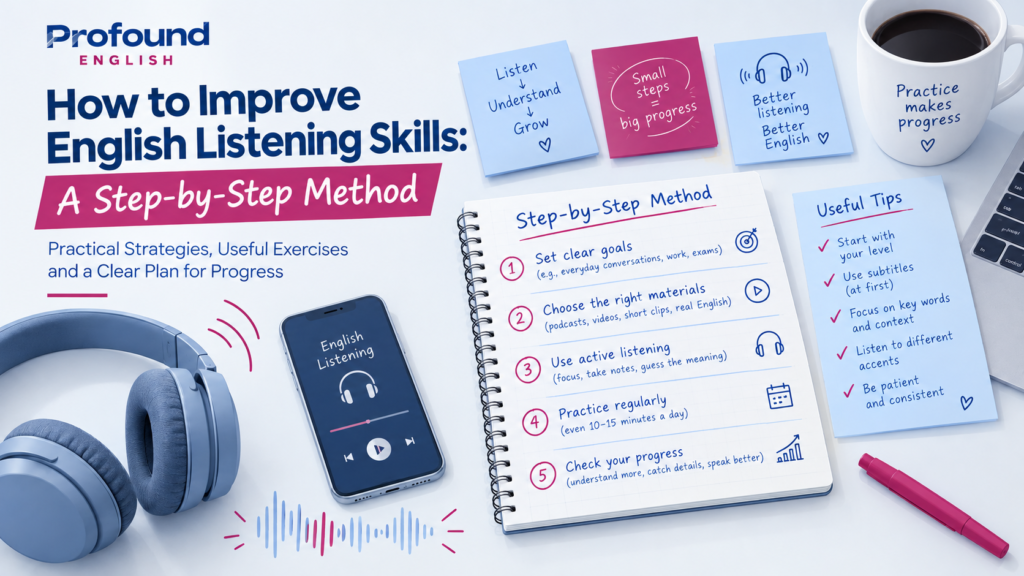
Your English listening skills improve through consistent, active practice with suitable materials and a method you can repeat. This article describes such a method: how to listen, what to listen to, how often to practise, how to avoid common mistakes, and how to check whether you are improving. It is useful for beginners and for advanced learners, but it is written mainly for A2 to B2 learners. It also includes a free seven-day plan and five exercises with answer keys.
Table of Contents
- Why Is English Listening So Difficult?
- Connected Speech and Reduced Sounds
- Different Accents and Pronunciation Patterns
- Vocabulary Recognition vs Listening Recognition
- Trying to Understand Every Word
- How to Improve English Listening Skills: The Core Method
- A Step-by-Step Listening Practice Routine
- Example of the Routine in Practice
- How to Choose the Right Listening Materials
- Active Listening vs Passive Listening
- How to Understand Native Speakers More Easily
- Common Listening Mistakes to Avoid
- A 7-Day English Listening Practice Plan
- How to Track Your Listening Progress
- English Listening Exercises
- Frequently Asked Questions
Why Is English Listening So Difficult?
Understanding speech means decoding a continuous stream of sound in real time. Here are the most common reasons this is hard.
Connected Speech and Reduced Sounds
In natural speech, words are rarely pronounced the way they sound when said one at a time. Speakers link, shorten, and blend words, a pattern usually called connected speech. Some common examples:
- “want to” often sounds like “wanna”
- “going to” often sounds like “gonna”
- “give me” often sounds like “gimme”
- “a lot of” often sounds like “a lotta”
- “What do you” can sound like “Whaddya”
- “pick it up” can sound like “pi-ki-tup”, because the final consonant of one word links to the vowel of the next
Small grammar words such as “of”, “to”, “and”, and “can” are usually pronounced weakly, so they are easy to miss.
Informal reductions like “wanna” and “gonna” are useful to recognise when you listen. In formal writing and in careful formal speech, use the full forms: “want to” and “going to”.
Different Accents and Pronunciation Patterns
English is spoken in many countries, and vowel sounds, rhythm, and some consonants vary between regions. If you have mostly heard one type of English, another accent can feel unfamiliar at first, even when the vocabulary is simple. No single accent is the “correct” one for understanding English. Listening to a range of speakers gradually trains your ear to cope with variation.
Vocabulary Recognition vs Listening Recognition
Knowing a word in writing does not guarantee you will recognise it in speech. Reading gives you time and visual shape. Listening gives you sound that disappears in a moment. A learner may know the word “comfortable” but not recognise it when it is spoken quickly as something like “KUMF-ter-bul”, with fewer syllables than the spelling suggests.
Recognising familiar words inside connected speech is a skill of its own, and it improves mainly through listening practice, not through extra reading. Vocabulary size matters too, because it is hard to understand words you have never learned. If you want to think about how much vocabulary supports everyday communication, see how much vocabulary you need to communicate in English.
Trying to Understand Every Word
Many learners stop mentally at each unfamiliar word. While you are thinking about that one word, the speaker continues, and you lose the next sentence as well. Soon the overall meaning has slipped away.
A more effective approach is to listen for the main message first, then return for details. A listener who understands “two friends are arranging a meeting for Friday evening” has understood something valuable, even if a few words were missed.
How to Improve English Listening Skills: The Core Method
The method below works with short audio clips, learner podcasts, educational videos, interviews, and other suitable materials. Its principles are:
- Use material that is challenging but manageable. You should understand some of it on the first listen, but not everything.
- Listen for the general meaning before analysing details. Decide what the recording is about before you worry about individual words.
- Repeat the same short recording when useful. Each replay should have a purpose.
- Use transcripts strategically. A transcript is a tool for checking what you missed, not a replacement for listening.
- Notice unfamiliar phrases and pronunciation patterns. Pay attention to how words actually sound.
- Review difficult sections instead of replaying everything. Go back to the exact place where meaning broke down.
- Practise consistently. Short, regular sessions give your ear repeated contact with the sounds of English.
Repeating a short recording with a clear objective is often more useful than listening to a long recording once and hoping something sticks. A clear objective (“find the two reasons the speaker gives”) makes you check your comprehension, and checking is where learning happens. A long recording heard without any check can feel productive without telling you what you really understood.
This is a practical method, not a universal formula. Learners differ in level, goals, and available time, so adjust the steps to suit you.
A Step-by-Step Listening Practice Routine
This routine can be used independently with any short recording of one to three minutes. Each step has a purpose, so try not to skip the early ones.
Step 1: Listen Without Subtitles or a Transcript
Play the recording once without reading anything. Try to identify:
- the topic
- the speaker’s main point
- the general situation (a conversation, a talk, an announcement, an interview)
- the parts you already understand
Do not worry about unfamiliar words during this first listen. Let them pass.
Step 2: Identify the Main Idea
After the first listen, write or say one or two sentences summarising the recording. For example:
- Understanding the general message: “The speaker is explaining why people should walk more often and gives a few simple ways to do it.”
- Trying to understand every word: “I did not understand ‘sedentary’, ‘incorporate’, or ‘brisk’.”
The first answer shows real comprehension even with missing words. The second only lists gaps. Aim for the first.
Step 3: Listen Again for Specific Information
Before you replay the recording, choose a goal. Listen for one type of detail, such as:
- names or places
- dates, times, or numbers
- reasons or causes
- instructions or the order of steps
Choosing the goal first keeps your attention focused. You can use different goals on different replays.
Step 4: Check the Transcript or Subtitles
Now read the transcript or turn on subtitles. Read as you listen, and mark:
- words you knew but did not recognise when spoken
- expressions that sounded different from their written form
- examples of connected speech
- new vocabulary that is genuinely useful (not every unfamiliar word)
- places where your first interpretation was wrong
Subtitles and transcripts should support active listening, not replace it. If you read throughout every session, you are practising reading, not listening.
Choose a small number of useful words and phrases to keep, and review them later. For ideas on how to remember them, see techniques for remembering English vocabulary.
Step 5: Replay Difficult Sections
Choose short sections, one or two sentences, where meaning broke down. Replay each one several times while looking at the transcript, then once without it. Listen for what the transcript showed you: the reduced word, the linked sounds, the stress.
Avoid repeating a sentence endlessly without a purpose. Two or three focused replays, followed by moving on, are usually more useful than ten replays with no goal. Once you can hear the difficult sentence, return to the full recording so you hear it in context again.
Step 6: Listen Again Without Reading
Replay the whole recording without the transcript. Ask yourself whether it feels clearer than the first time. The aim is better recognition and understanding, not memorising the transcript.
Step 7: Summarise What You Heard
Give a short spoken or written summary of the recording in your own words, without looking at the transcript. Summarising shows whether you understood the meaning or only recognised isolated words. If you cannot summarise, that tells you which parts need another look.
Example of the Routine in Practice
Suppose you choose a 90-second educational audio clip about a city bike-sharing scheme.
- You listen once. You understand that it is about renting bicycles in a city, and you hear “per hour” and some prices.
- You write: “The speaker explains how people can rent bicycles in the city and how much it costs.”
- You replay with one goal: the prices. You catch “two euros” and “half an hour” but are unsure about the rest.
- You read the transcript. You find that “half an hour” sounded like “halfanower”, and that “first thirty minutes are free” was something you misheard as “first thirty minutes is three”.
- You replay two difficult sentences three times each.
- You listen to the whole clip again without the transcript and notice that the prices are clearer.
- You say or write a three-sentence summary: what the scheme is, how to pay, and what is free.
This takes roughly 15 to 20 minutes and gives you a complete cycle of listening, checking, and review.
How to Choose the Right Listening Materials
The best material depends on your level, interests, and goals. Choose speech that is clear enough for you to follow some of it, topics you actually care about, and recordings short enough to finish and review.
| Material | Best For | Potential Challenge |
| Graded listening exercises | Beginners and structured practice | May sound less natural than everyday conversation |
| Short educational videos | Focused practice and familiar topics | Visual context can make comprehension seem easier than it is |
| Podcasts for learners | Regular listening and vocabulary development | Some episodes may contain unfamiliar expressions |
| Interviews and conversations | Natural speech and turn-taking | Speakers may interrupt each other or change topics |
| Films and TV series | Informal expressions and conversational English | Fast speech, background noise, and cultural references |
| News reports | Formal vocabulary and structured speech | Dense information and topic-specific language |
Not every material type suits every learner. A beginner will usually get more from graded exercises and learner podcasts than from a fast news report or an action film.
A recording is probably suitable if you understand part of it on the first listen, can get the main idea after one or two repeats, and the unfamiliar parts are manageable. If you understand almost nothing, it is too hard for now. If you understand nearly everything immediately, it is too easy to teach you much, although easy material is still fine for building confidence and speed.
If longer recordings tire you, start with short ones of one to three minutes and extend them gradually.
For free English listening exercises at different levels, with audio and transcripts, you can browse the British Council LearnEnglish listening section.
Active Listening vs Passive Listening
Active listening means you work with a recording: you set a goal, check what you understood, review the transcript, and listen again. Passive listening means English plays in the background while you do something else.
Passive exposure has some value. It can make the sound and rhythm of English more familiar, and it may help you feel comfortable with the language. Its limitation is that you rarely check comprehension, so it is hard to notice gaps or correct misunderstandings. Active listening gives you feedback and targets specific problems, but it takes more effort and more time per recording.
Passive exposure should not replace focused practice. Many learners combine both: focused practice sessions, plus background English when it is convenient. We cannot say precisely how much more effective one is than the other, because it depends on the learner, the material, and the goals.
A simple active listening sequence:
- Listen to a short recording.
- Identify the main idea.
- Check specific details.
- Review the transcript.
- Listen again.
How to Understand Native Speakers More Easily
Natural speech has patterns. Learning to recognise them makes it less overwhelming.
Learn Common Word Combinations
Fluent speakers process groups of words, not single words. When you know that certain words commonly go together, you can predict what comes next and recognise the whole group faster. Examples:
- “make a decision”: a common combination (not “do a decision”)
- “take a break”: you take a short rest
- “by the way”: used to add information, often casually
- “as soon as possible”: a very common phrase, often shortened to “ASAP” in writing
- “a bit of”: as in “a bit of help”, meaning a small amount
When you meet phrases like these in a transcript, save the whole phrase, not just its individual words.
Recognise Connected Speech
Here are common patterns to listen for:
- Linking: a final consonant joins the next vowel: “turn it off” sounds like “tur-ni-toff”.
- Weak forms: “can” is often pronounced weakly (“I can swim”), while “can’t” is stressed more strongly and has a different vowel. This is one reason these two words are easy to confuse.
- Dropped or softened sounds: “next week” can sound like “nex week”.
- Common informal reductions: “gonna”, “wanna”, “gotta”.
You need to recognise these patterns, not necessarily imitate every informal reduction in your own speech.
Focus on Stress and Intonation
In English, important words are usually stressed: they are louder, longer, or higher in pitch. Stress helps you find the key information. In “I need to BUY milk, not BORROW it”, the stressed words show the contrast.
Stress can also change meaning. “I didn’t say HE took it” suggests someone else took it. “I didn’t SAY he took it” suggests you only implied it. Intonation (rising or falling pitch) helps you recognise questions, surprise, and doubt. For example, “You’re coming?” with rising pitch is a question, even without the question structure.
Get Used to Different Accents
Start with relatively clear speech, then gradually add variety. For example, listen to one speaker for a few days, then switch to a speaker from a different region. At first the new accent may feel difficult, and that is normal. Expect adaptation to take some repeated exposure, and expect it to vary from learner to learner.
Use Context to Understand Unfamiliar Words
The topic, the surrounding words, and the speaker’s purpose often give strong clues about meaning. Consider this sentence: “The train was delayed, so the passengers were stranded at the station for two hours, waiting for information.” You may not know “stranded”, but the situation (a delayed train, waiting for two hours) suggests they were stuck and could not leave. That is usually enough to follow the story.
Grammar also gives clues. Tenses and time expressions affect how a sentence is understood, so it helps to be comfortable with the basics of English tenses. For a clear overview, see English tenses explained. In the same way, hearing “He is working from home this week” tells you something different from “He works from home”, which is a general habit. If you want to review that distinction, see the difference between Present Simple and Present Continuous.
Common Listening Mistakes to Avoid
- Translating every sentence word by word.
Why it is unhelpful: Translation is slow, and speech moves on while you translate.
Alternative: Listen for ideas and the overall message, and only translate specific items afterwards. - Choosing material far above your level.
Why it is unhelpful: If you cannot understand most of it, you cannot learn from it, and you may lose motivation.
Alternative: Choose recordings where you understand at least part of the message on a first listen. - Relying on subtitles throughout the entire exercise.
Why it is unhelpful: You end up reading, not listening.
Alternative: Listen first without them, then use them only to check specific problems. - Listening repeatedly without a specific goal.
Why it is unhelpful: Repeating the same audio without a task can create a feeling of progress without any evidence.
Alternative: Give each replay one clear task, such as finding the numbers or the reasons. - Avoiding unfamiliar accents completely.
Why it is unhelpful: Real conversations include many accents, and avoidance keeps them difficult.
Alternative: Add one new speaker or accent at a time, and keep recordings short at first. - Focusing only on vocabulary instead of overall meaning.
Why it is unhelpful: Knowing most words does not guarantee you understand the message.
Alternative: Always check comprehension with a summary, not just a list of new words. - Practising inconsistently.
Why it is unhelpful: Long gaps between sessions make it hard to build familiarity with sounds and patterns.
Alternative: Choose a small amount of time you can keep up, such as ten minutes a day. See short, regular English-learning sessions for ideas on fitting short sessions into a busy day. - Assuming that understanding one recording means all similar recordings will be easy.
Why it is unhelpful: Different speakers, speeds, and topics can change difficulty a lot.
Alternative: Test yourself regularly with new speakers and topics, not only with materials you already know.
A 7-Day English Listening Practice Plan
This plan is a simple starting point. It uses free materials, such as short recordings with transcripts from free listening websites. No paid subscription, course, or lesson is required. Ten to twenty minutes a day is a manageable starting amount, but this is a practical suggestion, not a scientifically proven formula. Adjust the time to your level and schedule.
Once you finish the week, repeat the plan with new recordings as you become more comfortable, and gradually choose slightly more challenging material.
| Day | Practice Focus | Suggested Activity | Approximate Time |
| 1 | Assess your current comprehension | Choose a 1 to 2 minute recording. Listen once without a transcript, write what you understood, then check with the transcript. Note how much you understood. | 15 minutes |
| 2 | Identify the main idea | Choose a new short recording. Listen once or twice and write a one-sentence summary of the main idea. Then check the transcript. | 10 to 15 minutes |
| 3 | Specific details | Choose a recording with numbers, names, or times. Decide your target (for example, all the numbers) and listen for them. Check with the transcript. | 15 minutes |
| 4 | Transcript work | Listen to a recording, then read the transcript. Mark words you knew but missed, and phrases that sounded different. Replay those sections. | 15 to 20 minutes |
| 5 | Connected speech | Using the same or a new recording with a transcript, find five examples of linking, reduction, or weak forms. Replay each and try to say it aloud. | 15 minutes |
| 6 | A different speaker or accent | Choose a recording by a speaker with a different accent. Follow the basic routine: main idea, details, transcript check. | 15 to 20 minutes |
| 7 | Compare | Repeat a recording from Day 1 or Day 2 without the transcript. Compare what you understand now with your earlier notes. | 10 to 15 minutes |
How to Track Your Listening Progress
One difficult recording does not show your overall progress, so compare your results across several sessions. Keep a simple log. For each recording, note:
- the topic of the recording
- whether you understood the main idea
- how many important details you identified
- whether you needed the transcript
- which pronunciation patterns caused difficulty
- whether the same recording became easier on a later attempt
A table or notebook is enough. Reviewing your notes every week or two helps you see patterns, such as numbers being hard to catch or certain linked sounds causing problems. Revisiting an older recording is one of the clearest ways to see change, because the material stays the same while your listening develops.
Progress is not always steady. Some days are harder than others because of topic, speaker, fatigue, or recording quality. Avoid expecting fixed timelines or specific fluency results. Look for gradual trends instead.
English Listening Exercises
These five exercises each train a different skill. Because they must work for everyone, they use written scripts, not real audio. To practise listening, ask a friend to read the script aloud to you, or record yourself reading it and listen later (with the text hidden), and then check your answers. If you only read the script silently, you are practising reading, not listening. They are free and need no special platform.
Exercise 1: Identify the Main Idea
Instructions: Have the script read aloud to you (or read it aloud, record it, and listen later). Listen once without looking at the text. Then answer the questions.
Script (a short announcement):
“Good afternoon, everyone. This is an announcement from the city library. Because of repair work on the roof, the main reading room will be closed from Monday to Thursday next week. The children’s section and the computer room will stay open as usual. We apologise for the inconvenience, and we expect the reading room to reopen on Friday morning.”
Questions:
- What is the main idea of the announcement?
- Which parts of the library stay open?
Answer key:
- The main reading room will be closed for repairs for part of next week.
- The children’s section and the computer room.
Explanation: The main idea is the overall message (a temporary closure), not every detail. The second question checks a specific detail.
Exercise 2: Recognise Key Details
Instructions: Listen to the dialogue once. Then listen again for times, numbers, and places, and answer.
Script (a conversation at a train station):
A: Excuse me, what time is the next train to Lviv?
B: The next one leaves at 14:40 from platform 3.
A: And how much is a ticket?
B: A single ticket is 380 hryvnias, and a return ticket is 650.
A: I’ll take a return, please.
Questions:
- What time does the train leave?
- Which platform?
- How much is the ticket the passenger buys?
Answer key:
- 14:40
- Platform 3
- 650 hryvnias (a return ticket)
Explanation: The speaker gives two prices, so you need to listen for which one the passenger chooses (“I’ll take a return”). This is typical of real listening: the first number you hear is not always the answer.
Exercise 3: Understand Connected Speech
Instructions: The sentences below are written the way they might sound in fast, informal speech. Read each one aloud, then write the standard form. Try saying them quickly, as in natural speech.
- “Whaddya wanna do tonight?”
- “I’m gonna call him later.”
- “Gimme a minute, I gotta find my keys.”
- “I’ve got a lotta work today.”
Answer key:
- “What do you want to do tonight?”
- “I’m going to call him later.”
- “Give me a minute, I have got to find my keys.” (or “I’ve got to find my keys”)
- “I have got a lot of work today.”
Explanation: These are informal spoken forms. They are helpful to recognise, but in formal writing and careful speech you should use the full forms.
Exercise 4: Infer Meaning from Context
Instructions: Have the script read aloud. Think about the meaning of the word in bold, using the context.
Script:
“Last Saturday, our flight was delayed for five hours because of heavy fog. Dozens of passengers were stranded at the airport, sitting on the floor and checking their phones. Some were quite angry, but most of us just waited and tried to stay calm.”
Questions:
- What do you think “stranded” means?
- Which details helped you decide?
Answer key:
- Stuck in a place, unable to leave or continue the journey.
- The flight was delayed for five hours, passengers were waiting at the airport, and some were angry.
Explanation: You do not need to know the exact dictionary meaning to follow the story. The situation gives you enough information.
Exercise 5: Summarise Spoken Information
Instructions: Have the script read aloud. Listen twice, then give a summary in two sentences without looking at the text.
Script:
“I started cycling to work three months ago. At first, it was difficult because the route has a long hill, and I arrived tired. But after a few weeks, it became easier. Now I save money on bus tickets, and I feel more energetic during the day. The only problem is the weather. When it rains, I take the bus.”
Question: Summarise the speaker’s experience in two sentences.
Sample answer: “The speaker started cycling to work, which was hard at first but became easier, and now saves money and feels more energetic. On rainy days the speaker still takes the bus.”
Checklist for your summary: Does it include the main change (cycling to work), the result (easier, cheaper, more energy), and the one problem (rain)? Is it in your own words, not copied from the script?
Frequently Asked Questions
How can I improve my English listening skills at home?
Use short recordings of one to three minutes, and follow a repeatable routine: listen once for the main idea, replay for specific details, check the transcript, replay difficult parts, and listen again without reading. Practise regularly, even for ten minutes a day. Free recordings with transcripts are enough to get started.
How long does it take to improve English listening comprehension?
It depends on your starting level, how consistently you practise, how difficult the materials are, your vocabulary, and how much spoken English you hear. There is no fixed number of days or weeks that applies to everyone. Track your progress over time to see your own pace.
Is it better to listen with or without subtitles?
Both have a place. Listening without subtitles trains your ear and shows what you really understand. Subtitles help you check what you missed and learn how words are spelled. A good approach is to listen first without them, then use them to review specific sections. Relying on subtitles all the time turns the exercise into reading.
Should I listen to English every day?
Regular exposure is useful because your ear gets repeated contact with the sounds and rhythm of English. But frequency alone is not enough. Focused practice, where you check your understanding, works alongside daily listening. A short, focused session each day is often more manageable than a long session once a week.
Why can I understand written English but not spoken English?
Reading lets you see word boundaries, pause, and re-read. Speech is continuous, fast, and temporary, and words change shape in connected speech. You may know the word on the page but not recognise its spoken form. This is why listening needs separate practice.
What should beginners listen to in English?
Beginners usually do best with short, clear recordings, graded listening exercises, familiar topics, and materials that include transcripts. Slow, clearly spoken audio with a simple structure makes it easier to learn how spoken words sound. You can move to more natural speech gradually.
Can I improve English listening by watching films and TV series?
Yes, they can help, especially for informal expressions and natural conversation, and the visual context can support understanding. However, films and series often have fast speech, background noise, slang, and cultural references. If you struggle with fast dialogue, start with short scenes, use subtitles strategically, and replay difficult parts.
Should I repeat the same audio several times?
Repeating can be useful when each repeat has a different goal: first the main idea, then details, then connected speech. When you understand the recording well and repeating no longer reveals anything new, move on to a new recording. Later you can return to the old one to check your progress.
Final Thoughts
Improving your listening is a matter of method and consistency. Choose materials that are challenging but manageable. Listen for the main idea first, then for details. Replay difficult sections with a clear objective, and use transcripts to find the gaps in your comprehension. Then listen again without reading, and give a short summary of what you heard.
Practise regularly, even in short sessions, and track your progress with recordings you can compare over time. Progress varies from person to person, so focus on your own trends and not on a fixed timeline.

