



Mixing up present perfect and past simple tenses is the fastest way to sound unnatural in English, even with perfect grammar elsewhere. Here’s the full breakdown, with examples, two quizzes, and resources to practice further.
Table of Contents:
- The core difference: unfinished time vs finished time
- Side-by-side comparison table
- Tricky cases that confuse even intermediate learners
- Common mistakes non-native speakers make
- Exercise 1: Fill in the blanks
- Exercise 2: Choose the correct option
- Helpful resources for further practice
- FAQ
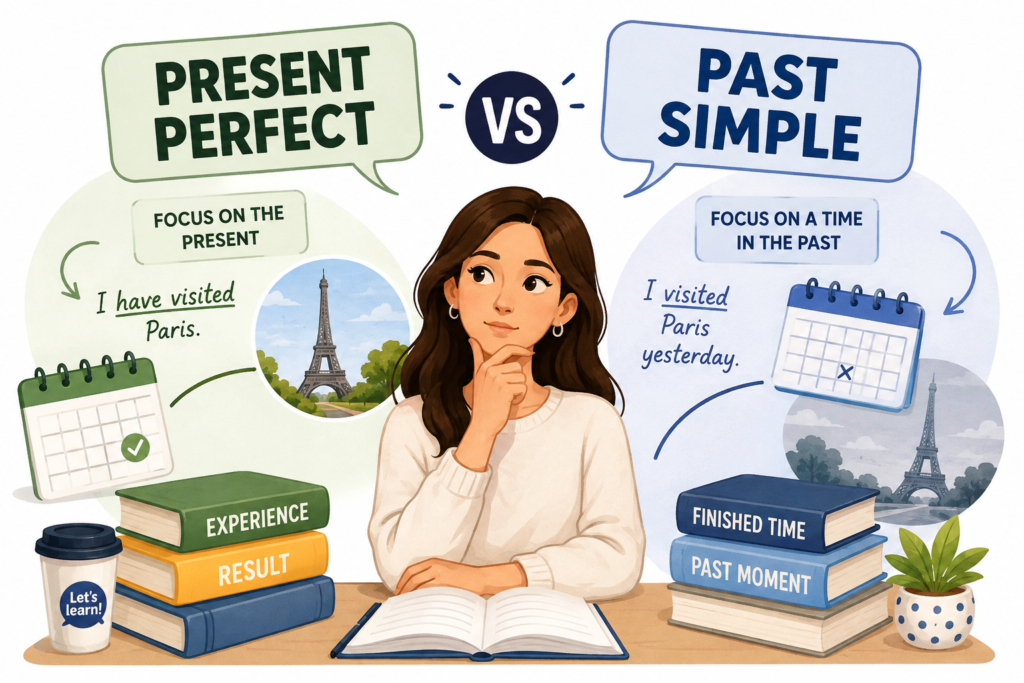
The core difference: unfinished time vs finished time
Past Simple describes a completed action at a specific point in the past that’s disconnected from now.
- I visited London in 2019. – a plain fact from the past, full stop.
- She called me at 5 PM. – a specific moment, the action is over.
Present Perfect emphasizes a result or connection to the present moment; the exact time doesn’t matter.
- I have visited London. – the experience itself matters, not when it happened.
- She has called me three times today. – the day isn’t over, so the action still feels relevant.
Quick rule: if you can add “when exactly” (yesterday, in 2020, last week), use Past Simple. If you’re talking about experience, result, or an unfinished period, use Present Perfect. For the official breakdown, check the Cambridge Dictionary grammar guide.
Side-by-side comparison table
| Present Perfect | Past Simple |
| already, just, yet | yesterday, ago |
| since 2020, for 5 years | last week, in 2019 |
| ever, never | when, then |
| so far, recently, lately | at that moment, that day |
| this week/month (unfinished period) | last week/month (finished period) |
Example: She has already finished her report (result matters now) vs She finished her report yesterday (specific past moment).
Tricky cases that confuse even intermediate learners
1. “For” and “since” aren’t exclusive to Present Perfect. They can appear in Past Simple too, if the action is fully over: I lived in Kyiv for 5 years (I don’t live there anymore) vs I have lived in Kyiv for 5 years (I still live there).
2. State verbs. Verbs like know, believe, own, understand don’t take Continuous forms, but often trip learners up in Perfect constructions: I have known her since 2015 – correct, because the state continues.
3. Questions with “Have you ever…?” This is the classic structure for asking about experience: Have you ever been to Japan? – the exact time doesn’t matter, only the fact itself.
4. “This is the first time…” This phrase always triggers Present Perfect: This is the first time I have tried sushi (never a standalone past tense here).
Prefer video lessons? BBC Learning English has free lessons covering exactly this topic.
Common mistakes non-native speakers make
- Confusing “ago” and “since”: I have been here since 3 years ❌ → I have been here for 3 years ✅ (since + point in time, for + duration).
- Using Present Perfect with a specific time: I have seen him yesterday ❌ → I saw him yesterday ✅.
- Dropping the auxiliary verb: I never been to Paris ❌ → I have never been to Paris ✅.
- Direct translation from a native language: many languages don’t distinguish “finished vs unfinished,” so learners default to Past Simple where Present Perfect is needed.
Exercise 1: Fill in the blanks
- She ___ (finish) her homework already.
- We ___ (go) to Rome in 2021.
- I ___ (not see) this movie yet.
- ___ you ever ___ (try) sushi?
- He ___ (live) in Berlin for 3 years now.
Exercise 2: Choose the correct option
- I (saw / have seen) that film three times – it’s my favourite.
- She (lost / has lost) her phone yesterday and still can’t find it.
- We (lived / have lived) in Paris from 2015 to 2018.
- (Did you finish / Have you finished) the report? The deadline is in an hour.
- My grandfather (never traveled / has never traveled) outside his country.
Answers 1: 1. has finished; 2. went; 3. haven’t seen; 4. Have… tried; 5. has lived
Answers 2: 1. have seen; 2. lost; 3. lived; 4. Have you finished; 5. has never traveled
Helpful resources for further practice
Want more interactive quizzes? Perfect English Grammar has a dedicated section on Present Perfect vs Past Simple, and the Grammarly Blog regularly breaks down common mistakes made by both native and non-native speakers.
FAQ
Can I use “yesterday” with Present Perfect? No, “yesterday” always requires Past Simple since it points to a specific completed moment.
What’s the fastest way to remember the difference? Think of Present Perfect as a “bridge” connecting past and present, and Past Simple as a “closed book” from the past.
Can both tenses appear in the same sentence? Yes: I have lost my keys, so I can’t open the door, I looked everywhere yesterday. Perfect shows the current result, Simple shows the specific past action.

