



Most learners meet modal verbs early. “Can I have some water?” and “You should try this” are among the first useful sentences in English. Yet modal verbs remain confusing long after the basics are learned. One word can carry several meanings: “must” can express a rule or a guess, and “could” can refer to the past or make a polite request. Some forms look similar but say very different things, such as “mustn’t” and “don’t have to.”
This guide explains how English modal verbs work and when to use each one. It shows how to choose between similar forms, and it ends with exercises and an answer key so you can check your understanding. It also links to other lessons on the school blog, such as our guide to English tenses, because modals often work together with tense forms.
Table of Contents
- What Are English Modal Verbs?
- The basic structure
- How modal verbs differ from ordinary verbs
- The Main English Modal Verbs
- English Modal Verbs Comparison Table
- Modal Verbs for Ability, Permission, Possibility, Obligation and Advice
- Common Mistakes with English Modal Verbs
- How to Choose the Right Modal Verb
- Modal Verbs in Everyday English
- Practice: English Modal Verbs Exercises
- Answer Key
- Quick Summary
- FAQ
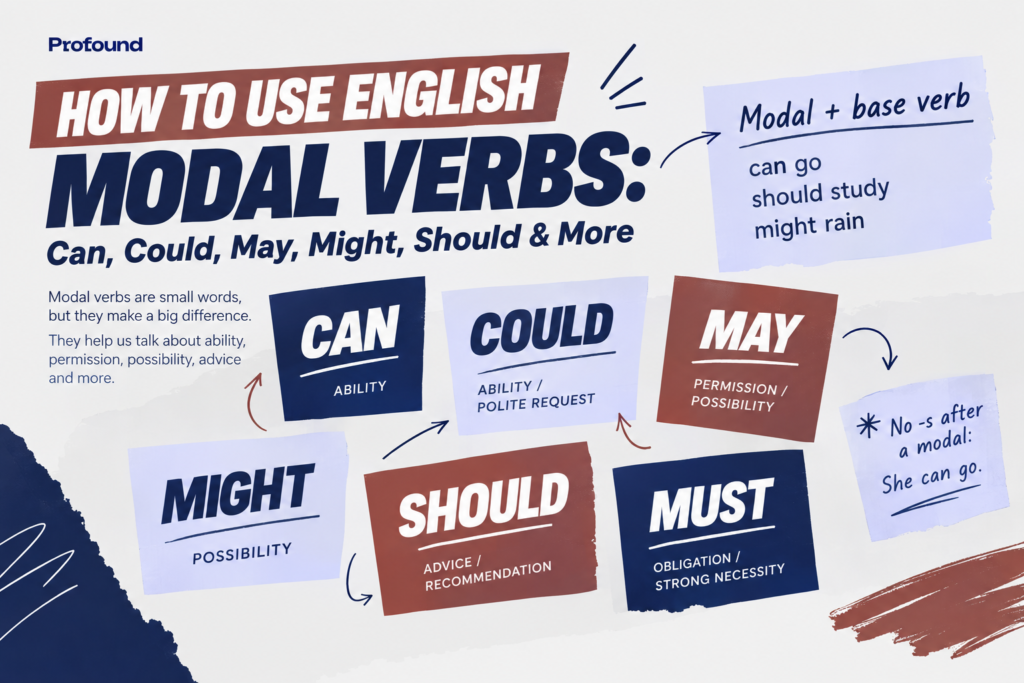
What Are English Modal Verbs?
Modal verbs are helping verbs that add meaning to another verb. They show the speaker’s attitude to an action or situation: whether it is possible, allowed, necessary, advisable, likely, or polite to ask about.
Compare these two sentences:
- She studies.
- She should study.
The first is a simple fact. The second is advice. The modal verb “should” changed the meaning without adding any new action.
Here are more examples:
- I can swim. (ability)
- You may leave early today. (permission)
- They might come later. (possibility)
- We must hurry. (necessity)
Modal verbs in English are a small group, but they are used constantly in speech and writing. Linguists describe the whole system in detail in an authoritative grammar source, but for everyday use you only need to learn the forms and their main meanings.
The basic structure
The pattern is simple:
Subject + modal verb + base form of the main verb
- I can swim.
- She should study.
- They might come later.
The base form is the verb without “to” and without any ending: swim, study, come. This is the most important rule, and it explains the most common errors:
Incorrect: She can sings.
Correct: She can sing.
Incorrect: He should to go.
Correct: He should go.
How modal verbs differ from ordinary verbs
Modal verbs follow their own grammar rules:
- No -s in the third person. With ordinary verbs, we add -s in the Present Simple (she works). Modal verbs never change: she can work, he must go.
- No “do/does/did” in questions or negatives. We invert the subject and the modal: Can you help? We add “not” directly: You should not worry.
- No “to” before the main verb. (The exception is the semi-modal “ought to,” explained later.)
- No infinitive or -ing forms. There is no “to can” or “musting.” When you need such a form, you use a replacement such as “be able to” or “have to.”
- Two modals cannot normally stand together. We do not say “I will can go.” We say “I will be able to go.”
The Main English Modal Verbs
The core modal verbs you need to know are:
- can
- could
- may
- might
- must
- should
- shall
- will
- would
Alongside them, English uses several expressions that do a similar job but do not follow all the modal rules:
- have to (obligation): it changes like a normal verb (she has to, he had to, do you have to?)
- need to (necessity): also behaves like a normal verb
- ought to (advice): close to “should,” but it keeps “to”
- be able to (ability): a flexible replacement for “can” in tenses where “can” does not exist
These are called semi-modals or modal-like expressions. They are covered in their own section below, because learners often mix them up with the core modal verbs.
Can
“Can” is the most common modal verb. It has several uses.
Ability
- I can swim.
- She can speak three languages.
- Can you drive?
General possibility
- It can be difficult to find parking here.
- Prices can change quickly.
Permission (informal)
- Can I use your phone?
- You can park here after six.
Requests
- Can you help me with this bag?
- Can you send me the address?
Offers
- Can I carry that for you?
- I can pick you up from the station.
Notice how different these three sentences are:
- “I can swim.” The subject has an ability.
- “Can I open the window?” The speaker asks for permission.
- “It can be difficult.” This describes something that sometimes happens. It is a general statement, not a single event.
Negative form. The negative is “cannot,” written as one word, or the contraction “can’t.” Avoid writing “can not” as two words unless you want extra emphasis. In speech, “can’t” is standard.
- I can’t hear you.
- You cannot enter without a ticket.
Could
“Could” is often taught as “the past of can,” but that is only part of the story. It has four main uses.
Past ability
- I could swim when I was five.
- She could read before she started school.
Polite requests
- Could you help me, please?
- Could I borrow your notes?
Possibility (present or future)
- It could rain later.
- He could be in a meeting.
Suggestions
- We could have dinner at that new place.
- You could try restarting the computer.
Compare “can” and “could” in requests. “Can you help me?” is friendly and natural. “Could you help me?” sounds a little more polite and careful. Both are fine in everyday conversation, but “could” is safer with a stranger, a teacher, or a client.
An important limit: “could” for past ability describes a general skill or possibility over time. For one specific achievement in the past, we usually use “was able to”:
- When I was young, I could run for hours. (general ability)
- Yesterday I was able to finish the report before lunch. (one specific success)
In negative sentences, “couldn’t” works for both: “I couldn’t finish the report yesterday.”
May
“May” has two main uses.
Formal permission
- May I come in?
- Visitors may use the library until 8 p.m.
Possibility
- It may rain later.
- She may already know the answer.
For permission, “may” and “can” are both correct. “May” sounds more formal and polite, so it fits a formal email, an official rule, or a conversation with someone you do not know well. Among friends, “Can I sit here?” is completely natural. “May I sit here?” sounds more careful.
In the negative, “may not” can mean either “it is not permitted” (You may not use your phone during the exam) or “it is possible that it is not true” (She may not be at home). Context makes the meaning clear.
Might
“Might” mainly expresses possibility.
- They might come later.
- I might go to the gym after work.
- He might not know about the change.
Compare:
- It may rain.
- It might rain.
In most everyday situations, both are acceptable, and many speakers use them almost interchangeably. Some speakers feel that “might” suggests a little more doubt, but this depends on the speaker and the context. Do not try to attach a precise probability to either one. The real difference is often just tone and personal habit.
“Might” is also commonly used when the situation is imagined or less likely. It is a useful form when you want to sound tentative: “I might be wrong, but I think the meeting is at three.”
Must
“Must” has three main functions.
Strong obligation or necessity
- You must wear a seat belt.
- Employees must sign in at reception.
- I must call my mother tonight.
Logical deduction (a confident guess based on evidence)
- She must be tired. She has been working since six.
- You must be very proud of your son.
Strong advice or recommendation
- You must try this cake. It’s amazing.
Compare:
- “You must wear a seat belt.” This is obligation.
- “She must be tired.” This is deduction.
The negative of “must” needs careful attention because it does not work the same way for both meanings.
Mustn’t means prohibition. It is not allowed.
- You mustn’t smoke here. (Smoking is forbidden.)
- Students mustn’t use phones during the test.
Don’t have to means no necessity. You can do it if you like, but it is not required.
- You don’t have to come to the meeting. (It’s optional.)
- We don’t have to leave yet.
These are completely different:
- “You mustn’t do it” means you are not allowed to do it.
- “You don’t have to do it” means it is not necessary.
Confusing them can cause real misunderstanding. “You mustn’t tell her” and “You don’t have to tell her” give opposite instructions.
For the negative of deduction, we do not use “mustn’t.” We use “can’t”:
- He can’t be at work. It’s Sunday.
For past obligation, “must” has no past form, so we use “had to”: “I had to leave early yesterday.”
Should
“Should” is the standard modal verb for advice.
Advice and recommendations
- You should get some rest.
- You should study before the exam.
- We should book tickets soon.
Expectation (something is likely or normal)
- The train should arrive soon.
- The package should be here by Friday.
Mild obligation
- Drivers should keep a safe distance.
Negative. “Shouldn’t” gives negative advice or expresses something that is not expected.
- You shouldn’t stay up so late.
- That shouldn’t take long.
“Should” is softer than “must.” “You should see a doctor” is advice. “You must see a doctor” sounds urgent and strong. You can also use “should have” with a past participle to talk about past regrets or missed advice (“I should have called you”), but that is a topic for a separate lesson.
Shall
“Shall” is much less common in everyday modern English, especially in American English. You will still meet it in several situations.
Offers and suggestions in questions with I/we
- Shall I open the window?
- Shall we start?
- What shall we do tonight?
This use is still fairly natural in British English. In American English, people more often say “Should I open the window?” or “Do you want me to open the window?” or “Let’s start.”
Formal or legal language
- The tenant shall pay rent on the first day of each month.
In contracts and official rules, “shall” expresses an obligation.
Future with I/we
- I shall be there by noon.
This use sounds formal or old-fashioned today, and most speakers say “I will” or “I’ll” instead.
The practical advice for learners: recognize “shall” when you see it, use “Shall I…?” and “Shall we…?” comfortably if you like, and use “will” for ordinary future statements.
Will
“Will” has several important uses.
Future statements
- It will be sunny tomorrow.
- The meeting will start at ten.
Decisions made at the moment of speaking
- “There’s no milk.” “I’ll get some.”
- I’ll take the blue one.
Promises
- I will call you tonight.
- I won’t tell anyone.
Willingness or refusal
- I’ll help you with the move.
- The car won’t start. (It refuses to.)
Predictions
- I think she will pass the exam.
Negative. “Will not” is contracted to “won’t.”
To choose between “will” and “going to” for future plans, see our lesson on Future Simple vs Going to. As a simple starting point, “will” often expresses a decision made now or a prediction, while “going to” often expresses a plan already made.
Would
“Would” appears in several very common patterns.
Polite requests
- Would you help me, please?
- Would you mind closing the door?
Preferences and offers
- I would like some tea. (usually shortened to “I’d like”)
- Would you like some coffee?
- I would rather stay home tonight.
Hypothetical situations
- I would travel more if I had more time.
- What would you do in my place?
Repeated past actions
- When I was a child, we would visit my grandparents every summer.
This use of “would” describes habits in the past. It works with actions, not with states: we can say “we would visit,” but not “I would have a bicycle” to mean “I had a bicycle.” For states, use the simple past or “used to.”
Would and will. “Would” often works as the more distant, more polite, or more imaginary version of “will.” It is also used as the past form of “will” in reported speech:
- “I will call you.” became He said he would call me.
Hypothetical sentences with “would” are closely connected to if-clauses. Our guide to conditionals in English explains this pattern in full.
Have To, Need To, Ought To and Be Able To
These expressions are not core modal verbs, but they are used in place of modals or alongside them. They are important because learners often assume they behave the same way as “must” or “can.” They do not.
Key grammar difference: “have to,” “need to,” and “be able to” change like ordinary verbs (he has to, do you need to, she was able to). “Ought to” is closer to a modal verb but keeps “to.”
Must vs have to
Both express obligation, and in many sentences either is possible. The difference is in the source of the obligation.
- “Must” often shows that the speaker feels or decides the obligation: I must call my mother tonight.
- “Have to” often describes an external rule or circumstance: I have to wear a uniform at work.
In British English this distinction is often clearer. In American English, “have to” is used far more often in everyday speech, and “must” can sound formal or strong.
“Must” has no past or future form of its own, so use “have to” for those:
- I had to leave early yesterday.
- You will have to show your passport.
The negatives are very different: “mustn’t” is prohibition, while “don’t have to” means something is not required.
Should vs ought to
The meaning is almost the same. Both give advice:
- You should call her.
- You ought to call her.
“Ought to” sounds slightly more formal or moral, and it is less common, especially in questions and negatives. In everyday English, “should” is the safer and more natural choice.
Can vs be able to
In the present, “can” and “am able to” are often close in meaning, but “can” is more natural and shorter. “Be able to” is needed when “can” has no form:
- I have been able to swim since I was four. (see Present Perfect)
- You will be able to see the results tomorrow.
- I’d love to be able to travel more.
“Be able to” is also used for a single successful achievement in the past: “I was able to fix the printer.” Compare this with “I could fix printers when I worked there,” which describes a general ability.
Need to vs must
Both express necessity, but “need to” is more neutral and practical:
- I need to buy a new laptop.
- I must buy a new laptop.
The second sentence sounds more urgent or personal. In the negative, “don’t need to” and “needn’t” (mostly British) mean the same as “don’t have to”:
- You don’t need to bring anything.
English Modal Verbs Comparison Table
| Modal verb | Main meaning or use | Example |
| can | ability, general possibility, informal permission, requests, offers | She can play the piano. |
| could | past ability, polite requests, possibility, suggestions | Could you open the door? |
| may | formal permission, possibility | May I ask a question? |
| might | possibility, often with more doubt | It might snow tonight. |
| must | strong obligation, logical deduction | You must be hungry. |
| should | advice, expectation, mild obligation | You should sleep more. |
| shall | offers and suggestions (I/we), formal rules | Shall we go? |
| will | future, decisions, promises, predictions | I will call you later. |
| would | polite requests, preferences, hypothetical situations, past habits | I would like some water. |
Now the pairs that learners confuse most often:
| Pair | Difference | Example |
| must vs have to | “Must” often expresses the speaker’s own feeling of obligation; “have to” often expresses an external rule. | I must study tonight. / I have to wear a helmet. |
| mustn’t vs don’t have to | “Mustn’t” means forbidden; “don’t have to” means not necessary. | You mustn’t park here. / You don’t have to park here. |
| can vs could | “Can” is direct and used for present ability; “could” is more polite in requests and used for past ability and less certain possibility. | Can you help? / Could you help? |
| may vs might | Both express possibility; “may” also expresses formal permission; “might” often sounds more tentative. | She may join us. / She might join us. |
| should vs must | “Should” is advice; “must” is strong obligation or a confident conclusion. | You should rest. / You must rest. |
| can vs be able to | “Can” is used in the present; “be able to” fills gaps in other tenses and for one-time success. | I can drive. / I will be able to drive soon. |
Modal Verbs for Ability, Permission, Possibility, Obligation and Advice
Sometimes it helps to think in terms of function: what do you want to say? The list below shows which modal verbs fit each purpose.
Ability: can, could, be able to
- I can cook pasta.
- She could run fast when she was young.
- He wasn’t able to attend the meeting.
Permission: can, could, may
- Can I sit here?
- Could I leave early today?
- May I use the restroom?
Possibility: can, could, may, might
- Winters can be very cold here.
- It could be a mistake.
- She may be late.
- They might not come.
Obligation: must, have to, should
- You must show your ID.
- I have to work on Saturday.
- Drivers should stop at a red light.
Advice: should, ought to
- You should see a dentist.
- You ought to apologize.
Requests: can, could, would, may
- Can you wait a moment?
- Could you send me the file?
- Would you help me with this?
- May I have your name?
Offers: can, shall, will
- I can help you with that.
- Shall I call a taxi?
- I’ll carry your bag.
Common Mistakes with English Modal Verbs
1. Using “to” after a modal
Incorrect: You must to finish this today.
Correct: You must finish this today.
Why: After a core modal verb we use the base form without “to.”
2. Adding -s to the main verb
Incorrect: He can plays the guitar.
Correct: He can play the guitar.
Why: The modal already carries the meaning. Neither the modal nor the main verb takes -s.
3. Using two modal verbs together
Incorrect: You will must show your passport.
Correct: You will have to show your passport.
Why: “Must” has no future form. Use “have to” instead.
4. Confusing mustn’t and don’t have to
Incorrect: You mustn’t come if you don’t want to. (meaning: it is not required)
Correct: You don’t have to come if you don’t want to.
Why: “Mustn’t” means forbidden. “Don’t have to” means not necessary.
5. Confusing can and may in formal situations
Incorrect: Can I address the committee, sir? (in a very formal setting)
Correct: May I address the committee, sir?
Why: “Can” is not wrong in general, but “may” is the more appropriate choice in formal situations.
6. Using “could” for a single past success
Incorrect: I could pass the driving test yesterday.
Correct: I was able to pass the driving test yesterday.
Why: For one specific achievement, use “was able to” (or “managed to”). “Could” describes general ability in the past.
7. Making incorrect questions
Incorrect: Do you can help me?
Correct: Can you help me?
Why: Modal verbs make questions by moving in front of the subject. We do not use “do/does.”
8. Making incorrect negatives
Incorrect: She doesn’t should go.
Correct: She shouldn’t go.
Why: We add “not” directly to the modal. We do not use “do/does/did.”
9. Using “would” for a past state
Incorrect: When I was a child, I would have a red bicycle.
Correct: When I was a child, I had a red bicycle.
Why: “Would” describes repeated actions in the past, not states like “have,” “be,” or “know.”
10. Confusing should and must
Incorrect: You must visit the museum, but it’s completely up to you.
Correct: You should visit the museum. (or: You must visit the museum. It’s fantastic.)
Why: “Should” gives ordinary advice, while “must” sounds strong. In casual recommendations “must” can be used enthusiastically, but not when you mean the choice is optional.
11. Using “mustn’t” for a negative guess
Incorrect: He mustn’t be at home. The lights are off.
Correct: He can’t be at home. The lights are off.
Why: For negative deduction we use “can’t,” not “mustn’t.”
How to Choose the Right Modal Verb
Ask yourself what you want to express, then use the matching group.
Are you talking about ability?
Use: can (present), could (past general ability), be able to (other tenses, one-time success).
Are you asking for permission?
Use: can (informal), could (more polite), may (formal).
Are you giving advice?
Use: should (normal choice), ought to (a little more formal).
Are you expressing strong obligation?
Use: must (speaker’s feeling), have to (external rule or circumstance).
Is something forbidden?
Use: mustn’t, can’t, or “not allowed to.”
Is something unnecessary?
Use: don’t have to, don’t need to.
Are you expressing possibility?
Use: may, might, could.
Are you drawing a logical conclusion?
Use: must (positive), can’t (negative).
Are you making a polite request?
Use: could, would, may. “Can” is also fine in relaxed situations.
Are you making an offer or a suggestion?
Use: can, shall (I/we), could.
Are you making a decision right now or a promise?
Use: will.
Are you talking about an imaginary situation?
Use: would.
Modal Verbs in Everyday English
Real conversations use modal verbs all the time. Here are some realistic situations.
At work
- “Could you send me the report by Friday?”
- “Sure. I should be able to finish it tomorrow.”
- “You don’t have to rush. Monday is also fine.”
Studying
- “Should I revise all the units for the test?”
- “You should focus on units four to six. The teacher might ask about the vocabulary from unit two, too.”
Travelling
- “Excuse me, can I take my laptop in my hand luggage?”
- “Yes, but you must take it out at security.”
- “May I see your boarding pass, please?”
Everyday plans
- “What shall we do on Saturday?”
- “We could go hiking if the weather is good.”
- “It might rain, though. We’d better check the forecast.”
Asking for help
- “Would you mind giving me a hand with this box?”
- “Of course. Can you lift your end a little higher?”
Making recommendations
- “You should try the soup here. It’s excellent.”
- “You must be joking. I hate soup!”
Talking about possibilities
- “Where is Anna?”
- “She might be in the library. Or she could be at lunch.”
- “She can’t be at lunch. It’s only ten o’clock.”
Practice: English Modal Verbs Exercises
Regular short practice works well for modal verbs. If you like learning in small pieces, our article on microlearning explains how to fit exercises like these into a busy day.
Part A: Choose the correct option
- You look exhausted. You (must / should / may) be working too hard.
- Visitors (mustn’t / don’t have to) take photos inside the museum. There are signs everywhere.
- You (mustn’t / don’t have to) book a table. The restaurant is almost always empty on weekdays.
- “I’m freezing.” “I (will / would) close the window.”
- If I had a bigger apartment, I (will / would) invite everyone for dinner.
- (Could / Should) you tell me where the station is, please?
Part B: Fill in the blank
Use one modal verb or a modal expression. Use the words in brackets where given.
- My doctor says I ______ drink more water. (advice)
- I ______ work late last night, so I missed the film. (obligation, past)
- “Where is Tom?” “I’m not sure. He ______ be in the garden.” (possibility, not certain)
- It’s a beautiful day. ______ we have lunch outside? (suggestion)
- I was tired, but I ______ finish the report last night. (be able to, one success)
Part C: Correct the mistake
- She can to speak three languages.
- Does he can drive?
- He must goes now.
- I will can help you tomorrow.
Part D: Rewrite the sentence
- Rewrite with a modal verb: “Is it all right if I sit here?” (formal)
- Rewrite with “have to”: “It’s not necessary for you to bring anything.”
- Rewrite with “must”: “I’m sure he is at home. His car is outside.”
Answer Key
- must. This is a logical conclusion from what you see. “Should” would give advice, and “may” would only suggest a possibility.
- mustn’t. The signs tell us it is forbidden.
- don’t have to. Booking is not necessary.
- will. This is a decision made at the moment of speaking.
- would. This is an imaginary situation with “if.”
- Could. It is a polite request. “Should you tell me” would change it into advice and is not natural here.
- should (or “ought to”). The doctor gives advice.
- had to. “Must” has no past form.
- might (or “may” or “could”). All three express uncertain possibility.
- Shall. It is a suggestion with “we.” “Shall” is natural in British English. American speakers might say “Should we” or “Let’s.”
- was able to. It is one specific success in the past. “Could” is not used for this.
- She can speak three languages. (no “to”)
- Can he drive? (no “do/does” with modals)
- He must go now. (base form, no -s)
- I will be able to help you tomorrow. (two modals cannot go together)
- May I sit here?
- You don’t have to bring anything.
- He must be at home. His car is outside.
Quick Summary
| Modal | Main uses | Example |
| can | ability, permission, requests, offers | Can you swim? |
| could | past ability, polite requests, suggestions, possibility | Could you help me? |
| may | formal permission, possibility | May I come in? |
| might | possibility | It might rain. |
| must | strong obligation, deduction | You must be tired. |
| should | advice, expectation | You should rest. |
| shall | offers and suggestions, formal rules | Shall I help? |
| will | future, decisions, promises | I will call you. |
| would | polite requests, preferences, hypothetical situations | I would like tea. |
The core idea is simple. Modal verbs do not describe an action themselves. They describe your attitude to the action: can it happen, may it happen, must it happen, should it happen. Learn the pattern (subject + modal + base verb), learn the main meanings, and pay special attention to the small differences between similar forms.
FAQ
What are modal verbs in English?
Modal verbs are helping verbs such as can, could, may, might, must, should, shall, will, and would. They add meaning to a main verb, for example ability, possibility, permission, obligation, or advice.
What are the most common English modal verbs?
The most common ones are can, could, will, would, should, and must. May and might are also frequent, especially for possibility, while shall is less common in everyday American English.
What is the difference between can and could?
“Can” is used for present ability, informal permission, and direct requests. “Could” is used for past general ability, more polite requests, suggestions, and less certain possibility. “Could” is not always the past of “can.”
What is the difference between may and might?
Both express possibility, and in many sentences they are interchangeable. “May” can also express formal permission, which “might” normally does not. “Might” often sounds slightly more tentative.
What is the difference between must and have to?
Both express obligation. “Must” often shows the speaker’s own sense of necessity, while “have to” often describes a rule or external situation. “Have to” is also used in the past and future, where “must” has no form.
What is the difference between mustn’t and don’t have to?
“Mustn’t” means something is forbidden. “Don’t have to” means something is not necessary. “You mustn’t go” means “Do not go.” “You don’t have to go” means “You can go, but you are free not to.”
Can modal verbs be used with “to”?
Core modal verbs (can, could, may, might, must, should, will, would) are followed by the base form without “to.” The exception is “ought to,” which keeps “to.” Expressions such as “have to,” “need to,” and “be able to” also include “to,” but they are not core modals.
Can you use two modal verbs together?
In standard English, you generally cannot combine two core modals, for example “will can” or “must should.” Use a substitute instead: “will be able to,” “will have to,” or “might have to.”
Which modal verb is used for advice?
“Should” is the most common modal verb for advice. “Ought to” is similar but less common in everyday speech.
Which modal verb is used for possibility?
May, might, and could are used for possibility. “Can” is used for general possibility, such as “Winters can be very cold here.”

